

You just got help from two people at once, maybe coworkers, friends, or family, and now you’re stuck typing the same message over and over, deleting it, and starting again.
Should you write “thank you both” or “thanks to both of you”? Picking the wrong one won’t ruin your day, but it can make a message feel stiff or slightly off.
The good news is that thank you both vs thanks to both of you comes down to one simple grammar difference, and once you see it, you’ll never second guess it again.
Quick Answer
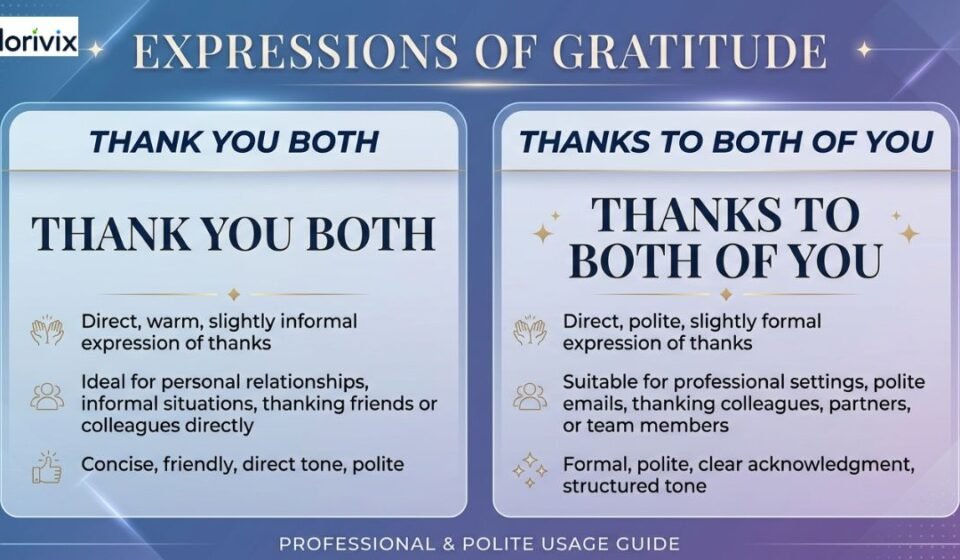
“Thank you both” is a direct, spoken thank you aimed at two people, similar to saying “thank you” to each of them at once.
“Thanks to both of you” shifts the focus to the reason for your gratitude, often explaining what the two people did or contributed. Both are correct English. The choice depends on whether you’re simply thanking someone or explaining why.
What Does “Thank You Both” Mean?
“Thank you both” is a short, friendly way of thanking two people directly. The word “both” works here as a pronoun that stands in for “the two of you.” It’s the same structure as saying “thank you all” to a group, just scaled down to two people.
This phrase feels personal and immediate. It’s the kind of thing you’d say out loud after someone hands you a gift, finishes a favor, or helps you finish a task.
Example: “Thank you both for coming to my birthday dinner last night.”
What Does “Thanks to Both of You” Mean?

“Thanks to both of you” leans on a different grammar pattern. Here, “thanks to” acts almost like a cause-and-effect phrase, similar to saying “because of you.” It usually appears when you’re explaining a result, not just offering a simple thank you.
This phrasing often shows up when something good happened because two people worked together or helped in some way.
Example: “Thanks to both of you, the project got finished a full week early.”
Notice how this sentence explains an outcome. That’s the biggest clue separating it from “thank you both.”
Key Differences at a Glance
| Feature | Thank You Both | Thanks to Both of You |
| Function | Direct thank you | Explains a cause or result |
| Grammar role | “Both” replaces “you two” | “Thanks to” means “because of” |
| Typical use | Casual thank you, no explanation needed | Thank you with a reason attached |
| Sentence position | Usually starts a sentence | Can start or interrupt a sentence |
| Formality | Neutral to casual | Neutral to slightly more formal |
When to Use Each Phrase
Use “thank you both” when you’re simply expressing gratitude and don’t need to explain why. It works well in texts, emails, cards, speeches, and everyday conversation.
- “Thank you both for your patience.”
- “Thank you both for the lovely gift.”
Use “thanks to both of you” when you want to highlight what the two people did or the outcome their help created. It naturally pairs with a result, a change, or an accomplishment.
- “Thanks to both of you, I passed my exam.”
- “The event ran smoothly, thanks to both of you.”
If you’re not explaining a specific result, “thank you both” is usually the simpler, more natural choice.
Formal or Casual: Which Tone Fits Best?
Neither phrase is formal or informal by nature. Both fit comfortably in everyday speech, workplace emails, and personal messages.
That said, “thanks to both of you” can feel slightly more polished because it often appears in structured sentences that explain a result. “Thank you both” feels more conversational since it mirrors how people naturally speak.
For a wedding speech, thank-you card, or work email, both phrases work fine. Choose based on whether you need to explain a reason, not based on formality alone.
American English vs British English Usage
Both phrases are used in American and British English without any major difference in meaning. American English tends to favor the shorter, more direct “thank you both,” especially in spoken conversation and casual writing.
British English speakers use both phrases as well, though “thanks to both of you” appears slightly more often in written contexts, such as emails or notes, where explaining a cause feels natural. Neither version is considered more correct in one dialect than the other. The difference is more about style preference than grammar rules.
Common Mistakes to Avoid
A few small errors show up often with these phrases:
- Mixing the structures: Avoid saying “thanks both to you,” which breaks the natural word order.
- Dropping “of”: “Thanks to both you” sounds incomplete. The correct form is “thanks to both of you.”
- Using “thanks to” without a reason: If there’s no cause or result being explained, “thank you both” usually fits better.
- Overusing commas: “Thanks to both of you, for your help” adds an unnecessary comma. Write it as “Thanks to both of you for your help.”
Small fixes like these make your writing sound more natural and confident.
A Simple Trick to Remember the Difference
Here’s an easy way to keep both phrases straight:
If you can finish the sentence with a reason, use “thanks to both of you.” If you’re just saying thank you with nothing else attached, use “thank you both.”
Think of “thanks to” as a bridge connecting a cause to a result. “Thank you both” doesn’t need that bridge. It stands on its own.
Other Natural Ways to Thank Two People
If you want variety beyond these two phrases, a few alternatives work well depending on tone:
- “I appreciate you both.”
- “Thank you two so much.”
- “I’m grateful to both of you.”
- “You two made this possible.”
These options are useful when writing multiple thank-you messages and want to avoid repeating the same phrase.
Real Example Sentences You Can Use
Casual conversation: “Thank you both for helping me move this weekend.”
Workplace email: “Thanks to both of you, the client presentation went smoothly.”
Thank-you card: “Thank you both for such a thoughtful gift.”
Team update: “Thanks to both of you, we hit our deadline early.”
Text message: “Thank you both, you really saved me today.”
These examples show how each phrase fits naturally depending on whether you’re stating a simple thank you or pointing to a specific outcome.
Frequently Asked Questions
Is “thank you both” grammatically correct?
Yes. “Both” functions as a pronoun referring to two people, making “thank you both” a complete and correct sentence.
Is “thanks to both of you” the same as “because of both of you”?
They’re very close in meaning. “Thanks to” often works as a softer, more polite way of saying “because of.”
Can I use “thanks to both of you” without explaining a reason?
You can, but it sounds more natural when paired with a result or explanation. Without that context, “thank you both” is usually the better fit.
Which phrase is more common in everyday speech?
“Thank you both” is more common in spoken English because it’s shorter and doesn’t require extra context.
Can these phrases be used in professional emails?
Yes. Both work well in professional settings. Choose “thank you both” for a quick thank you and “thanks to both of you” when explaining what the two people helped accomplish.
Final Thoughts
Both phrases are correct, useful, and easy to use once you understand the small difference behind them. “Thank you both” works as a simple, direct thank you.
“Thanks to both of you” adds a reason or result to your gratitude. Pay attention to whether you’re explaining an outcome, and the right phrase will come naturally every time.