

You typed “convertor” into an email, then paused. Something felt off. Was it wrong? Would your boss notice? Would a client judge you for it?Here’s the short answer before we go anywhere else: converter is the standard spelling.
Convertor shows up here and there, but it’s not the version you should be leaning on for everyday writing, business emails, or website content.Now let’s unpack why, because the “why” is actually more interesting than you’d think.
Convertor or Converter: Quick Answer
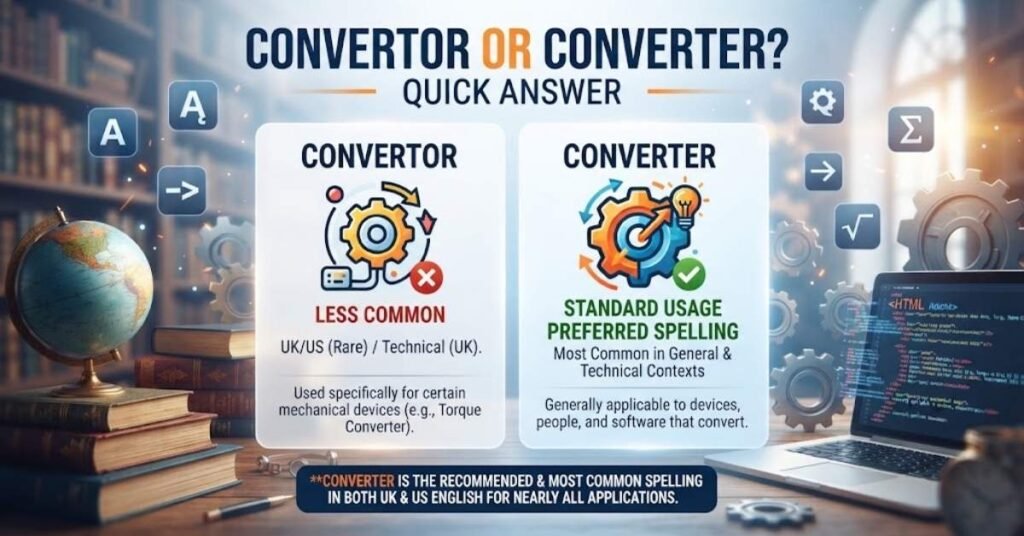
If you only remember one thing from this whole article, remember this: converter wins. It’s the accepted, dictionary backed, widely used spelling across American English, British English, and pretty much every English speaking region on the planet.
Convertor isn’t a made up word, but it’s rare. You’ll spot it occasionally in older technical manuals or niche engineering documents, and that’s about it. For anything you’re writing today, whether it’s a product description, a blog post, or a quick text to a coworker, converter is the safe, correct, and professional choice.
Examples:
Here’s how this plays out in real sentences:
- “I need a currency converter for my trip to Japan.”
- “This power converter handles both 110V and 220V.”
- “Download the file converter before you send that document.”
- “Our engineers tested the new voltage converter yesterday.”
Notice something? Every single example uses converter, not convertor. That’s not an accident. That’s just how modern English works.
Simple rule
Here’s a trick that’ll stick with you. When a verb ends in “-vert” (like convert), the person or thing that does the converting usually takes the “-er” ending, not “-or.” Think converter, not convertor, the same way you’d say “reporter” and not “reportor.”
If you’re ever stuck mid sentence wondering which one to type, just default to “-er.” Nine times out of ten, you’ll be right.
The Origin of Converter or Convertor
Words don’t just appear out of nowhere. They evolve, borrow from other languages, and sometimes get stuck in a weird tug of war between spelling traditions. Converter and convertor are a perfect example of that tug of war.
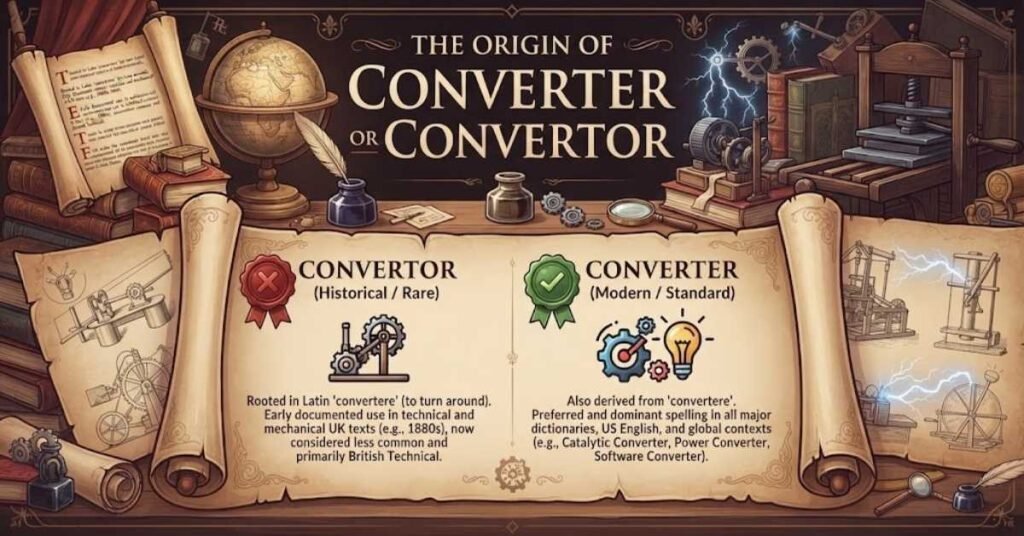
The root word, “convert,” comes from Latin, specifically “convertere,” meaning to turn around or change direction. English absorbed a ton of Latin vocabulary over the centuries, and when it did, it had to decide how to handle word endings for nouns describing “the person or thing that does something.”
Historical background
English generally leans on two suffixes for this job: -er suffix and -or suffix. Words like “teacher,” “writer,” and “converter” use “-er.” Words like “director,” “actor,” and “creator” use “-or.” There’s no single hard rule that decides which suffix a word gets. It mostly comes down to historical usage and how the word settled into common speech over time.
Convertor likely popped up as a variant spelling, possibly influenced by Latin agent nouns that traditionally use “-or.” But it never caught on the way “converter” did. Dictionaries eventually locked in “converter” as the standard spelling, and that’s the version that stuck around in everyday and professional writing.
British English vs American English Spelling
People often assume this spelling difference is a British versus American thing, kind of like “colour” versus “color” or “organise” versus “organize.” Makes sense, right? English has plenty of these regional splits.
But here’s the twist: this isn’t one of them.
Key rule
Both British English and American English agree on this one. Converter is correct in the UK, the US, Canada, Australia, and pretty much every Commonwealth country. There’s no hidden regional rule that makes “convertor” the “British way” or the “technical way.” It’s simply a less common variant that never gained the same traction.
Comparison table
| Spelling | US English | UK English | Commonly Used? |
| Converter | ✔ Correct | ✔ Correct | ✔ Yes |
| Convertor | ✘ Rare | ✘ Rare | ✘ No |
Why “converter” wins
Simple. Modern English favors consistency, and dictionaries across both sides of the Atlantic list converter as the primary, preferred spelling. When style guides, journalists, and educators all point the same direction, that’s usually a sign of where the language has settled.
Which Spelling Should You Use?
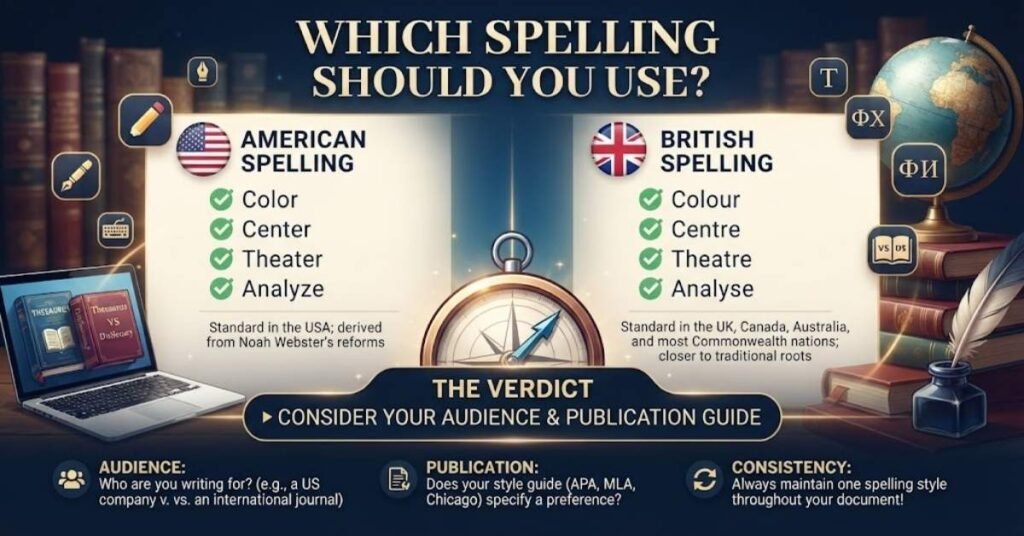
Let’s make this practical. You’re not writing a linguistics thesis, you’re probably writing an email, a product page, or a quick social post. So which one should actually land in your document?
For US audiences
Use converter. Every time. American dictionaries, style guides, and tech companies all use this spelling consistently.
For UK and Commonwealth audiences
Same answer. Use converter. British publications, from newspapers to academic journals, stick with this spelling too.
For global communication
If you’re writing for an international audience, whether it’s a SaaS company’s help docs or a global marketing email, converter is your safest bet. It reads as correct and polished no matter where your reader is sitting.
Quick advice
When in doubt, type “converter.” It won’t confuse anyone, it won’t look outdated, and it matches what reader expectations have been trained on for decades.
🔤 Converter or Convertor: Spelling, Meaning, and Usage Questions
A lot of people search this exact phrase because they’re genuinely unsure, and honestly, that confusion makes sense. English doesn’t hand out a rulebook for every suffix decision it makes.
Here’s the thing though: this isn’t really a “meaning” question. Both spellings, when used, point to the same idea, something or someone that changes one form into another. The confusion is purely about spelling variation, not definition. Once you separate those two things in your head, the whole debate gets a lot less stressful.
Common Mistakes with Convertor or Converter
Even sharp writers slip up here sometimes. Let’s look at where things usually go sideways so you can dodge the same traps.
1. Using “convertor” thinking it is more technical
This one’s common. People assume the “-or” ending sounds fancier or more scientific, kind of like how “director” sounds more official than “directer” (which isn’t even a word, by the way). But that logic doesn’t apply here. Converter is the standard term across technical writing, technical documentation, and technical manuals too.
2. Mixing spellings in one document
Ever proofread something and spot both spellings in the same paragraph? It happens more than you’d guess, especially in longer reports where multiple people edited the file. Pick one spelling, converter, and stick with it from the first page to the last. Consistency matters more than people realize for reader trust.
3. Copying outdated sources
If you’re referencing an old engineering manual or a decades old textbook, you might stumble across “convertor” simply because that’s what was common back then. Copying that spelling into fresh content spreads an outdated habit. Older manuals aren’t your style guide, current dictionaries are.
4. Assuming regional difference
We already busted this myth, but it’s worth repeating because it’s such a persistent one. There’s no British versus American split here. Assuming otherwise just leads to inconsistent writing across your content.
❓ Convertor vs Converter: Common Search Confusions Explained
Search engines see this comparison a lot, and the patterns behind those searches are pretty revealing.
✔ Standard Spelling
Converter is the accepted form, listed as primary in every major English dictionary.
✔ Alternative Form
Convertor exists as a rare form, occasionally spotted in niche technical texts, but it’s not something you should reach for in regular writing.
⚠️ Common Errors from Search Queries
People also mistype variations like “conertor,” “convert-er,” or “convereter.” These are simply incorrect spelling attempts, not alternate forms worth considering.
🧠 Related Word Confusion
Some readers also confuse “converter” with “conversor,” a term that pops up in Spanish or in specific software contexts but isn’t standard English at all.
🌍 Regional Clarification
One more time for the people in the back: no regional split exists here. UK English and US English both back converter fully.
🧠 Easy Memory Trick
Think of “convert” plus “er,” the same pattern as “report” plus “er” equals “reporter.” That mental shortcut will save you every single time you’re unsure.
Convertor or Converter in Everyday Examples
Theory’s great, but seeing this play out across different writing formats makes it click even faster.
Emails
“Hey, can you send over the audio converter link before our call?” Simple, clear, and correct. Emails are casual by nature, but spelling still matters for how polished you come across.
Technology content
Tech writers use this word constantly. “The digital converter supports multiple formats and maintains signal quality across different input sources.” Technology content leans heavily on precise, consistent terminology.
News writing
Journalists covering electronics, energy, or product descriptions for gadgets almost always use “converter.” Editorial style guides at major publications back this up too.
Social media
Even in short, punchy captions, “converter” holds strong. “This little converter app just saved my weekend project” reads naturally and doesn’t trip anyone up.
Formal writing
Academic writing and professional writing both favor “converter” as well. If you’re drafting a formal report or a research paper mentioning conversion tools, stick with the standard spelling to maintain professionalism.
Convertor or Converter: Google Trends & Usage Data
Curious how these two spellings actually stack up in real search behavior? The numbers tell a pretty clear story.
Why users search both forms
People search “convertor” mostly out of genuine uncertainty, not because it’s a legitimate alternative they intend to use. Search intent here usually boils down to one question: “Am I spelling this right?”
Global usage patterns
Across North America, Europe, and Asia, converter dominates search volume and actual usage in published content. Global usage data consistently favors the standard spelling by a wide margin.
Writing advice
If your goal is ranking well and reading professionally, lean into usage frequency data. Writers, editors, and content teams that follow modern standards consistently choose “converter” over its rare counterpart.
Keyword Comparison Table
| Term | Correct? | Common Context |
| Converter | ✔ Yes | Everyday, technical, formal |
| Convertor | ✘ Rare | Old manuals, niche texts |
| Video converter | ✔ Yes | Software, apps |
| Power converter | ✔ Yes | Electronics, engineering |
| Currency converter | ✔ Yes | Finance, travel |
| Conersor | ✘ No | Not standard English |
Conclusion
At the end of the day, this isn’t a complicated grammar rule dressed up to look scary. Converter is your go to spelling, full stop. It works across British English, American English, technical writing, casual emails, and everything in between.
Convertor isn’t a typo exactly, but it’s outdated enough that using it today might make your writing look a little behind the times. So next time your fingers hover over the keyboard, trust the “-er” ending and move on with your day.
FAQs
1. Is “convertor” wrong?
Not technically wrong, but it’s an outdated, rare form that dictionaries list as secondary at best. Stick with “converter” for anything you’re publishing.
2. Why is “converter” more popular?
Because it follows the common English pattern of pairing “-er” with action verbs, and because major dictionaries and style guides adopted it as the preferred form decades ago.
3. Do dictionaries accept both forms?
Some do list “convertor” as a variant, but “converter” is always the primary, recommended choice across Merriam Webster, Oxford, and Cambridge dictionaries.
4. Is there a regional difference?
No. This myth gets repeated a lot, but neither UK English nor US English treats “convertor” as their official regional spelling.
5. Which spelling is better?
Converter, without question. It’s the widely accepted spelling for everyday writing, business content, and technical documentation alike.
6. Can I use “convertor” in technical writing?
You might spot it in older technical references, but current technical documentation overwhelmingly uses “converter.” Best to match modern standards.
7. Is pronunciation different?
Nope, both spellings sound identical when spoken aloud. The difference lives purely in spelling rules, not in how the word is pronounced.