

You just typed a name into an email and froze. Is it Mathew or Matthew? That tiny pause happens to almost everyone, and it’s more common than you’d think. One missing letter can change how a name looks, feels, and even how “official” it seems.Here’s the short version before we go deeper: Matthew is the standard, widely accepted spelling of Matthew, used in official records, religious texts, and everyday writing.
Mathew is a valid but far less common spelling variation, often seen as a personal name choice rather than the traditional form.Now let’s unpack why that’s true, where each version comes from, and how to use both with total confidence.
Mathew or Matthew: Quick Answer
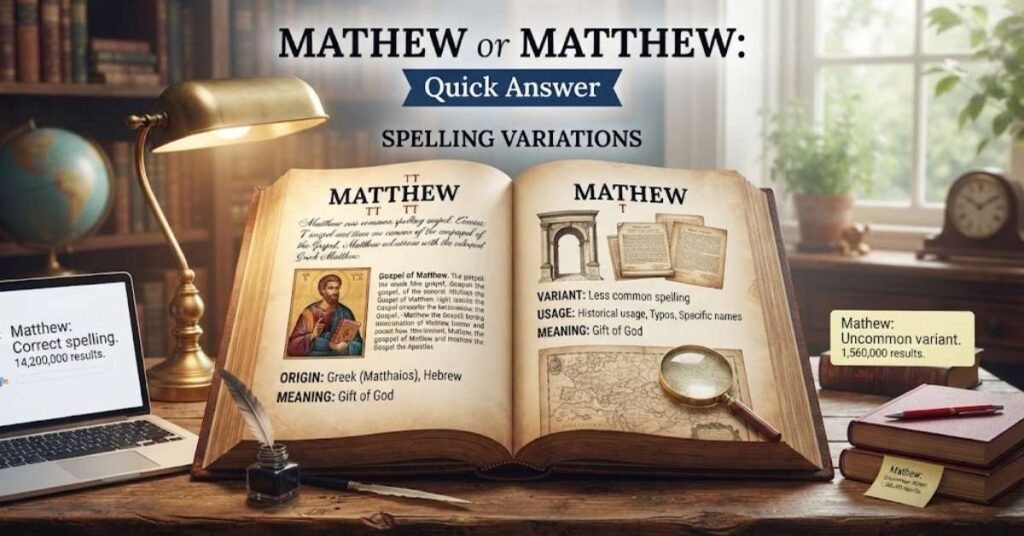
If you only remember one thing from this article, remember this: Matthew with two “t”s is the standard spelling in almost every English-speaking country. It shows up in birth certificates, news writing, and the Bible.
Mathew isn’t wrong. It’s an uncommon spelling that some parents pick for their child’s given name, or that people accidentally use when typing fast. Think of it like Stephen versus Steven. Both exist, but one is far more familiar.
So if you’re writing a name for the first time and you don’t know the person’s preferred spelling, go with Matthew. It’s the safer, more accepted spelling by a wide margin.
The Origin of Mathew or Matthew

Names carry history, and this one has a long journey behind it. The name origin traces back to the Hebrew name Mattityahu, which beautifully means “gift of God.” That’s a lovely thing to know if you’ve ever wondered why this name has stuck around for thousands of years.
From there, the name moved through Greek as Matthaios, then into Latin as Matthaeus. Each language added or dropped a letter here and there, which is honestly how most name history works. Old French turned it into Mathieu, and Spanish gave us Mateo. English eventually settled on Matthew as its standard form.
This kind of language evolution isn’t unusual at all. Names travel across borders, get reshaped by local pronunciation, and slowly form new versions. That’s exactly why we now have both Mathew and Matthew floating around today.
British English vs American English Spelling
Here’s something that surprises a lot of people. Unlike words such as “colour” and “color,” this isn’t really a British English versus American English spelling fight. Both countries treat Matthew as the standard.
UK spelling and US spelling rules agree here, which is rare and honestly kind of refreshing. Whether you’re writing for a British newspaper or an American blog, Matthew is the expected form. Mathew shows up in both regions too, but always as the less common choice.
Comparison Table
| Feature | Matthew | Mathew |
| Spelling type | Standard spelling | Uncommon spelling |
| Usage in official documents | Very common | Rare |
| Region | Global, both UK and US | Occasional in both |
| Religious texts | Always used | Not used |
| Popularity | High | Low |
This table makes it pretty clear. If you’re comparing Matthew vs Mathew for anything formal, the two-“t” version wins almost every time.
Which Spelling Should You Use?
This depends heavily on context, and that’s the honest answer. There isn’t one universal rule that fits every single situation, so let’s break it down by scenario.
For professional writing
In professional writing, stick with Matthew unless you know for certain the person spells their name differently. This applies to formal writing, resumes, business emails, and official documents. Getting someone’s name wrong on a certificate or contract isn’t a small mistake, it can cause real confusion later.
For personal names
When it comes to an actual personal name, respect matters more than convention. If someone was raised spelling their first name as Mathew, that’s their identity, not a typo. Always double check before assuming.
For global audiences
Writing for global audiences? Go with Matthew. It’s recognized everywhere, avoids confusion, and matches what most readers expect to see in news writing or international content.
For branding or usernames
Branding is where things loosen up a bit. Usernames like @MathewTech or @MatthewWrites show how creators sometimes pick Mathew simply because it’s shorter, unique, or available when Matthew isn’t. In this space, username availability often decides the spelling more than tradition does.
🔹 How to Spell Matthew Correctly (Common Questions Answered)
People search this constantly, and honestly, it makes sense. One letter changes the entire look of the word.
Why does Matthew have two “t”s?
Because of its Latin root, Matthaeus. That double “t” carried over through centuries of historical texts and stuck as the accepted English form. It’s not random, it’s inherited.
Are there different spellings of Matthew?
Yes, actually quite a few across languages. You’ve got Mathieu in French, Mateo in Spanish, and Matthaios in Greek. In English specifically, the two real options are Matthew and the spelling variant Mathew.
Common Mistakes with Mathew or Matthew
Small errors happen more often than people realize, especially with names this common. Let’s go through the ones that trip people up again and again.
1. Dropping one “t” by accident
This is the most frequent spelling mistake. Someone types fast, autocorrect doesn’t catch it, and suddenly Matthew becomes Mathew in an important email.
2. Assuming both are equally common
They’re not. Treating Mathew and Matthew as a fifty-fifty split leads to unnecessary confusion in writing, especially in academic writing or research papers.
3. Changing someone’s name automatically
If a colleague named Mathew Johnson signs his emails that way, don’t “correct” it to Matthew. That’s disrespectful, not helpful. Respect personal spelling always.
4. Using different spellings in one document
Spelling consistency matters. If you write Matthew in paragraph one and Mathew in paragraph three, it looks careless, and readers will notice.
5. Relying only on pronunciation
Both names sound identical when spoken aloud. This is exactly why pronunciation differences don’t help you figure out spelling. You genuinely need to see or ask for the written version.
Mathew or Matthew in Everyday Examples
Seeing these names used in real situations makes the difference far easier to remember than any rule ever could.
Emails
“Matthew joined the meeting ten minutes late but caught up quickly.” Notice how naturally that reads. In email signatures, the double “t” spelling is almost always what you’ll find.
News writing
Journalism leans heavily on Matthew as the default. Reporters covering public figures rarely encounter the shorter spelling unless it’s the subject’s actual name.
Social media
Social media profiles are where things get playful. You’ll spot handles and bios using Mathew purely for style, standing out, or because the standard version was already taken.
Formal documents
Legal documents, certificates, and school records almost universally use Matthew. This is one area where guessing wrong genuinely creates paperwork headaches.
Mathew or Matthew: Google Trends & Usage Data
Numbers tell a clear story here, and they back up everything we’ve covered so far.
Popularity by country
Across United States names, United Kingdom names, Canada names, and Australia names, Matthew consistently ranks as one of the most popular names for boys. Mathew appears in search trends too, but at a noticeably smaller volume.
Context of usage
Search queries for “is Matthew spelled with two t’s” and “difference between Mathew and Matthew” spike regularly. This tells us people aren’t confused about which is more correct, they just want quick confirmation.
Keyword Variations Comparison
Keyword variations like “how do you spell Matthew” and “how to spell Matthew” dominate online searches, while “Mathew spelling” queries trail behind. This gap in keyword comparison data mirrors real world usage almost perfectly.
🔹 Matthew vs Mathew: Spelling Differences Explained
Let’s simplify this entire topic into one clean, digestible section.
Key Difference:
One letter. That’s genuinely it. Matthew carries a double “t,” while Mathew drops one. Everything else about pronunciation and meaning stays identical.
Which one is more common?
Matthew, without question. It’s the traditional spelling, the modern spelling, and the one you’ll see in nearly every historical source and religious source combined.
Common search variations include:
- how to spell Matthew
- is Mathew correct
- Matthew or Mathew which is correct
- why does Matthew have two t’s
When can you use Mathew?
Use it when it’s someone’s actual chosen name variant, or when you’re deliberately picking a unique spelling for branding purposes. Outside those two cases, Matthew remains your safest bet.
Religious and Historical Roots Worth Knowing
Beyond grammar, there’s a deeper layer here connected to faith and history. Saint Matthew was one of the twelve apostles, and his name appears throughout Christian scripture in nearly every major biblical translation. This religious weight is a big reason Matthew became so deeply rooted in Western naming traditions.
Scribes and translators across centuries preserved the double “t” spelling as they copied and translated texts. That consistency across historical records is part of why the spelling never really drifted, unlike many other names that changed shape over time.
Why This Small Spelling Choice Still Matters Today
You might think one letter is trivial, but name accuracy genuinely affects communication clarity. A misspelled name on a resume, invoice, or professional identity document can create real friction, especially in workplaces where document verification and name verification are taken seriously.
There’s also an emotional layer here. A name is tied to identity, and getting it right shows attention and respect. Whether it’s a client, a coworker, or a reader commenting on your blog, spelling their name correctly builds trust faster than almost anything else you can do.
Conclusion
So, Mathew or Matthew? For nearly every situation, Matthew is your answer. It’s the standard English spelling, backed by history, religion, and modern usage data alike. Mathew still holds its place as a legitimate, if uncommon spelling, especially for personal names and creative branding.The real takeaway is simpler than it seems. When in doubt, default to Matthew.
When you know someone’s actual spelling, respect it without question. That’s how you avoid spelling errors, keep your writing consistent, and show genuine care for the names you use.Got a Matthew or Mathew in your life? Drop their spelling in the comments, we’d love to see how common each version really is among our readers.
FAQs
1. Is Mathew incorrect?
No, it’s not incorrect. It’s simply an uncommon variant compared to the far more popular Matthew.
2. Why does Matthew have two “t” letters?
It comes from the Latin Matthaeus, which carried the double “t” that English later kept intact.
3. Are Mathew and Matthew pronounced differently?
Not at all. They sound completely identical when spoken, which is exactly why spelling confusion happens so often.
4. Which spelling appears in religious texts?
Matthew is the version used across biblical translations and all major Christian scripture references to Saint Matthew.
5. Can Mathew be used as a unique spelling?
Yes, plenty of parents and creators choose it intentionally as a personal branding choice or a distinctive name variant.
6. Is one spelling more professional?
Matthew is generally viewed as the more formal, expected spelling in professional documents and business settings.
7. Should I correct someone who writes Mathew?
No, never assume it’s a mistake. Always respect personal spelling, since it may be their actual, intentional given name.