


Ever typed a sentence, stopped, and wondered if the word looked off? You’re not alone. Plenty of writers stare at “resignate” and “resonate” and can’t tell which one is right.Here’s the short answer. Resonate is the correct word. Resignate isn’t standard English, and most people who write it have made a simple spelling mistake.
This guide shows you what each word means, why the mix-up happens, and how to pick the right one every time. A few easy tricks near the end will help you stop making this typing error.
Resignate
Let’s start with the troublemaker. The major dictionaries list resign and resignation, but they don’t list resignate. In everyday usage, that makes it an incorrect spelling.
People often reach for it when they mean quitting a job. That’s the job of resign. Forms like resignates, resignated, and resignating have the same problem, so none of them count as standard usage.
Resonate
Now for the winner. Resonate means to produce sound, reflect sound, or echo. It also means something strikes a chord with you.
Think of a song that made you tear up. That song resonated with you. The emotional connection felt real, and that’s exactly what the word describes.
Resignate or Resonate: Quick Answer
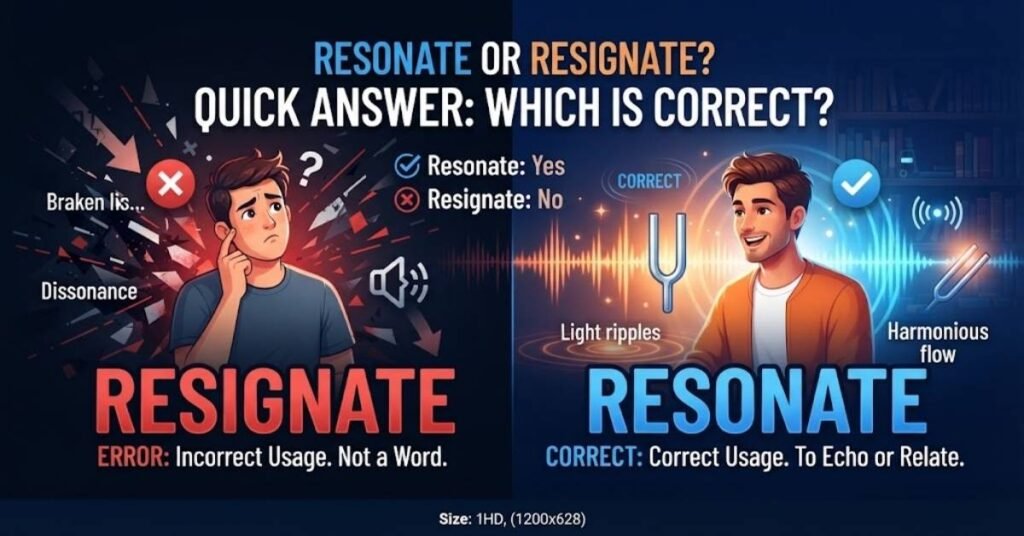
Use resonate. If you want a word for sound, echo, or a strong connection, this is your pick.
Meant to quit a job? Write resign. Meant to assign someone to a role? Write designate. “Resignate” doesn’t fit anywhere in modern English.
Here’s a quick hook. If the sentence is about impact or emotional response, write resonate. If it’s about leaving a position, write resign.
The Origin of Resignate or Resonate
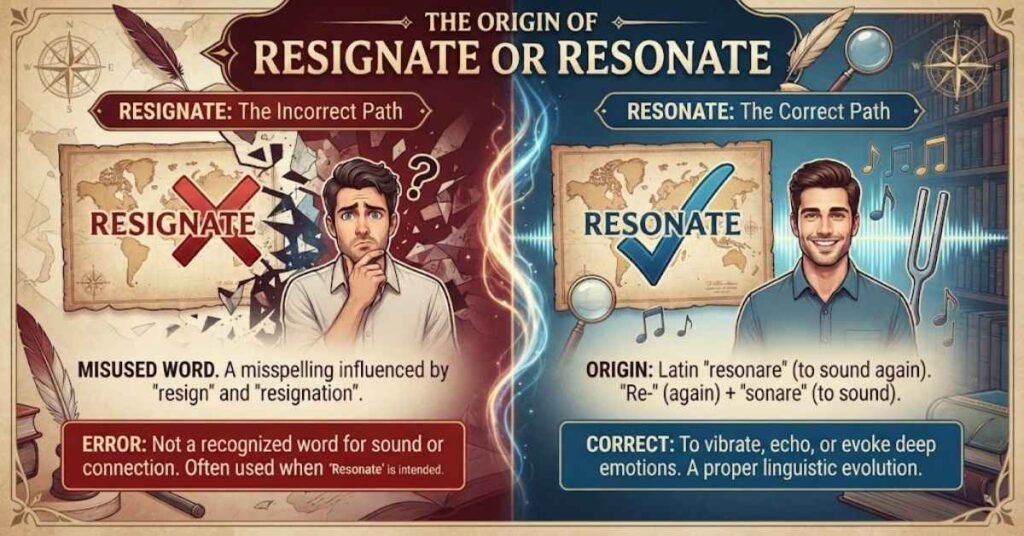
Word history explains a lot here. Once you see where each word comes from, the confusion makes more sense.
Origin of “Resonate”
Resonate comes from the Latin word resonare, which means to sound again or to echo. It combines “re” (again) with “sonare” (to sound).
Early historical usage focused on sound vibrations, like a voice filling a hall. The emotional sense came later, when people started saying an idea “echoed” inside them.
About “Resignate”
Resign has a different root. It comes from Latin resignare, which means to unseal or cancel, and it reached English through Old French.
Resignate has no solid place in dictionary sources today. If you spot it in an old text, treat it as a rare variant, not something to copy.
Why Confusion Exists
The two words look alike at a glance. Both start with “res” and share a similar word pattern, which makes them similar-looking words.
There’s a verb pattern at work too. Words like designate end in “-nate,” so “resignate” feels like it should exist. Your brain fills in the gap.
British English vs American English Spelling
Good news: this pair doesn’t split along regional spelling lines. American English, British English, and Commonwealth English all use resonate.
Some words do change by country, like color/colour and center/centre. This one stays the same everywhere, so you don’t need to memorize a regional variation.
Key Differences to Know
The real difference isn’t the country. It’s the meaning. Resonate deals with sound and connection, while resign deals with leaving a job or accepting something.
Resignate doesn’t earn a place in either dialect. Whether you write for US readers or UK readers, the same spelling rule applies.
Comparison Table
| Word | US English | UK English | Standard? | Core Meaning |
| Resonate | Yes | Yes | Yes | Echo, or strike a chord |
| Resign | Yes | Yes | Yes | Quit a job or position |
| Designate | Yes | Yes | Yes | Assign or choose |
| Resignate | No | No | No | Usually a mistaken form |
Which Spelling Should You Use?
The answer is simple, but it helps to see it by audience. Your readers may sit in different countries, and one rule covers all of them.
For US Readers
Write resonate. American English dictionaries list it with both the sound and emotional meanings.
For UK and Commonwealth Readers
Same answer. British English and Commonwealth English use resonate too, so you won’t need a special version.
For Global Audiences
International audiences get one consistent form. Since Global English doesn’t split this word, resonate works for worldwide usage.
Professional Advice
In professional writing, small slips hurt your credibility. A wrong word in a proposal or business communication can make readers doubt the rest.
Take ten seconds to check spelling before you hit send. That habit builds trust and shows professionalism.
Common Mistakes with Resignate or Resonate
Most errors fall into four buckets. Knowing them helps you catch problems before your readers do.
Mistake 1: Typing “resignate” instead of “resonate”
This is the big one. A writer types “Your story resignated with me,” when the sentence needs resonated.
It often comes from fast typing. Your fingers know “re,” then “sign,” and the rest happens on autopilot.
Mistake 2: Confusing with “resign”
Some writers swap in resign by accident. “The message will resign with readers” makes no sense. The sentence needs resonate.
It works in reverse too. “I plan to resonate from my job” gets a laugh, but only after it’s published.
Mistake 3: Misunderstanding meaning
Resonate doesn’t mean “to agree” or “to be loud.” It means something creates a meaningful link. The intellectual connection or emotional connection is the whole point.
So “I resonate with your plan” only works if the plan truly connects with you. Otherwise pick a plainer word.
Mistake 4: Overusing the word
Resonate shows up in almost every marketing line. Too many, and it turns into background noise.
Mix in alternatives like connect or relate. Your writing stays fresh, and the strong uses land harder.
⚠️ Common Search Variations and Spelling Confusion
People search for this word in odd ways. Some of the common search terms include:
- How do you spell resignate
- Resignate meaning
- Define resignated
- Resignated definition
- Resonate vs resignate
- Reaignate and reasonation (typos of typos)
Each one tells you the same story. The reader isn’t sure of the correct spelling and wants a fast, clear answer.
If that’s you, take the easy route. Search “resonate meaning,” check the dictionary definition, and move on.
Resignate or Resonate in Everyday Examples
Seeing the word in action helps it stick. Here’s how resonate shows up across real writing contexts.
Emails
In workplace communication, it sounds warm without being stiff. “Your proposal resonates with our team goals” is a clean line.
You could also write, “Thanks for the feedback. It resonated with me.” Both feel natural and professional.
News Writing
Reporters love it for public speeches and reactions. “The speech resonated across the country” is a typical headline sentence.
Another common one: “Her message resonated with young voters.” It signals that the message truly landed.
Social Media
On social media posts, people use it for quotes, videos, and films. “This quote resonates deeply” is a classic caption.
“That film resonated with me” works too. Add a question, like “Did it hit you the same way?”, to spark replies.
Formal Writing
Academic writing uses it for research and theory. “The theory resonates with historical patterns” fits well.
“The findings resonate with current trends” also works. It’s precise and doesn’t sound pushy.
How to Use Resonate in a Sentence
Certain phrases pair naturally with resonate. Learning them helps you sound smooth and confident.
Common ones include resonates with me, resonates with readers, resonates with audiences, resonates emotionally, and resonates deeply. You can also say a message resonates, a story resonates, or music resonates.
For the sound meaning, picture bells in a hall or voices in valleys. “The bells resonate through the valley” is a good example. Notice the verb form changes with the sentence: resonates, resonated, and resonating.
Resignate or Resonate: Google Trends & Usage Data
Numbers can be useful, but they change fast. Instead of quoting figures that may age badly, let’s look at the pattern.
When you check Google Trends yourself, you’ll usually see resonate dominate search popularity. Resignate appears mostly as a search variation from people unsure of the spelling.
Try it. Enter both words in Google Trends and compare the lines. It takes a minute and gives you usage data you can trust.
Keyword Comparison Table
| Keyword | Type | What the Searcher Wants | Correct Word? |
| Resonate meaning | Definition | What the word means | Yes |
| Resignate meaning | Definition | Whether it’s real | No |
| How to spell resignate | Spelling | The right spelling | No, use resonate |
| Resonate vs resignate | Comparison | Which one to use | Resonate |
| Resonates with me | Phrase | Sentence help | Yes |
🧠 Why People Accidentally Write “Resignate”
Nobody types the wrong word on purpose. A few small forces line up to cause it.
Autocorrect can swap a word before you notice. Pronunciation similarities also confuse the ear, since both words start with a “rez” sound.
Add fast typing and a busy day, and your fingers take over. That’s a normal writing error, not a sign of weak skills.
Simple Tricks to Stop Mixing Them Up
A few habits fix this for good. Read sentences aloud first. If a line sounds off, your ear often catches what your eyes missed.
Second, run a spell-check or use grammar tools. They flag most common errors quickly.
Third, ask one question: does the sentence involve sound or connection? If yes, write resonate. That’s mistake prevention in a single step.
Why Getting It Right Builds Trust
Readers judge quickly. A wrong word in a blog post or proposal can make the whole piece feel careless.
For bloggers, content creators, and language learners, clear communication builds authenticity and confidence. It’s a small detail that adds up.
Conclusion
Resonate is the word you want. Resignate isn’t standard usage, and it usually comes from a typing error or a mix-up with resign.Keep the sound and emotional connection idea in mind, and you’ll get it right.
Have you ever caught yourself writing “resignate”? Drop a comment, share this with a friend who writes a lot, and tell us which word trips you up next.
FAQs
1. Is resignate a real word?
Not in standard English. The major dictionaries list resign and resignation, but not resignate. If you see it, it’s most likely a spelling mistake.
2. What does resonate mean?
It means to echo, to produce sound, or to strike a chord with someone. It describes both sound reflection and a meaningful emotional impact.
3. Why do people confuse these words?
They look alike and share similar pronunciation at the start. Autocorrect, fast typing, and word patterns like “designate” add to the mix-up.
4. Can resonate describe emotions?
Yes. You can say something resonates emotionally or resonates deeply. It shows a strong connection between an idea, story, or message and the listener.
5. Is resonate formal or informal?
It works in both. You can use it in emails, academic writing, and social media without sounding stiff or casual.
6. Does spelling change by country?
No. American English, British English, and Commonwealth English all use resonate. It doesn’t follow patterns like color/colour.
7. Are there synonyms for resonate?
Yes. Try connect, relate, echo, reflect, or strike a chord. Each fits slightly different contexts, so pick the one that matches your meaning.