


Typed “liason” into an email and something felt off? You’re not alone.This word trips up more people than almost any other in the English language. And the answer is simple: liaison is the only correct spelling. Liason is a common misspelling, not a real word.
Stick around, because we’ll break down exactly why this happens, where the word comes from, and how you’ll never mix it up again.
Liason
Liason is not a word. It’s a spelling mistake people make because of how the word sounds when spoken quickly. You won’t find it in any dictionary, and using it in professional writing can hurt your credibility.
Liaison
Liaison means a connection or link between two people or groups. It also refers to a person whose job is to keep communication flowing between departments, teams, or organizations. Think of a liaison officer standing between two sides, making sure everyone stays on the same page.
⚡ Liason vs Liaison – Quick Answer
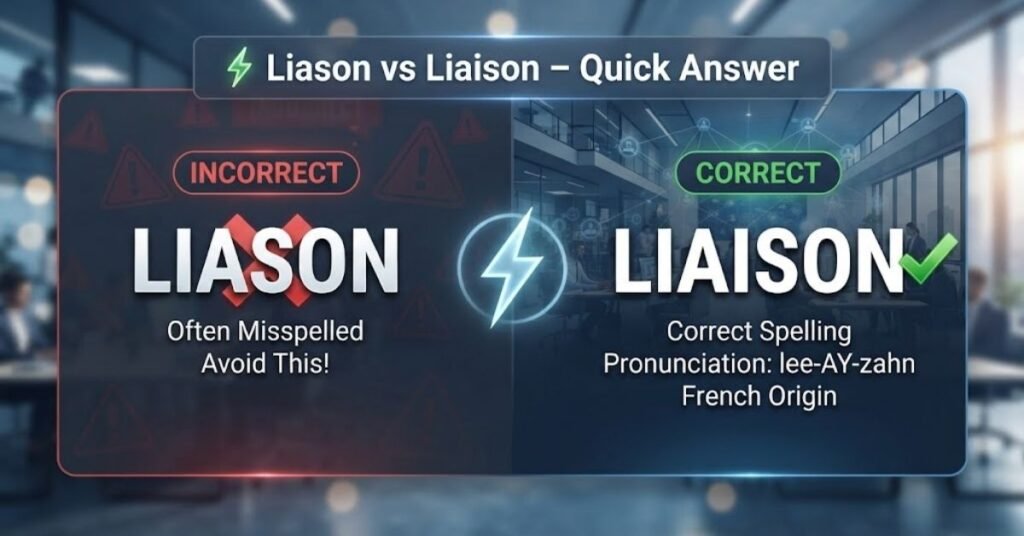
Here’s the short version so you can get back to writing.
Liaison is correct. Liason is incorrect, in every English-speaking country, in every context. The confusion comes from its French origin and its tricky silent letters, which we’ll dig into shortly.
Examples
- Correct: She works as a liaison between the sales and marketing teams.
- Incorrect: She works as a “liason” between the sales and marketing teams.
- Correct: The hospital hired a new liaison officer for patient families.
📜 The Origin of Liaison
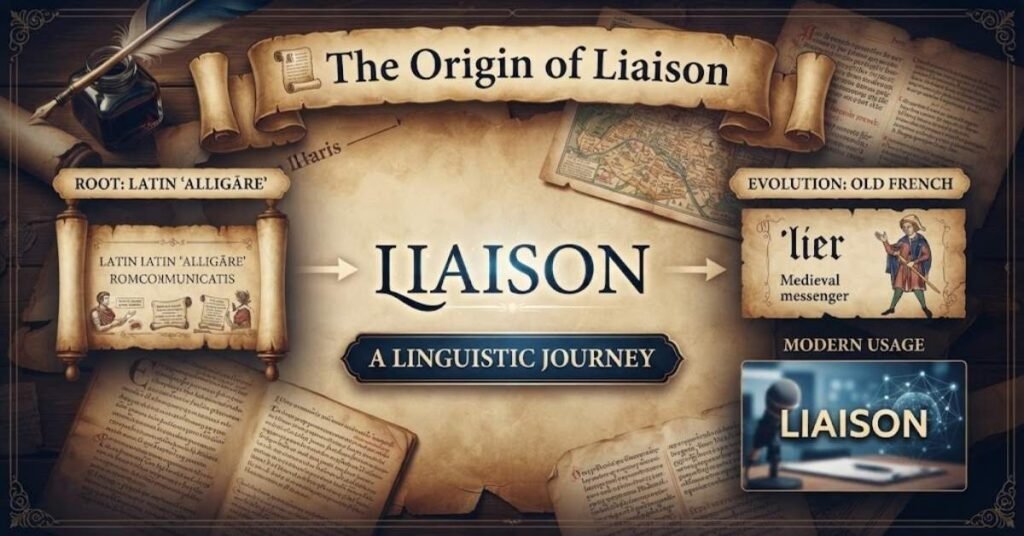
Words don’t just appear out of nowhere. This one has a story worth knowing.
Word History
Liaison comes straight from the French word “liaison,” which itself grew out of the Latin “ligare,” meaning to bind or tie together. French cooking even uses the term for a thickening agent that binds a sauce. So the idea of connecting things has always been baked into this word.
Why It Is Confusing
English borrowed the word but kept its French origin spelling intact, silent letters and all. That’s rare. Most borrowed words get simplified over time, but liaison never did, which is exactly why so many people search for the correct spelling every single day.
Simple Meaning
Strip away the history, and the word meaning is easy. It’s a bridge. A go between. A communication link that keeps two sides talking instead of guessing.
🇬🇧🇺🇸 British English vs American English Spelling
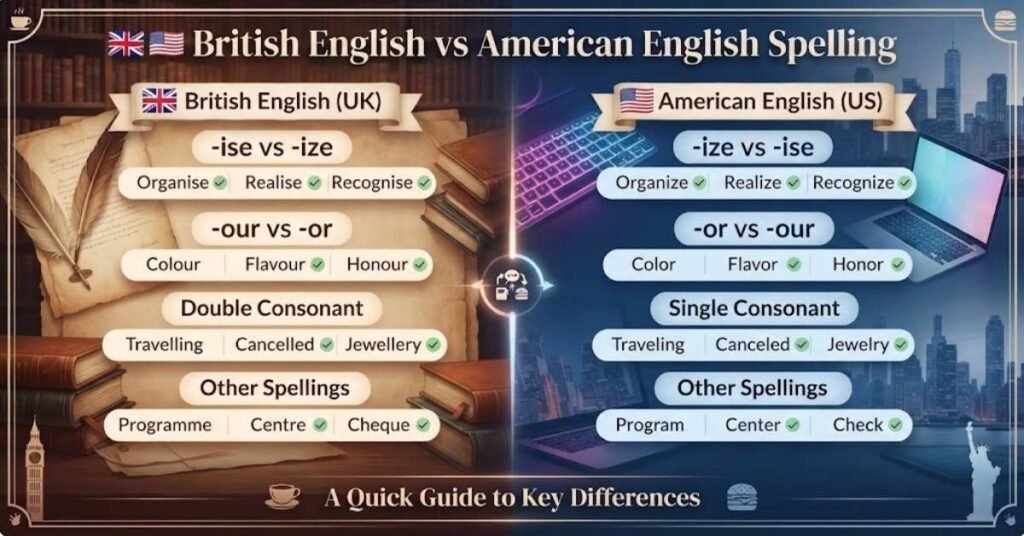
Good news here. This is one of the rare words where British English and American English don’t fight.
Unlike “colour” versus “color” or “organise” versus “organize,” liaison stays the same on both sides of the Atlantic. The spelling is identical, though US pronunciation and UK pronunciation can sound slightly different. Americans often say “lee-AY-zon,” while British speakers lean toward “lee-AY-zawn.”
So if you were hoping the spelling changes depending on where you live, sorry, it doesn’t. This is same spelling worldwide, no exceptions.
🌍 Which Spelling Should You Use?
Always use liaison. There’s no version of English, formal or casual, where “liason” becomes acceptable.
Simple Rule
If you remember one thing from this article, make it this: liaison has two i’s. One after the “l,” and one before the final “n.” Miss either one, and you’ve written the wrong word.
❌ Common Mistakes with Liason vs Liaison
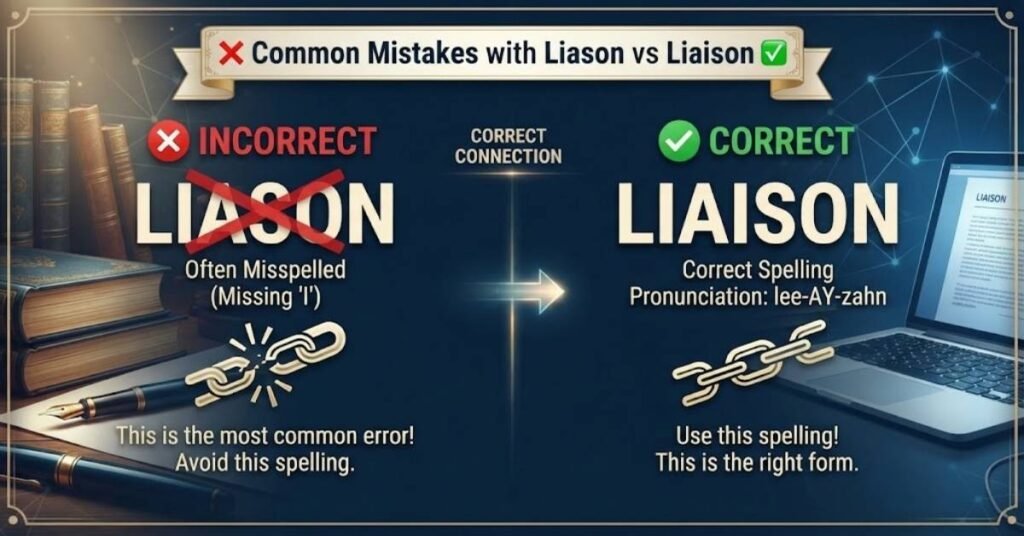
Let’s get specific about how people mess this up, because knowing the pattern helps you avoid it.
1. Missing Letters
The most frequent error is dropping the second “i,” turning liaison into “liason.” It looks harmless, almost like a shortcut, but it’s simply wrong.
2. Wrong Order
Some writers swap letters around, producing odd versions like “liaosn” or “liasoin.” This usually happens when typing fast without double checking.
3. Writing by Sound
English spelling rarely matches pronunciation perfectly, and this word is a textbook example. Because the sound vs spelling difference is so wide here, people spell it the way it sounds, which almost never works out.
4. Fast Typing Errors
Autocorrect doesn’t always catch this one, especially on phones. A rushed email or text message is prime territory for typing errors like “liazon” or “lision” to slip through unnoticed.
🔤 How to Spell Liaison Correctly (Common Search Queries Answered)
People type all sorts of variations into Google, hunting for clarity. Let’s answer them directly.
If you searched “liaison or liason,” the answer is liaison. If you searched “liaison vs liason,” again, liaison wins, always. Break it into chunks if that helps: li-ai-son. Say it slowly, spell it slowly, and it starts to stick.
Another trick that works well is reading it out loud while tracing each letter with your finger. It sounds old school, but muscle memory helps more than people expect, especially for a word this irregular.
📘 Understanding the Word Structure
Breaking down the word structure makes the whole thing less intimidating.
Think of it as lia + iso + n. That middle chunk, “iso,” is the part most people forget or scramble. Once you separate the word into these three pieces, the spelling pattern becomes far easier to remember than trying to memorize eight letters in a row.
📖 Liaison Meaning, Usage & Word Forms (Including Common Confusions)
Now let’s get into how this word actually functions in a sentence, plus the versions that trip people up.
✔️ Correct Meaning
At its core, liaison means a connection, a relationship, or a person who connects groups. It shows up constantly in workplace terminology, especially in roles that require constant back and forth between different sides.
❌ Incorrect Variations People Search
Beyond “liason,” people also type “laison,” “liazon,” “liasion,” and “lision.” Every single one of these is wrong. Only one spelling survives the dictionary test, and you already know which one.
🔤 Verb Forms & Spelling Confusion
The verb form is “liaise,” not “liason” or “liasion.” So you’d say someone is liaising with another department, not “liasoning” or “liaisoning” with them. This verb form confuses even native speakers, so don’t feel bad if it’s new to you.
📜 Liaison Root Word & Origin
As covered earlier, the root word traces back to Latin through French, tied to the idea of binding things together. Knowing this origin doesn’t just satisfy curiosity, it genuinely helps you remember why the spelling looks the way it does.
📊 Comparison Table – Liason vs Liaison
| Feature | Liaison (Correct) | Liason (Incorrect) |
| Dictionary status | Valid word | Not a real word |
| Origin | French, from Latin “ligare” | No valid origin |
| Spelling | Two i’s, correct order | Missing letter |
| Usage in writing | Accepted everywhere | Flagged as an error |
| Meaning | Connection, communication link | No meaning |
✍️ Liaison in Everyday Examples
Seeing the word in real situations makes it stick better than any rule ever could.
“Please loop in our liaison from the finance team before Friday.” This kind of line shows up constantly in email communication, especially in business communication between departments.
📰 News
Journalists often describe someone as “acting as a liaison between the government and local communities.” That’s standard news writing language, used to describe official communication without extra fluff.
📱 Social Media
Even casual posts use it. Someone might write, “Thrilled to start my new role as community liaison officer!” Social media usage of the word tends to be shorter, but the spelling rules don’t change just because the platform is casual.
📄 Formal Writing
In contracts, reports, and official documents, formal writing almost always uses “liaison” to describe a designated point of contact. Getting it wrong here can look sloppy on something meant to represent your professionalism.
🏢 Office Use
Around the office, you’ll hear things like, “She’s our liaison position for client onboarding.” This is common office communication, and it’s one of the most frequent real world uses of the term.
📊 Liason vs Liaison – Google Trends & Usage Data
Curious how many people actually search for the wrong spelling? Quite a lot, it turns out.
Popular Searches
Terms like “liaison or liason,” “how to spell liaison,” and “liaison meaning” rank among common search queries every month. This tells us the confusion isn’t rare, it’s widespread.
Usage Insight
Usage data consistently shows “liaison” as the dominant spelling in published content, while “liason” appears almost exclusively in casual writing, texts, and rushed emails.
Where It Is Used
You’ll find the correct term across government offices, schools, businesses, healthcare systems, and nonprofit organizations. Wherever coordination between groups matters, this word tends to show up.
🧠 Easy Memory Tricks
Rules are fine, but tricks are what actually stay in your head.
Trick 1: Two “i” Letters
Picture two eyes staring at each other across the word, that’s your reminder for the double “i.” Cheesy, sure, but it works.
2: Think “Link”
Liaison and link both start similarly and both describe a connection. Let one remind you of the other.
3: Pattern
Break it into lia-i-son when you write it slowly. Chunking beats memorizing the whole thing at once.
4: Slow Pronunciation
Say “lee-ay-zon” out loud a few times before you type it. Slowing down your speech often slows down your spelling mistakes too.
📖 Advanced Usage Examples
Let’s move beyond the basics and look at how different industries lean on this word.
Business
Companies often appoint a company liaison to manage vendor relationships or client accounts, making sure nothing falls through the cracks during a project handoff.
Government
Government communication frequently relies on a public liaison, someone tasked with translating policy into plain language for citizens and the press.
Education
Schools appoint an education liaison to bridge the gap between teacher and parents, especially when a student needs extra support or accommodations.
Healthcare
In hospitals, a healthcare liaison connects doctor and family, explaining treatment plans and answering questions when emotions run high and clarity matters most.
🧾 Liaison in Professional Writing
Getting this word right in a professional setting says more about you than you’d think.
Correct
“Our liaison officer will coordinate all communication between the two offices starting Monday.” Clean, correct, and confidence inspiring.
Incorrect
“Our ‘liason officer’ will coordinate all communication.” Even a single error like this can make a reader pause, and that pause is never good in professional writing.
Why Important
Writing accuracy builds trust building with clients, colleagues, and readers. A small spelling slip might seem minor, but it chips away at workplace professionalism, especially in official documents.
🌎 Why This Confusion Happens
Let’s zoom out and connect all the dots we’ve covered.
1. French Origin
Because the word kept its French word structure instead of being simplified, English speakers inherited spelling patterns that don’t feel natural.
2. Silent Letters
Silent letters rarely announce themselves, and this word has more going on beneath the surface than it lets on when spoken aloud.
3. Sound vs spelling difference
Since pronunciation doesn’t map cleanly onto spelling, your ear can’t always save you here. Your eyes need to do the work instead.
4. Typing mistakes
Add fast typing, autocorrect gaps, and mobile keyboards into the mix, and it’s no surprise common spelling errors keep happening across emails and posts.
🏁 Conclusion
So there you have it. Liaison is correct, always, everywhere. Liason is a spelling mistake, nothing more.
Once you understand the French origin, the silent letters, and the little spelling pattern tricks, this word stops being scary. Next time you need to describe a communication link or a liaison role at work, you’ll spell it right without a second thought.
❓ FAQs
1. Which is correct?
Liaison is the correct spelling. “Liason” is not a recognized word in any dictionary.
2. Is liason a real word?
No. It’s a common misspelling of liaison and doesn’t appear in standard dictionaries like Cambridge Dictionary.
3. What does liaison mean?
It means a connection, relationship, or a person who connects groups, often used to describe coordination between teams or organizations.
4. Is spelling same in US and UK?
Yes. Both British English and American English spell it identically as “liaison,” though pronunciation can differ slightly.
5. Why hard to spell?
Its French origin, silent letters, and the gap between sound vs spelling difference make it one of the trickier words in English.
6. How to remember?
Break it into lia-i-son, picture two i’s like two eyes, and say it slowly before writing it down.
7. Is it used in jobs?
Yes. Roles like liaison officer appear across businesses, schools, government offices, and healthcare, wherever coordination between groups is needed.