
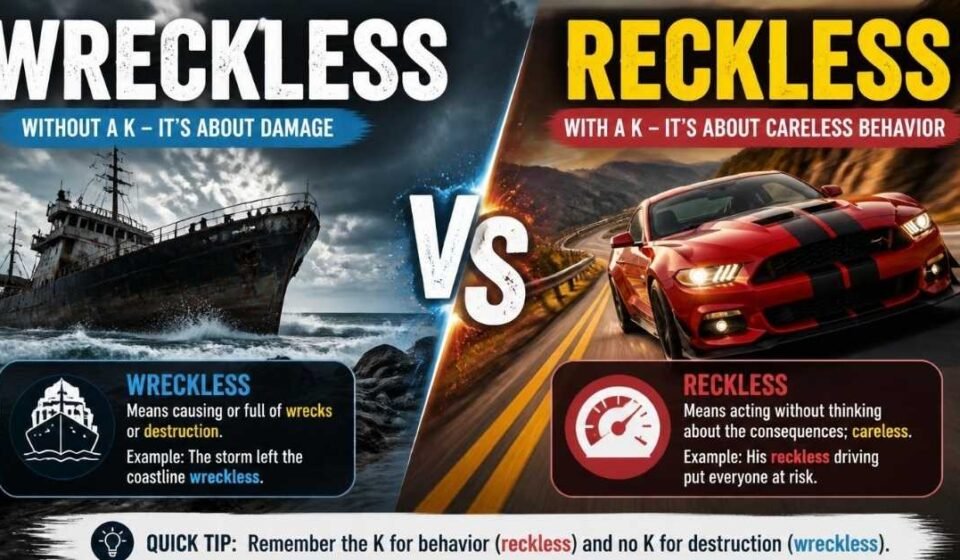

Ever typed “wreckless driving” in a text and paused, wondering if that’s even a real word? You’re not alone. This mix-up trips up more people than you’d think, and honestly, it makes sense once you know why. The short answer? Reckless is the only correct spelling. Wreckless doesn’t exist in standard English, no matter how often it shows up in casual writing.
Let’s break down why this happens, where the word actually comes from, and how you can nail it every single time.
Wreckless or Reckless: Quick Answer
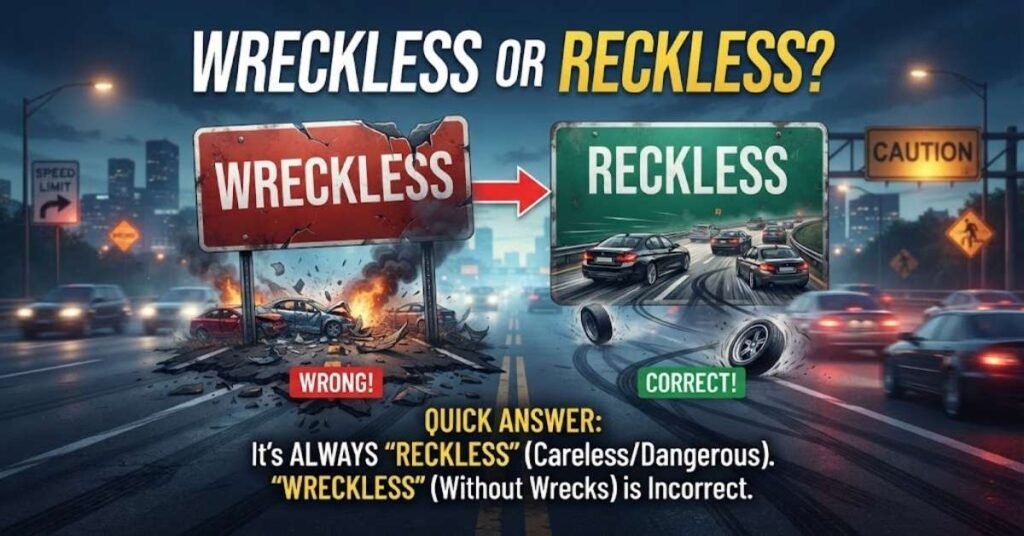
Reckless is the word you want. It’s an adjective that describes careless or thoughtless behavior, usually the kind that ignores danger or consequences. Think reckless driving, reckless spending, or just acting without a shred of caution.
Wreckless isn’t in any major dictionary. People write it because it sounds like it should relate to a wreck, like a car crash. That connection feels logical, but it’s a spelling mistake, not an alternate form.
So if you’re drafting an email, a school paper, or a social media caption, stick with reckless. It’s the only version that’ll pass a spellchecker, a teacher’s red pen, or your boss’s inbox.
The Origin of Wreckless or Reckless
Here’s where it gets interesting. The word reckless traces back to Old English, specifically a word called “reccan,” which meant to care or take heed. Add the suffix “-less,” and you get something that literally means without care.
By the time we hit Middle English, the spelling had shifted toward “rekkelees,” eventually smoothing out into the reckless we use today. Notice something? There’s no “wreck” anywhere in that etymology. The word “wreck” comes from a completely different Old English root tied to shipwrecks and ruin.
So the two words share a sound, not a history. That’s the whole word confusion in a nutshell: our brains hear “reckless” and picture a reckless driving accident, so we assume “wreck” belongs in there. It doesn’t, and that’s exactly why so many people misspell it.
British English vs American English Spelling
Good news here: this isn’t one of those words where British English and American English disagree. Whether you’re in the UK, the US, Canada, or Australia, reckless is spelled the same way everywhere.
Unlike words such as “colour” versus “color,” there’s no UK English or US English variant to worry about. Commonwealth English and American spelling both agree on this one, which honestly makes life easier.
So if you were hoping regional spelling rules might excuse “wreckless,” they won’t. This is a universal case of one correct spelling and one persistent incorrect spelling that shows up regardless of where the writer lives.
Which Spelling Should You Use?
Always go with reckless. There’s no scenario, formal or informal, where “wreckless” is the right call. Whether you’re writing a formal writing piece for work or a quick caption on social media, reckless is your only option.
Some people assume slang or casual tone gives them a pass to bend spelling rules. It doesn’t work that way here. Even in informal writing, a misspelled word still reads as a mistake, not a stylistic choice.
If you’re ever unsure mid sentence, picture the meaning: careless, thoughtless, without regard for danger. That mental shortcut will steer you toward reckless almost every time.
Common Mistakes with Wreckless or Reckless
Let’s talk about where this trips people up most. These slip ups happen in emails, texts, even professional documents, so it’s worth knowing the patterns.
- Writing “wreckless driving” instead of reckless driving on social media posts or in casual chats
- Using “wreckless” in academic writing, which can hurt grades or credibility
- Autocorrect sometimes fails to catch it, especially on phones with weaker spellcheckers
- Confusing “reckless” with “wreck” because of the shared sound, not the actual word origin
- Assuming “wreckless” means “without wrecks,” which flips the intended meaning entirely
That last one’s a fun twist. If “wreckless” existed, it would logically mean the opposite of what people intend, more like “avoiding wrecks” than “careless.” Kind of ironic, right?
Wreckless or Reckless in Everyday Examples
Seeing the word in action helps it stick. Here are a few ways reckless shows up in daily life, at work, on the road, and in conversation.
- “His reckless driving nearly caused a pileup on the highway.”
- “She’s been making some pretty reckless decisions with her savings lately.”
- “Texting while driving is a classic example of reckless behavior.”
- “The company faced backlash after reckless spending drained its budget.”
- “Ignoring safety gear on a job site counts as a reckless action, plain and simple.”
Notice how the word fits naturally into so many contexts, from road safety talk to money management. That versatility is part of why it shows up so often, and why getting the spelling right actually matters.
Why People Keep Mixing Up Wreckless and Reckless
So why does this particular error stick around? Part of it comes down to sound. English is full of words that look like they should relate but don’t, and “reckless” versus “wreck” is a textbook case.
There’s also a visual logic at play. Reckless driving often leads to actual wrecks, so the brain builds a shortcut connecting the two. It’s not a bad guess, honestly, just an incorrect one linguistically.
Add in autocorrect quirks and quick typing on phones, and the error spreads even faster. Once a misspelling looks common enough, people start assuming it must be valid. That’s how spelling myths take hold.
How to Remember the Correct Spelling
Need a trick that sticks? Try this: reckless relates to “reck,” an old word for care. No “reck,” no care, hence reckless. There’s no “wreck” hiding in there at all.
- Picture the word “reck” like a tiny reminder of “care,” minus the care
- Say it out loud slowly: reck-less, not wreck-less
- Remember that “wreck” is about damage, while “reckless” is about the behavior that might cause damage
- If a Grammarly or Microsoft Word check flags it, trust the tool over instinct
Once that distinction clicks, you’ll stop second guessing yourself every time you type it.
Wreckless or Reckless: Google Trends & Usage Data
Curious how often people actually search for the wrong spelling? While exact figures shift over time, online searches consistently show that “reckless” dominates as the standard term across news articles, official documents, and everyday writing.
“Wreckless” still pops up in search queries, mostly from people double checking their spelling or genuinely unsure which form is right. That pattern makes sense. Confusing words tend to generate their own curiosity driven traffic.
What this tells us is simple: the correct form isn’t going anywhere, and people searching for clarity usually land on explainers like this one to settle the question once and for all.
Reckless Behavior in Law and Everyday Life
Here’s a content gap worth filling. In legal contexts, “reckless” carries real weight. Terms like reckless endangerment or reckless driving charges show up in court documents, police reports, and news coverage of accidents.
Courts often distinguish reckless behavior from intentional harm. It’s not that someone meant to cause damage, but they ignored obvious risk anyway. That distinction matters for company vehicles, highway incidents, and even workplace safety violations.
Understanding this legal weight adds another reason to get the spelling right. A misspelled word in an official document can look sloppy, even if the meaning is clear to the reader.
Keyword Variations Comparison Table
| Word Form | Correct? | Example Usage |
| Reckless | Yes | Reckless driving caused the crash |
| Wreckless | No | Common misspelling, avoid in writing |
| Recklessly | Yes | He drove recklessly through town |
| Recklessness | Yes | Her recklessness cost her the job |
| Wrecklessness | No | Not a recognized word form |
This table makes the pattern obvious at a glance. Every version built on “reckless” is valid. Every version built on “wreck” plus “less” isn’t.
Conclusion
At the end of the day, this comes down to one simple rule: reckless is correct, wreckless isn’t. The confusion makes total sense given how the words sound, but now you know the real etymology behind it.
Next time you’re describing reckless driving, reckless spending, or just plain careless choices, you’ll spell it with confidence. And if you ever catch someone else writing “wreckless,” well, now you’ve got the receipts to set them straight.
FAQs
Is “wreckless” ever correct in any dictionary?
No. Major dictionaries recognize reckless only. “Wreckless” isn’t a standard English word.
Why do so many people write “wreckless” instead of “reckless”?
It’s mostly sound association. People connect the word to “wreck,” since reckless actions often cause wrecks, even though the actual word origin has nothing to do with wrecking.
Does British English spell it differently than American English?
No. Both UK English and US English use the identical spelling, reckless, with no regional variation.
What part of speech is “reckless”?
It’s an adjective. The adverb form is “recklessly,” and the noun form is “recklessness.”
Can autocorrect fix this mistake automatically?
Usually, yes. Tools like Grammarly and Microsoft Word typically flag “wreckless,” though it’s smart to double check on faster typing platforms like phones.
Is “reckless” used in legal language?
Yes. Terms like reckless endangerment and reckless driving appear frequently in legal and law enforcement contexts.
What’s a simple way to remember the correct spelling?
Think of the old word “reck,” meaning care. Reckless means without that care, no “wreck” involved at all.