


Let’s clear this up right away. Column is the correct spelling. Colum is not a real word in standard English, it’s simply a common misspelling that pops up when people type fast or rely too much on how the word sounds.You’ll see this mix up a lot in emails, spreadsheets, and even in social media posts. The confusion mostly comes from that silent n at the end, which doesn’t get pronounced clearly when you say the word out loud.
So if you’re ever stuck typing colum or column, just remember this: column has that extra n, and it’s not optional. Keep reading, because we’ll walk through the why, the how, and every situation where this word shows up.
How to Spell Column Correctly (Common Variations Explained)
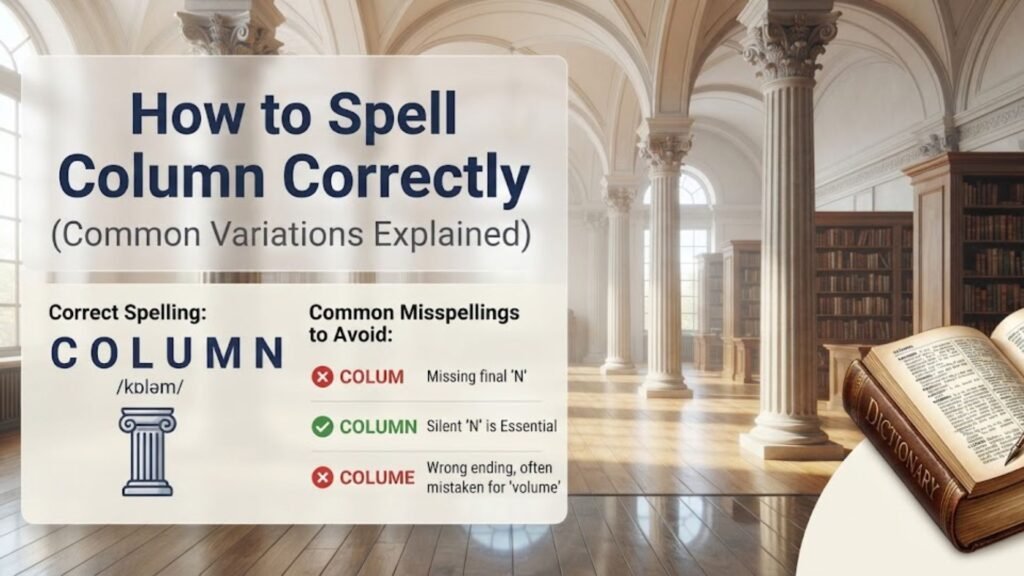
The correct spelling of column is c-o-l-u-m-n. That’s six letters, and the tricky part is always the ending. People often write colun, colum, or even colomn because they’re spelling it the way it sounds rather than the way it’s actually written.
Here’s a fun fact that helps a lot of people. Column belongs to the same word family as columnist and columnar, and in both of those words, you can actually hear the n. Say “columnist” out loud. Hear that n? That’s your clue that it belongs in column too.
Think of it like a hidden helper. The n stays quiet in “column” but shows up loud and clear in its relatives. This little trick works better than any spelling rule you’ll find in a textbook, and it’s the kind of thing a teacher or an editor might tell you over coffee, not something you’d read in a dry grammar guide.
The Origin of Colum or Column
Every word has a backstory, and column’s is pretty interesting. It comes from the Latin word columna, which basically meant a pillar or a support structure, something tall and upright holding things up.
Over centuries, as Latin roots filtered into French and then into English, the spelling stuck around even though the pronunciation shifted. This happens a lot in English. Words like autumn, hymn, and solemn all kept their silent n for the same historical reason, the spelling froze in place while the way we say it evolved.
So when you write column with that silent n, you’re actually preserving a tiny piece of Latin history. Kind of cool when you think about it that way, right? It’s not just a random rule, it’s language evolution frozen mid sentence.
British English vs American English Spelling
Good news here, there’s zero difference. British English and American English both spell it column, no exceptions. This is actually rare, because so many words split between the two, think colour versus color, or centre versus center.
Column dodged that whole mess. Whether you’re writing for a UK audience, a US audience, or anyone in between, column stays exactly the same. That consistency makes it one less thing to worry about if you’re writing for a global audience.
Comparison Table
| Word | British English | American English |
| Column | column | column |
| Colour/Color | colour | color |
| Centre/Center | centre | center |
| Organise/Organize | organise | organize |
See how column just sits there, unbothered by regional spelling wars? That’s your one guaranteed safe word.
Which Spelling Should You Use?
The answer is always column, but how you use it can shift slightly depending on who’s reading. Let’s break it down by audience, because context matters more than people realize.
US Audience
American readers expect column, full stop. No variation, no regional twist. If you’re writing a report, a blog, or an email for a US audience, column is your only option, and thankfully it’s the easy one.
UK and Commonwealth Audience
Same story here. Whether you’re writing for readers in London, Sydney, or Toronto, column doesn’t change. This is one spelling that unites British English, American English, and Commonwealth English under one roof.
Global or Online Audience
If you’re writing for an international crowd or publishing online where readers come from everywhere, column is your safest bet. It’s the standard spelling recognized worldwide, so you won’t confuse anyone or look inconsistent.
Professional Writing
In business writing, reports, or anything client facing, spelling accuracy builds trust. A misspelled word like colum in a professional email can make a message look rushed or careless, even if the content itself is solid.
Educational Context
For students and English learners, getting column right matters for more than just grades. It’s often one of the first silent letter words people learn, so nailing it early makes future spelling patterns easier to spot.
Common Mistakes with Colum or Column
Let’s talk about where things go wrong, because almost everyone slips up here at least once.
1. Dropping the Silent Letter
This is the number one column spelling mistake. People hear the word, don’t hear the n clearly, and leave it out. The result is colum, which just isn’t a real word.
2. Mixing with Similar Words
Some writers accidentally blend column with words like collum or colun, especially when typing fast. These aren’t real words either, they’re just typing slips that stuck.
3. Incorrect Plural Form
The correct plural of column is columns, not colums. Dropping the n in the plural form is just as common as dropping it in the singular, so watch for it in both.
4. Confusion in Data Tables
When people work with spreadsheets, they often type column quickly across dozens of cells, and that’s exactly when typos creep in. A quick find and replace can save you from a document full of colums.
5. Autocorrect Issues
Ironically, autocorrect sometimes causes more harm than good. On some keyboards, a fast typed colum doesn’t get flagged because the software assumes you meant something else entirely, or it just doesn’t catch it fast enough.
Correction Tips
Here’s a simple memory trick that actually works. Picture a tall stone pillar with an extra beam running through the middle, that beam represents the n. Visually, column looks long and structured, just like the object it describes.
Practicing the word in full sentences also helps a ton. Write it a few times in context, like “the newspaper column was published Monday,” and your brain starts recognizing the correct letter order naturally.
Column Spelling, Meaning, and Pronunciation
Column is pronounced /ˈkɒləm/, and notice how the final n barely registers when you say it. That gap between pronunciation and spelling is exactly why this word trips people up so often.
Meaning wise, column carries a few different jobs. It can refer to a vertical structure like a pillar, a written section like a newspaper column, or a data column in a spreadsheet. Same word, three completely different worlds, and context tells you which one applies.
Understanding all three meanings actually helps with spelling too. The more familiar you are with a word and its uses, the less likely you are to second guess how it’s written. Familiarity builds spelling confidence.
Colum or Column in Everyday Examples
Let’s look at where this word actually shows up in daily life, because it’s more places than you’d think.
Emails
In professional emails, you might write “please check the third column in the attached sheet.” Getting this right matters for business communication, since small errors can chip away at how polished your message looks.
News Writing
Journalists write opinion columns every week, and readers expect that spelling to be flawless. A newspaper columnist publishing under a typo heading looks unprofessional fast.
Social Media
Even casual posts benefit from correct spelling. If you’re sharing a tech review comparing spreadsheet tools, writing “colum” instead of column undercuts your credibility, even in a quick tweet or caption.
Academic Writing
Students working with academic data or research tables need to spell column correctly, especially in formal papers where accuracy is graded directly.
Architecture
In architecture, columns are literal structural supports, think marble columns in ancient temples. This is actually the word’s original meaning, tracing straight back to that Latin root we talked about earlier.
Colum or Column – Google Trends & Usage Data
Search behavior tells an interesting story here. People frequently search things like “is it column or colum” or “why is the n silent in column,” which shows this confusion is widespread, not just a personal struggle.
Search interest for correct spelling terms tends to spike whenever students are writing papers or when professionals are drafting reports, both moments where accuracy suddenly feels urgent. Understanding this search intent helps explain why spelling guides like this one stay genuinely useful over time.
Comparison Table: Keyword Variations Side by Side
| Correct | Incorrect Variations |
| Column | Colum |
| Column | Coloumn |
| Column | Collum |
| Column | Collumn |
| Column | Colun |
| Column | Colomn |
| Columns | Colums |
Bookmark this table if you need a fast gut check next time you’re unsure.
Why This Silent Letter Confusion Happens So Often
English is full of silent letters, and column is far from alone. Words like autumn, hymn, and solemn all share that same quiet ending, which means once you understand column, you’ve basically cracked the code for a whole group of tricky words.
This pattern exists because English borrowed heavily from Latin and French over hundreds of years, and spelling often stayed locked in place while pronunciation drifted. Knowing this bit of language history doesn’t just help with column, it makes the rest of English spelling feel a little less random.
How Autocorrect and Predictive Text Are Changing Spelling Habits
Here’s something worth thinking about. As more people rely on predictive text and voice typing, fewer of us are actually typing out full words letter by letter. That means silent letters like the n in column get skipped even more often, since our brains aren’t reinforcing the spelling through repetition.
This is exactly why understanding the reasoning behind a word, not just memorizing it, matters more now than ever. When you know why the n is there, you’re less likely to lose it just because your phone tried to guess the rest of the word for you.
FAQs
1. Is “colum” ever correct in English?
No, colum isn’t a recognized word in standard English. It’s always a misspelling of column.
2. Why is the “n” silent in column?
The silent n comes from the word’s Latin origin, columna, and the spelling stuck even as pronunciation changed over time.
3. Do British and American English spell it differently?
No, both spell it exactly the same way, column, with no regional variation at all.
4. How can I remember the correct spelling?
Think of related words like columnist or columnar, where the n is clearly pronounced, then apply that same n to column.
5. What does column mean in writing?
It can mean a regular published article, like a weekly opinion column written by a journalist.
6. What does column mean in data tables?
It refers to a vertical section in a spreadsheet or table, running top to bottom.
7. Is column only used in architecture?
No, its architectural meaning is just one use. It also applies to writing, data, and structural design equally.
Conclusion
At the end of the day, column is the spelling you want, every single time, no matter your audience or context. Whether you’re writing an email, drafting a report, or filling out a spreadsheet, that silent n belongs there.
Now that you know the history, the pronunciation quirks, and the common slip ups, spelling this one correctly should feel a lot more natural. Got a spelling question you’re still unsure about? Drop it in the comments, we’d love to help you sort it out.