

You typed a word. Spell check didn’t flag it. But something feels off, right?That’s usually the moment “either” turns into “eather” on someone’s screen. It happens more than you’d think, especially when you’re typing fast or trusting autocorrect a little too much.Here’s the short answer before we go anywhere else: either is correct.
Eather isn’t a real word in any English dictionary, US or UK. It’s a phonetic spelling mistake, not a regional variant, not an old form, not a typo that somehow became acceptable.Now let’s get into why this mix up happens, where it came from, and how to make sure you never second guess it again.
Either
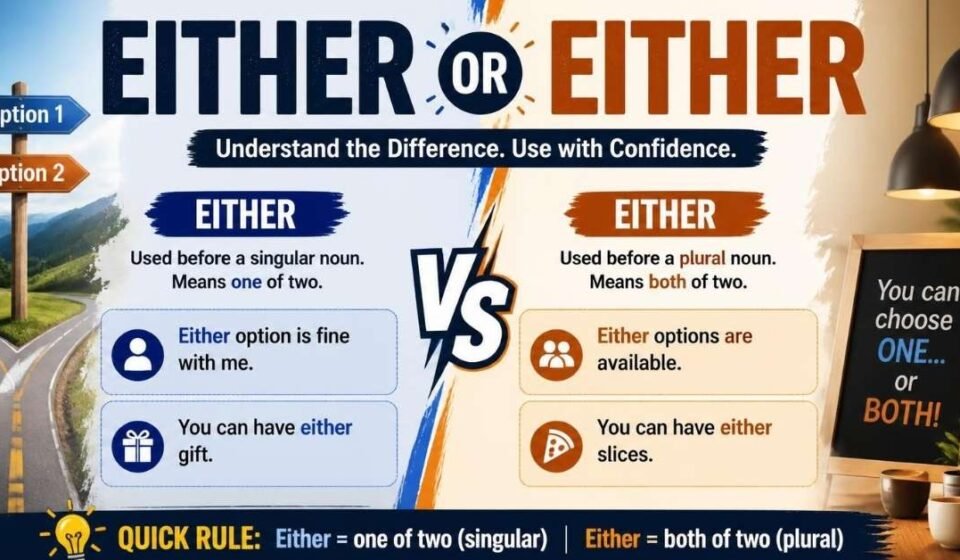
Either is a standard English word used to talk about one of two choices, or sometimes both. You’ll see it in casual chats, formal writing, contracts, news headlines, basically everywhere.
It works as a determiner, a pronoun, and part of the classic “either…or” pairing. Simple word, but it carries a lot of grammatical weight.
Eather
Eather isn’t in any standard dictionary. Not Merriam-Webster, not Oxford, not Cambridge. It shows up because people spell words the way they sound, and “either” has two accepted pronunciations that make this confusion pretty understandable.
Think of it like writing “recieve” instead of “receive.” The sound tricks your fingers before your brain catches up.
Either or Eather – Quick Answer

If you only remember one thing from this article, remember this: either is the only correct spelling. Eather is a nonstandard spelling, plain and simple.
People search this comparison because they’ve seen “eather” somewhere online, maybe in a text or a comment, and it looked believable enough to question. That’s fair. English spelling isn’t always logical.
Correct examples:
- You can choose either option, it’s up to you.
- Either the manager or the assistant will call you back.
- I don’t like either movie, honestly.
- She hasn’t decided either way yet.
Notice how natural these sound? That’s the goal, using either the way native speakers actually talk.
The Origin of Either or Eather

Words don’t just appear out of nowhere. There’s usually a history behind every quirky spelling rule in English, and “either” has a pretty interesting one.
Historical origin
Either traces back to Old English and Middle English, from a word close to ǣgther, which basically meant “each of two.” Over centuries, spelling shifted, pronunciation drifted, and we landed on the modern form.
You’ll also find old variants like eyther in historical texts. Language evolves slowly, then all at once, and this word is a good example of that pattern.
Why “eather” exists as a mistake
Eather never had a historical run. It’s not an outdated form or a forgotten dialect spelling, it’s simply a modern error.
Blame it on sound. The ee-ther pronunciation makes “eather” feel logical, even though it’s not backed by any English etymology or dictionary entry.
British English vs American English Spelling
This is where things get genuinely interesting, because the confusion around “either” isn’t really about spelling. It’s about sound.
What does differ?
British English and American English don’t disagree on the spelling of “either,” they agree completely: it’s always e-i-t-h-e-r. What differs is pronunciation.
In the UK, most speakers say eye-ther. In the US, ee-ther is far more common, though both versions exist in each country depending on region and personal habit.
Spelling comparison table
| Aspect | British English | American English |
| Spelling | Either | Either |
| Common pronunciation | Eye-ther | Ee-ther |
| Formal use | Same | Same |
| Dictionary status | Standard | Standard |
Same spelling, different sound. That’s the whole story, and it’s why so many people assume there’s a spelling split when there isn’t one.
Which Spelling Should You Use?
There’s no debate here, honestly. Either is your answer no matter where your reader lives.
For US audiences
Stick with either, and feel free to pronounce it ee-ther if that’s natural for you. American style guides, from AP to Chicago, treat this as standard English without exception.
For UK audiences
Same spelling applies. British readers will pronounce it eye-ther more often, but written word usage stays identical across both countries, Canada, and Australia too.
Common Mistakes with Either or Eather
Let’s break down exactly why people slip up here. Knowing the reasons makes it a lot easier to avoid them going forward.
1. Phonetic spelling
People write words the way they hear them. Since “either” has that soft “ee” sound for many speakers, “eather” looks like a reasonable match, even though it isn’t one.
2. Confusion with similar words
Words like weather, leather, and feather all end in “eather.” Your brain pattern matches, and suddenly “either” gets pulled into that group by mistake.
3. Autocorrect trust
Not every autocorrect tool catches this error, especially on mobile keyboards or in casual apps. People assume if it wasn’t flagged, it must be fine, and that assumption backfires.
4. ESL overgeneralization
ESL learners often apply spelling rules from patterns they’ve already learned. If “weather” and “feather” end that way, “eather” seems like it should follow suit. It’s a smart guess, just an incorrect one.
Either or Eather in Everyday Examples
Seeing the word used correctly across different formats helps it stick. Let’s walk through a few real world contexts.
Emails
Professional emails demand accuracy, since a small error can quietly hurt your credibility. “Please confirm either option by Friday” reads clean, confident, and correct.
News
News writing relies on tight, error free language, especially in headlines. You’ll never see “eather” in a published article from a legitimate outlet, and that consistency matters.
Social Media
Social media writing is more relaxed, but errors still stand out, sometimes painfully so. A misspelled word in a caption can distract from your actual message.
Formal Writing
In academic writing, essays, and exams, spelling precision counts toward your grade or your professional image. “Eather” in a thesis paper is the kind of mistake that gets circled in red.
Either or Eather – Google Trends & Usage Data
People don’t search random things without a reason. There’s usually a spark behind every trending query.
Why people search “either or eather”
Most searches come from genuine doubt, someone saw “eather” written somewhere and wanted to confirm if it was real. Search intent here is almost always about verification, not curiosity.
Google Trends data around confused word pairs shows spikes tied to viral posts or common typos going around online. This is one of those quiet but persistent search behavior patterns.
Popular regions
Interest tends to cluster in US audience and UK audience searches, along with steady numbers from Canada, Australia, and various non-native English regions where English learners are actively studying grammar rules.
Comparison Table: Either vs Eather
| Feature | Either | Eather |
| Dictionary status | Valid | Invalid word |
| Used in formal writing | Yes | No |
| Grammatically correct | Yes | No |
| Common cause | Standard word | Phonetic spelling error |
| Appears in style guides | Yes | Never |
This table makes it obvious at a glance. One column represents accepted English language usage, the other represents a mistake people should simply drop.
How to Remember the Correct Spelling
Memory tricks work better than repeating rules over and over. Here’s a simple one that sticks.
Picture the word “neither” standing right next to “either,” they’re basically siblings. If you already spell neither correctly, just remove the “n” and you’re done.
You could also link it to “I” before “the,” since “either” starts with e-i, not e-a. Small memory trick, big payoff when you’re typing quickly.
Grammar Rules for Using Either
Beyond spelling, using “either” correctly in a sentence takes a bit of grammar awareness. Let’s cover the main patterns.
As a determiner
Used before a noun, like “either book works for me.” It signals one of two options without naming a preference.
As a pronoun
Standing alone, as in “I’ll take either.” No noun needed, the meaning is already implied by context.
With “or”
The classic pairing: “either this or that.” This structure sets up a clear choice between two things, no ambiguity involved.
Negative sentences
Paired with not either, meaning agreement in the negative. “I don’t like coffee.” “I don’t either.” This pattern trips up a lot of English learners, so it’s worth practicing out loud.
Common Sentence Structures with Either
A few patterns show up again and again in real writing, and knowing them makes your sentence examples feel more natural.
- Either A or B: “Either John or Sara will present.”
- Either way: “Either way, we’re covered.”
- Either one: “Pick either one, they’re both good.”
- Not either: “I haven’t seen either movie.”
These aren’t rigid templates, they’re flexible frameworks you can bend depending on tone and context.
Either vs Neither (Bonus Clarification)
Either vs Neither confuses plenty of writers, and it’s worth untangling quickly. Either points to one of two positive choices. Neither rejects both.
“Either option works” means you’re okay with option one or two. “Neither option works” means you’re rejecting both entirely. Small word swap, completely different meaning, so context really does matter here.
Professional Writing Advice
If you’re writing for work, clients, or publishing online, small errors like “eather” chip away at trust faster than you’d expect. Credibility in writing often comes down to these tiny details readers notice subconsciously.
Run your work through a proper spelling check before hitting send, especially for contracts or client facing content. A second read out loud also catches errors your eyes tend to skip over.
Good writing skills aren’t about big vocabulary, they’re about writing accuracy and clarity. Getting “either” right is a small thing, but small things add up to communication skills that people actually trust.
Conclusion
Either is correct, always has been, always will be. Eather is a phonetic spelling mistake born from pronunciation habits, autocorrect gaps, and pattern matching with words like weather and feather.
Now that you’ve seen the origin, the grammar rules, and the regional pronunciation differences, this one shouldn’t trip you up again. Keep it simple: spell it either, say it however feels natural, and move on with confidence.
FAQs
1. Is “eather” ever correct?
No. It’s not listed in any English dictionaries, past or present, and it holds no grammatical function.
2. Why do people spell either as eather?
Mostly because of pronunciation differences and pattern matching with words like leather and weather.
3. Is the spelling different in British English?
No, the spelling stays the same. Only British pronunciation differs from American pronunciation.
4. Is either formal or informal?
Either works fine in both formal writing and casual conversation, it’s genuinely versatile.
5. Can either be pronounced two ways?
Yes. Eye-ther and ee-ther are both accepted, depending on region and personal preference.
6. Does autocorrect always catch “eather”?
Not always. Some autocorrect tools miss it, especially on certain keyboards or apps, so don’t rely on it completely.
7. Is either used with plural or singular nouns?
Typically singular, as in “either book,” though usage can flex slightly depending on sentence structure.