


You just typed a sentence about your house, paused, and stared at the plural of “roof.” Does it end in -fs or -ves? You’re not imagining the confusion. English lets some -f words shift to -ves (like “loaf” to “loaves”), so your brain naturally wants “roof” to follow suit.
The truth about roofs vs rooves is simpler than the confusion suggests, and getting it wrong is an easy habit to break once you know the rule.
Quick Answer
Roofs is the correct and standard plural of “roof” in modern English, both in the US and the UK. Rooves is an old, now-uncommon variant that some dictionaries still list, but it’s not used in current writing, business communication, or everyday speech. If you’re unsure which to use, choose roofs every time.
What Does “Roof” Mean?
A roof is the structure that covers and protects the top of a building, vehicle, or other enclosed space. It’s one of the most basic words in construction and everyday language, so getting its plural form right matters more than you might think, especially in professional or written contexts.
Examples of “roof” in sentences
- The roof leaked after last week’s storm.
- We need a new roof before winter.
- The cat climbed onto the garage roof.
Roofs vs Rooves: The Real Difference
The only real difference between these two words is that one is standard and one isn’t. Roofs is the plural form used in dictionaries, textbooks, newspapers, and everyday conversation. Rooves is a historical variant that mostly disappeared from common use by the mid-20th century.
Both words refer to the exact same thing: more than one roof. There’s no difference in meaning, tone, or formality between them in the way some people assume. It’s purely a spelling issue, and only one spelling is considered correct today.
Why Do People Think “Rooves” Is Correct?
This confusion comes from a genuine pattern in English grammar. Several nouns ending in -f switch to -ves in their plural form:
- leaf → leaves
- loaf → loaves
- wolf → wolves
- knife → knives
- half → halves
Because this pattern is so common, many English speakers apply it automatically to other -f words, including “roof.” It feels like it should follow the rule, so “rooves” seems logical even though it isn’t the accepted modern spelling.
Is “Rooves” Ever Correct?
Technically, “rooves” isn’t wrong in the sense of being a made-up word. It has a documented history in English and appears in some older texts and a handful of dictionaries as a secondary or archaic variant. But “documented” doesn’t mean “recommended.” In current usage, whether you’re writing a school essay, a business email, or a novel, roofs is the spelling that readers, editors, and style guides expect.
Example from older-style writing
Older British texts occasionally used “rooves” the way they used other now-outdated spellings. You might spot it in books published decades ago, but you won’t find it in a modern newspaper, contract, or textbook.
American vs British English: Which Spelling Wins?
A lot of US-versus-UK spelling debates exist (“color” vs “colour,” “organize” vs “organise”), so it’s fair to wonder if this is one of them. It isn’t.
American English
American English uses roofs exclusively. You won’t find “rooves” in US style guides, dictionaries used in American schools, or professional writing standards.
British English
British English also treats roofs as the standard plural. “Rooves” appears occasionally in older or regional British writing, but major UK dictionaries list “roofs” as the primary and recommended form. This isn’t a regional split like other spelling pairs; it’s simply an outdated form versus a current one.
How to Pronounce “Roofs”
Pronunciation adds to the confusion because “roof” itself has two accepted pronunciations, rhyming with either “hoof” or “goof.” The plural follows the same pattern: you can say it with an /f/ sound (roofs, rhymes with “hoofs”) or, less commonly, with a /v/-leaning sound in some regional accents. Neither pronunciation changes the correct spelling. However you say it, you still write roofs.
Roofs vs Rooves at a Glance
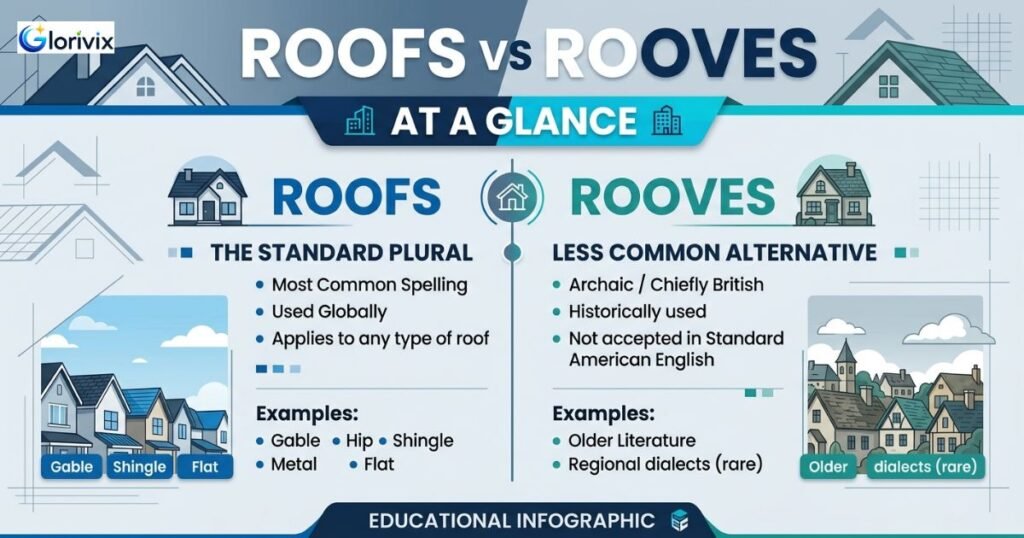
| Feature | Roofs | Rooves |
| Standard usage | Yes | No |
| Found in modern dictionaries | Yes, as primary form | Rarely, as secondary/archaic |
| Used in US English | Always | Never |
| Used in UK English | Always | Rarely, mostly historical |
| Recommended for writing | Yes | No |
| Grammatically valid today | Yes | Outdated |
Examples of “Roofs” in Everyday and Professional Use
Everyday sentences
- Snow piled up on the roofs of every house on the street.
- Several roofs in the neighborhood were damaged in the hailstorm.
- The kids love watching birds land on the roofs of the sheds.
Professional and construction-related examples
- The inspection found that three roofs needed immediate repair.
- Our company specializes in flat roofs for commercial buildings.
- The contract covers the replacement of all roofs on the property.
Common Mistakes to Avoid
Mistake #1: Writing “rooves” automatically
Because the -f to -ves pattern feels familiar, people sometimes type “rooves” without thinking twice. If you catch yourself doing this, a quick mental swap to “roofs” fixes it instantly.
Mistake #2: Assuming every -f word follows the same rule
English isn’t consistent here. Words like “chief” (chiefs), “belief” (beliefs), and “cliff” (cliffs) all stay in the -fs form, just like “roof.” Don’t assume one pattern applies to every word in this category.
Mistake #3: Mixing old and modern spelling in the same piece
If you’re writing something formal, stick with one standard throughout. Switching between “roofs” and “rooves” in the same document looks inconsistent and can distract readers or editors.
The Grammar Rule Behind Plural Nouns Ending in -f
English handles -f endings in three different ways, and there’s no single universal rule:
- Add -s only: roof → roofs, chief → chiefs, cliff → cliffs
- Change f to v and add -es: leaf → leaves, wolf → wolves, life → lives
- Either form is accepted: hoof → hoofs or hooves, scarf → scarfs or scarves
“Roof” falls firmly into the first category. Despite looking similar to words in category two, it never made the shift to -ves in modern usage, which is exactly why the confusion persists.
Words That Follow the Same Pattern
If “roofs” makes sense to you once you see it grouped correctly, these words follow the identical rule and stay in the -fs form:
- proof → proofs
- reef → reefs
- gulf → gulfs
- chef → chefs
- brief → briefs
Keeping a short mental list like this can help you avoid overcorrecting other -f words the way people overcorrect “roof.”
Which Spelling Should You Use Today?
Use roofs. There’s no scenario in modern writing, whether academic, professional, creative, or casual, where “rooves” is the better or more accurate choice. If you’re writing for an audience today, “roofs” is the spelling that matches reader expectations, style guides, and dictionary standards.
An Easy Way to Remember It
Here’s a simple trick: think of “roofs” like “proofs.” Both words end the same way, both stay in the -fs form, and neither one has a -ves version in modern English. If you can remember “proofs,” you can remember “roofs.”
Frequently Asked Questions
Is “rooves” a real word?
Yes, in the sense that it has historical use and appears in some dictionaries as a variant. But it’s not the standard or recommended spelling today.
Which is correct: roofs or rooves?
Roofs is correct in modern English. It’s the form used in dictionaries, style guides, and everyday writing across both American and British English.
Do British people say “rooves”?
Occasionally, in older texts or regional speech, but standard British English today uses “roofs” as the primary plural form.
Why doesn’t “roof” become “rooves” the way “leaf” becomes “leaves”?
English plural patterns for -f words aren’t consistent. “Roof” simply never followed the same shift that words like “leaf” and “wolf” did, and modern usage confirms “roofs” as the standard.
Can I use “rooves” in creative writing?
You can, especially for historical fiction or stylistic effect, but it will read as old-fashioned. For most creative writing aimed at modern readers, “roofs” is still the clearer choice.
Final Summary
The debate over roofs vs rooves comes down to one clear answer: “roofs” is correct in modern English, while “rooves” is an outdated variant that has mostly faded from use.
The confusion makes sense given how many other -f words shift to -ves, but “roof” was never one of them. Once you know the rule and see a few examples, choosing the right spelling becomes second nature.