
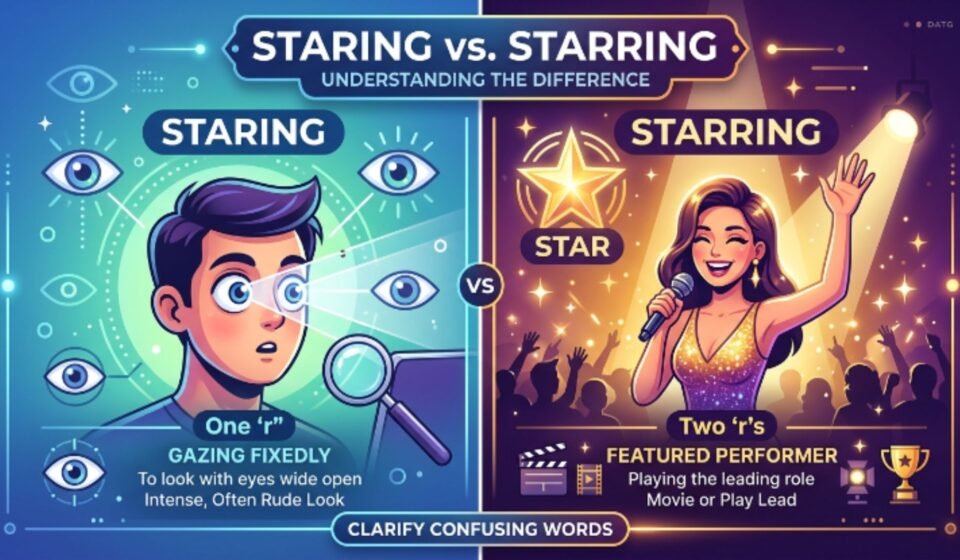

Ever typed “she’s starring at me” and then paused, wondering if that’s even a real sentence? You’re not alone. These two words look almost identical, sound almost identical, and yet they mean completely different things.
One word belongs on a movie poster. The other belongs in an awkward moment when someone won’t stop looking at you. Mixing them up is one of the most common word confusion mistakes in English, and it happens to native speakers too, not just learners.
Starring
Starring is the present form of the verb “star.” It means taking the lead role or main role in a movie, show, or play. Think Tom Cruise starring in an action film.
Staring
Staring is the present form of the verb “stare.” It means looking fixedly at something for a long time, often without blinking. Think of someone caught staring at their phone screen for hours.
Starring or Staring: Quick Answer ✅⚡
Short on time? Here’s the answer before we go any further.
✔ Main Difference:
Starring relates to acting and playing a main character in entertainment. Staring relates to looking closely at something with a fixed gaze. One is about performing, the other is about your eyes.
📌 Examples:
- Emma Stone is starring in the new Netflix film.
- He kept staring at the painting for ten minutes.
Starring or Staring: Definitions with Examples 📖✍️
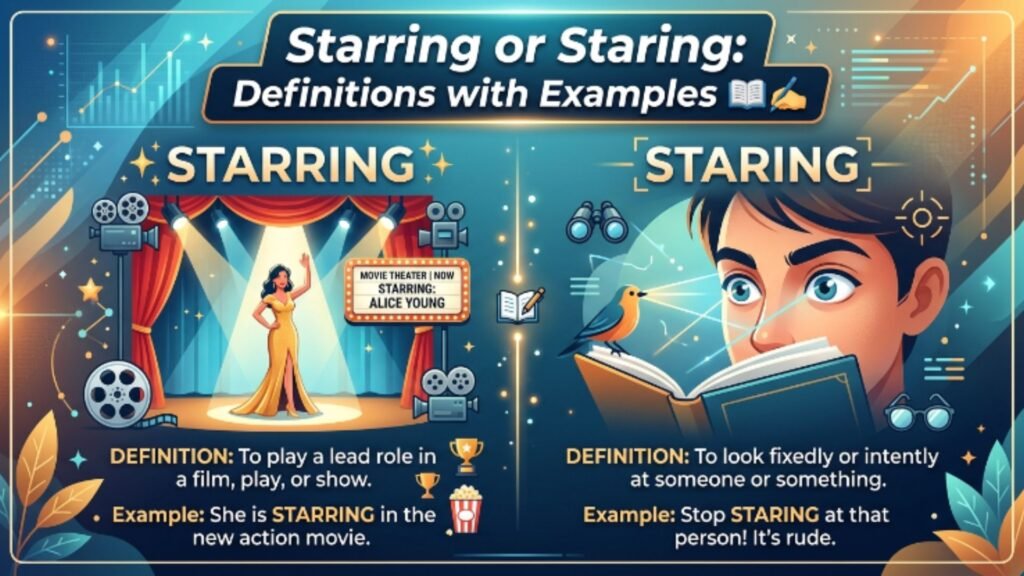
Let’s slow down and unpack both words properly, since a quick answer only gets you so far.
🟢 Starring (Definition)
Starring comes from the noun “star,” meaning a famous actor or performer. When someone is starring in something, they hold the leading role, not a small part. It’s the word you’ll see on posters, trailers, and streaming platform thumbnails.
📌 Examples:
- The trailer confirmed she’s starring as the lead detective.
- This TV series is starring two award-winning actors.
🔵 Staring (Definition)
Staring comes from “stare,” an old word tied to fixed eye contact and attention. It describes the act of looking at something for a long stretch, often with curiosity, confusion, or plain distraction.
📌 Examples:
- The kid was staring at the stars, lost in thought.
- Stop staring at the wall and get back to work.
🟡 Simple Meaning
If it’s about a movie role, it’s starring. If it’s about your eyes locked on something, it’s staring. That one line solves 90% of the confusion right there.
What Does “Starring” Mean in Movies and Films? 🎬
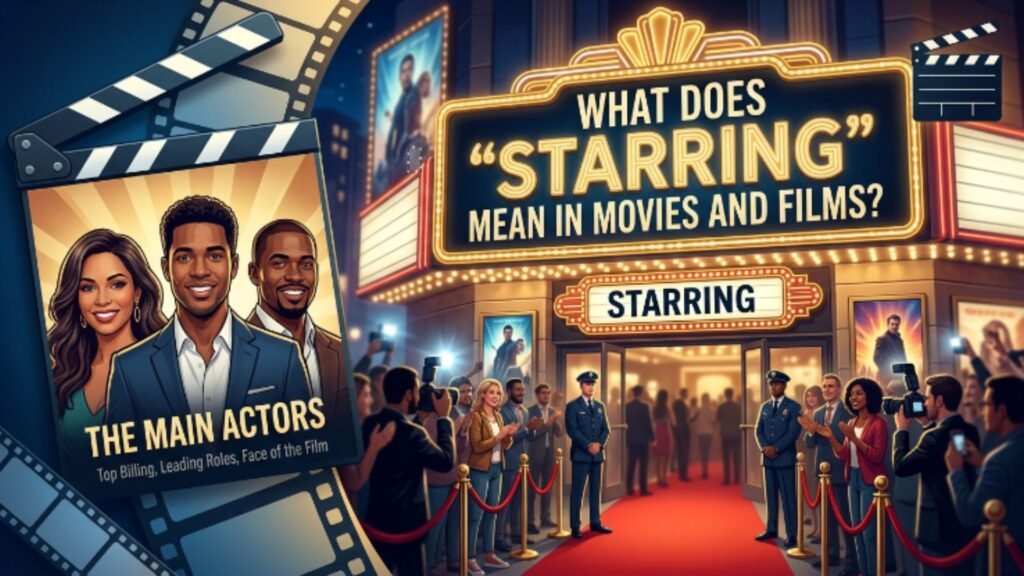
In entertainment English, starring is everywhere. Every movie poster, every trailer voiceover, every casting announcement leans on this word.
When a film’s description says “starring Tom Cruise,” that tells you Tom Cruise isn’t a background character. He’s the featured actor, the one carrying the story. Directors and studios use this word specifically to signal star power to audiences before they’ve even watched a single scene.
You’ll notice it on IMDb credits too, right under the film title, listing the main performer alongside a shorter roster of supporting names. That placement isn’t random. It tells casual viewers exactly who to expect front and center, which matters a lot when a studio is trying to sell tickets or streaming subscriptions.
Even award shows lean on this word constantly. Announcers describe nominees as “starring in” their breakout project, tying the verb directly to recognition and performance quality rather than just screen time.
The Origin of Starring or Staring 📜⏳
Word history explains a lot about why these two look so close but mean so little alike.
Starring:
This word traces back to “star,” used since the 1800s to describe a famous performer who shines above the rest of the cast, just like a star shines in the sky. Over time, “starring” became the standard verb for holding a lead role.
Staring:
Staring goes back much further, rooted in Old English “starian,” meaning to gaze fixedly. It’s one of those old, sturdy English verbs that barely changed meaning across centuries. People have been staring at things long before movies even existed.
What’s interesting is that these two words developed completely separately, with no shared root at all. They only started looking alike because English spelling settled on similar letter patterns for unrelated verbs, star plus ring on one side, stare plus ing on the other. That coincidence is really the entire reason this confusion exists today.
Starring or Staring: Usage Differences 🌍
Context decides everything here. Swap one word for the other and your sentence either sounds odd or means something totally different.
📊 Comparison Table:
| Feature | Starring | Staring |
| Root word | Star | Stare |
| Meaning | Acting, lead role | Looking fixedly |
| Used in | Movies, TV, plays | Daily conversation, writing |
| Common phrase | Starring in a film | Staring at something |
| Pronunciation | Similar, slightly shorter “a” | Similar, slightly longer “a” |
Which Word Should You Use? 🎯📝
Still unsure mid sentence? Here’s a fast way to decide.
✔ Use “Starring” When:
- Talking about a movie, film, TV show, or play
- Describing an actor’s main role
- Writing about casting, trailers, or entertainment news
✔ Use “Staring” When:
- Describing someone’s eyes fixed on an object
- Talking about attention, curiosity, or a fixed gaze
- Writing everyday sentences about looking at a screen, sky, or person
🧠 Easy Memory Trick
Star equals actor. Stare equals eyes. Star goes with acting, stare goes with your eyeballs staying put. Say that once and the confusion mostly disappears.
Common Mistakes with Starring or Staring ❌⚠️
Even confident writers slip up here. Here are the usual suspects.
1. Mixing Both Words
Writing “he is starring at me” instead of “he is staring at me” is the most frequent error, and it flips the meaning completely.
2. Wrong Context
Using “staring in a movie” instead of “starring in a movie” turns a casting sentence into nonsense.
3. Spelling Confusion
The double “r” matters. Starring has two R’s, staring has one. That tiny spelling difference changes the whole word.
4. Ignoring Meaning
Some writers just guess based on sound, since the pronunciation is so close. That’s exactly how mistakes slip through spell check.
Difference Between Staring and Starring 👀🎭
At its core, this comes down to two different verbs with two unrelated roots. Starring is about performance and recognition. Staring is about vision and focus.
One puts you on screen, the other keeps your eyes locked on something. They rhyme, they’re spelled almost the same, and that’s exactly why English learners and native speakers both trip over them.
Starring or Staring in Everyday Examples 💬📱
Seeing both words used across different situations makes the difference stick better than any rule ever could.
🏠 Daily Life
“My dog keeps staring at the fridge every time I open it.” That’s pure everyday looking, nothing to do with acting.
📱 Social Media
“Can’t stop staring at this sunset pic” versus “So excited, starring in my first short film!” Same platform, two completely different meanings.
📚 School
Teachers often say, “Stop staring out the window.” Students might write essays about a favorite actor “starring” in a classic film.
💼 Professional Use
A press release might read, “The campaign features an actor starring in three commercials.” Meanwhile, an HR note about screen time might mention employees “staring” at monitors too long.
Starring or Staring: Usage Trends & Popularity 📊📈
Search interest for both words spikes around award season and new movie releases, which makes sense given how often “starring” shows up in entertainment headlines.
📌 Trend Insight:
“Staring” tends to stay more consistent year round since it’s just part of everyday English. “Starring” spikes whenever a big film or TV series drops a trailer with a famous cast attached.
You’ll also see “starring” trend hard around Netflix release announcements, since streaming platforms plaster the word across thumbnails and social captions. Meanwhile, “staring” quietly holds steady in blogs, forums, and casual writing, popping up in phrases like “staring at my phone” or “staring at the ceiling,” neither of which has anything to do with entertainment.
Comparison Table 📋⚖️
| Category | Starring | Staring |
| Word type | Verb (acting) | Verb (looking) |
| Common setting | Movie, film, TV | Everyday life |
| Emotion tied to it | Excitement, recognition | Curiosity, distraction |
| Related word | Star, actor, lead role | Stare, gaze, eyes |
| Example sentence | “Starring in the new series” | “Staring at the screen” |
Common User Queries 🔍🔥
People searching this topic usually want quick, specific answers, so here’s what most readers are actually asking.
- Is it “staring at me” or “starring at me”? It’s staring at me, since this is about eye contact, not acting.
- What does starring mean in movies? It means holding the lead role or main character spot.
- Why do starring and staring sound so alike? Because they’re near homophones, differing by just one letter and a touch of pronunciation.
FAQs ❓💡
1. Are starring and staring the same?
No. They share similar spelling and similar pronunciation, but the meanings don’t overlap at all.
2. Which one means acting?
Starring is the one tied to acting, casting, and holding a leading role in entertainment.
3. Which one means looking?
Staring is the word for looking fixedly, whether at a person, a screen, or the sky.
4. Can they be used interchangeably?
Never. Swapping them changes the sentence’s meaning entirely and usually makes it confusing or incorrect.
5. Which is more common?
Staring shows up more often in daily conversation, while starring is common specifically in entertainment writing.
6. Easy way to remember?
Star equals performing, stare equals eyes. Keep that pairing in mind and you won’t mix them up again.
7. Is spelling important here?
Yes. The double “r” in starring is the only visual clue separating it from staring, so it genuinely matters.
Conclusion 🧾📌
So, starring or staring? Now you know it depends entirely on context. One belongs to Hollywood, the other belongs to your everyday habit of getting lost in a screen or a sunset.
Next time you write either word, pause for a second and ask yourself: is this about acting, or is this about looking? Get that answer right, and you’ll never confuse starring and staring again.
Got a sentence you’re still unsure about? Drop it in the comments and let’s figure it out together.