
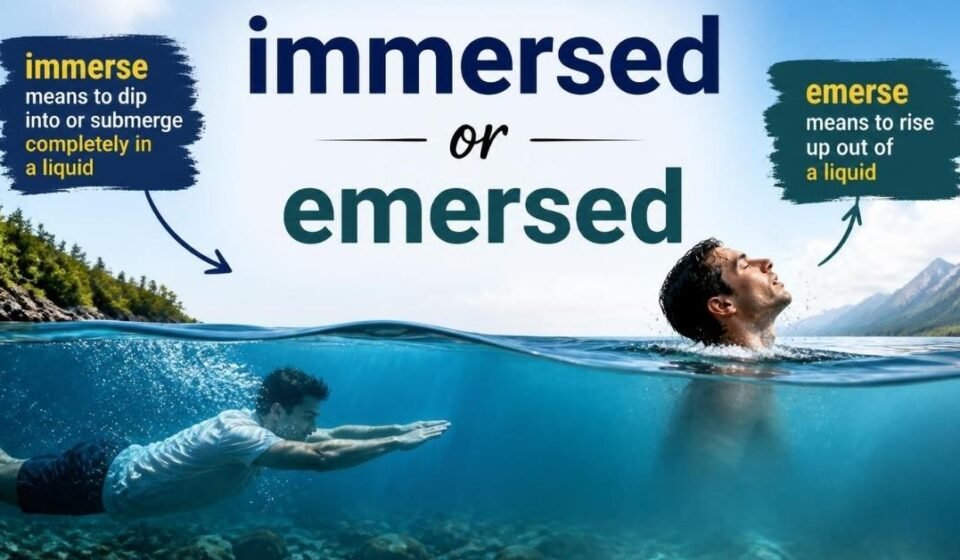

Ever read a sentence with “emersed” in it and thought it was a typo?You’re not alone. These two words look like twins, but they mean almost opposite things.
Get this wrong in a school paper, a work email, or a science report, and it can flip your whole meaning. Let’s clear it up for good.
Immersed

Immersed means fully covered or deeply involved in something. Think of a phone dropped in water, or a student immersed in studies.
It works both literally (into liquid) and figuratively (deep focus, emotional involvement). That’s why you’ll see it everywhere, from novels to office chat.
Emersed

Emersed is the rarer cousin. It means rising out of liquid, or something that’s now above the water surface.
You’ll mostly meet this one in biology and botany, describing emersed aquatic plants or emersed leaves poking out above a pond.
Immersed or Emersed: Quick Answer
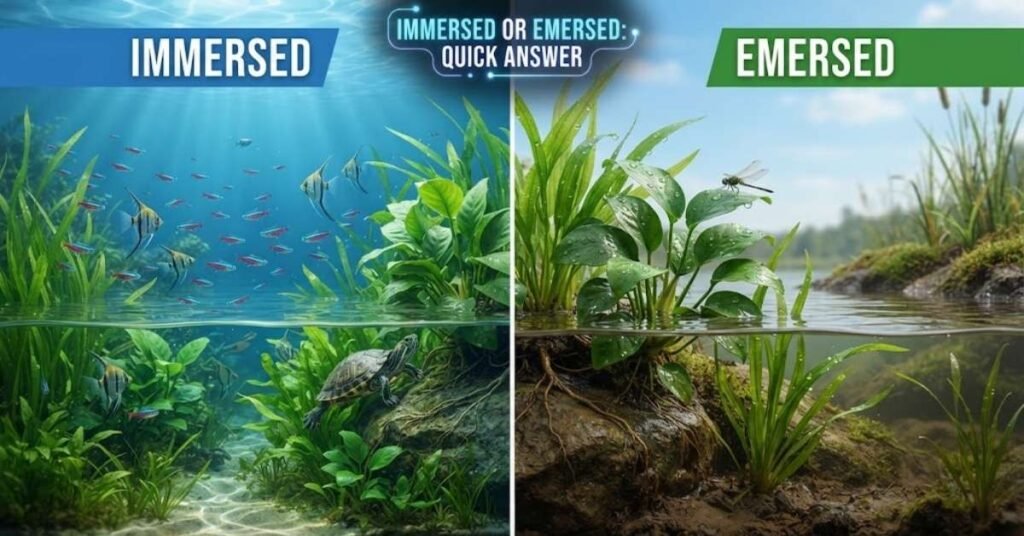
Short version: use immersed for almost everything. It covers being fully covered, deeply involved, or submerged.
Save emersed for science writing, where you’re talking about emersed vegetation, emersed roots, or something coming out of water.
If you’re not writing a botany report, immersed is very likely your word.
Examples
She was immersed in a novel for hours.
The emersed leaves of the plant caught the morning sun.
He stayed immersed in his work all weekend, barely noticing time pass.
The Origin of Immersed or Emersed
Both words trace back to Latin, and that’s exactly why they look alike. The shared root is mergere, meaning to dip or plunge.
What changes everything is the prefix. That tiny piece at the front decides the whole direction of meaning.
Origin of “Immersed”
Immersed comes from the Latin immergere. The prefix im means “into,” so the word literally means plunged into liquid.
Over time, English stretched this to cover mental and emotional states too, not just physical dipping.
Origin of “Emersed”
Emersed comes from emergere, where e or ex means “out of.” So it means coming out of liquid, the reverse of immersed.
This is the same root that gives us the word “emerge,” which explains a lot of the confusion.
Why the Spellings Look Similar
Both words share the Latin root “merge,” just with opposite prefixes. One prefix means into, the other means out of.
It’s a classic case of two words built from the same block, pointed in opposite directions.
British English vs American English Spelling
Here’s some good news. Immersed and emersed are spelled the same in British English and American English. No regional twist here.
The real difference isn’t spelling, it’s how often each word gets used, and in what setting.
Comparison Table
| Word | US English | UK English | Common Use |
| Immersed | Immersed | Immersed | Everyday, figurative, literal |
| Emersed | Emersed | Emersed | Scientific, botanical writing |
Which Spelling Should You Use?
This isn’t really a spelling debate. It’s a word choice question, and the answer depends on your audience and context.
Let’s break it down by who’s reading.
For US readers
American readers will recognize immersed instantly, in emails, articles, or casual chat. Emersed will read as unfamiliar unless you’re writing for a science crowd.
For UK or Commonwealth readers
Same story across the UK and Commonwealth. Immersed fits daily writing, while emersed stays inside academic or botanical contexts.
global audiences
No matter where your readers are, immersed is the safer, more widely understood choice. It works in emails, news writing, and social media without raising eyebrows.
Simple rule
Going into something? Use immersed. Coming out of water or liquid? That’s emersed. That one prefix trick solves it every time.
Common Mistakes with Immersed or Emersed
Even confident writers slip up here. These five mistakes come up again and again.
Mistake 1: Using emersed instead of immersed
Writing “I was emersed in the book” is wrong. You mean immersed, since you’re going into the story, not rising out of anything.
Mistake 2: Thinking both words mean the same
They’re not synonyms. One means fully covered or deeply involved, the other means rising out of water. Opposite directions entirely.
Mistake 3: Avoiding emersed entirely
Some writers just delete emersed to play safe. But in biology or environmental science, it’s the correct and precise term to use.
Mistake 4: Confusing with “emerged”
Emersed and emerged aren’t identical either. “Emerged” is a general verb for appearing, while emersed specifically describes something above a water line.
Mistake 5: Using immersed only literally
Immersed isn’t just about liquid. You can be immersed in culture, immersed in learning, or immersed in a game, no water required.
Immersed vs Emersed: Common Questions and Confusion Explained
Most confusion boils down to one thing: people rarely see emersed in daily life, so their brain autocorrects it to “immersed” or “emerged.”
Add the shared Latin root, and it’s easy to see why even careful writers second guess themselves.
The fix is remembering the prefix. Im means into, e or ex means out. That’s the whole trick.
Immersed or Emersed in Everyday Examples
Context changes everything here. Let’s look at where each word actually shows up.
Emails
In emails, you’ll almost always want immersed. “I’ve been immersed in meetings all week” reads naturally and professionally.
News writing
News writers lean on immersed for features about people deep in a project or cause. Emersed shows up rarely, usually in science reporting.
Social media
Social posts love immersed, as in immersed in a new series or immersed in celebrations. Casual, relatable, easy to understand.
Academic or formal writing
Academic and technical writing is where emersed finally gets its moment, especially in botany and environmental science papers.
Casual conversation
In daily speech, you’ll basically never hear emersed. Immersed carries the conversation, whether it’s about work, hobbies, or feelings.
Immersed or Emersed: Google Trends & Usage Data
Search behavior backs up everything above. People search for immersed far more often, across almost every region.
Popularity
Immersed has consistently high frequency in searches worldwide, while emersed stays a low frequency, niche term.
Regional interest
Interest in immersed spreads evenly across North America, Europe, and Australia. Emersed searches cluster around academic and scientific communities.
Scientific contexts
Within scientific contexts, emersed actually holds steady demand, especially from students and researchers studying aquatic plants.
Contextual usage
Outside science, emersed usage drops sharply. It’s a textbook case of a word staying alive only in its specialist lane.
Comparison Table: Keyword Variations Side by Side
| Term | Meaning | Typical Field |
| Immersed | Fully covered, deeply involved | Everyday, emotional, literal |
| Emersed | Rising out of liquid | Botany, biology, science |
| Immerse | Verb form of immersed | General usage |
| Emerse | Verb form of emersed | Rare, scientific |
| Immersion | State of being immersed | Education, tech, culture |
| Emersion | State of being emersed | Scientific writing |
| Emerged | Came out or appeared | General usage |
Spelling, Meaning, and Grammar of Immersed and Emersed
Let’s get technical for a second, but keep it simple.
Correct Spelling
Both words are spelled the same everywhere: immersed and emersed. Watch out for the common typo “emmersed,” which isn’t a real word.
Word Forms
The chains look like this: immerse to immersed to immersion. And emerse to emersed to emersion.
Meaning Breakdown
Immersed means covered, involved, or focused deeply. Emersed means visible above water, having risen out of liquid.
🔹 Common Grammar Questions
Both words work as past participles or adjectives. “The plant is emersed” and “she is immersed” follow the exact same grammar pattern.
🔹 Sentence Examples
The roots stayed emersed above the flooded field.
He remained immersed in his research for months straight.
Immersed and Emersed in Botany and Aquatic Science
This is where emersed truly earns its keep. Botanists use it constantly to describe emersed plants and emersed vegetation.
Think of a pond where some leaves float, some stay under, and others poke fully above the water surface. Those are your emersed leaves.
Scientists also track emersed coral and emersed rock as water level changes during low tide or seasonal flooding.
A Simple Memory Trick to Never Mix Them Up Again
Here’s a quick tip that sticks. Picture the letter i as an arrow pointing inward, like diving into water.
Now picture e as an arrow pointing outward, like something emerging or coming out. That single image solves the whole mix up instantly.
Conclusion
So, immersed or emersed, which one wins? For almost every situation you’ll write in, immersed is your word.
Save emersed for science writing about plants, roots, or anything rising above water. Remember the prefix trick, and you’ll never confuse them again.
FAQs
1. Are immersed and emersed synonyms?
No, they’re near opposites. Immersed means covered or involved, emersed means risen out of liquid.
2. Which word is more common?
Immersed is far more common, used daily in speech, writing, and social media.
3. Can emersed be used in normal conversation?
Technically yes, but it sounds unusual outside science or botany discussions.
4. Is emersed the same as emerged?
Not quite. Emerged is a general verb, while emersed specifically describes something above a water line.
5. Can immersed describe emotions?
Absolutely. You can be immersed in culture, immersed in music, or immersed in learning, no water needed.
6. Do British and American writers use different spellings?
No, both spell it immersed and emersed the same way. Usage frequency is the only real difference.
7. How can I remember the difference?
Think im for into, e for out. That prefix trick works every single time.

