
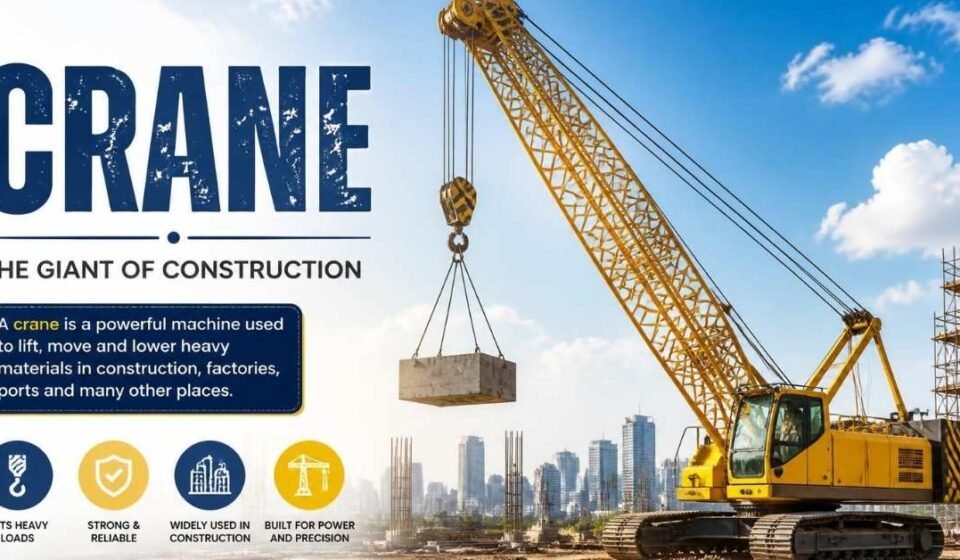

You’re typing a quick message about a building site, and your fingers write “crain.” Something looks off. So, is it crain or crane?Here’s the short answer. Crane is the correct spelling of the standard English word. Crain isn’t a dictionary word. It’s mostly a surname.
Stick around and you’ll get the meanings, the pronunciation, a few memory tricks, and the common mistakes that trip people up. By the end, you won’t second-guess this again.
Crain
Crain is a family name and, in a few cases, a place name. You’ll spot it on business cards, bylines, and mailboxes. It isn’t a common noun.
If you use it for a lifting machine or a bird, it counts as a misspelling. Spellcheck will flag it for good reason.
Crane
Crane is the standard English word. It’s a common noun that names both a heavy lifting machine and a tall bird.
It also works as a verb. You’ll see how later in this guide.
Crain or Crane: Quick Answer ✅

Think of it like this. One spelling belongs in dictionaries, and the other belongs on name tags.
So when you write about buildings, birds, or lifting, go with crane. Every time.
✔ Main Difference:
The difference comes down to correct usage. Crane is a real word with real meanings, while crain is a surname that people sometimes type by accident.
That’s the whole rule. Everything else in this article just backs it up.
📌 Examples:
- ✅ The crane lifted steel beams to the fifth floor.
- ✅ A crane stood in the shallow water at dawn.
- ✅ Mr. Crain called to confirm your appointment. (a name, so it works)
- ❌ The crain moved the containers. (incorrect usage)
What Does “Crane” Mean? 🏗️
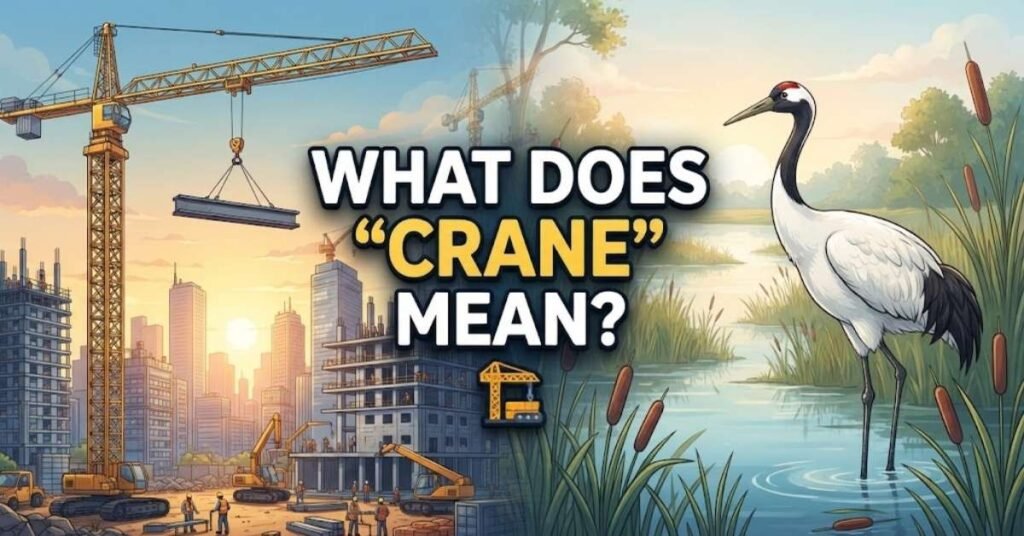
Crane carries two main meanings. One is a machine and the other is a bird. Context tells you which one the writer has in mind.
Let’s take them one at a time.
1. Crane (Machine) 🏗️
A construction crane is a piece of lifting equipment built to raise and move heavy objects. It hoists steel beams, concrete blocks, and shipping containers that no crew could budge by hand.
You’ll find a crane machine at almost every construction site. It’s the tall, patient giant that keeps the whole job moving.
📌 Examples:
- The crane operator swung the load left.
- We booked a crane through an equipment rental company.
- A crane towers over the new office block.
2. Crane (Bird) 🐦
The crane bird is a tall bird with a long neck and long legs. It’s a classic wetland bird, happiest wading through shallow water and marsh habitat.
Cranes are also known for their graceful movement. Their courtship dances look like slow, elegant ballet.
📌 Examples:
- A crane flew low over the lake.
- The crane raised its head and called loudly.
- Photographers waited hours to catch a crane at sunset.
What Does “Crain” Mean? 📖
Crain isn’t a common noun in English. You won’t find it in most dictionaries as a regular word. It works as a surname, and you may know it from the business publication brand Crain’s.
Many family names come from old nicknames, so Crain likely started as a variant of Crane. Someone tall and thin may have earned that label centuries ago.
📌 Example:
- “Dr. Crain will see you now.” (name usage, which is correct)
Crane vs Crain: Core Difference 📚⚖️
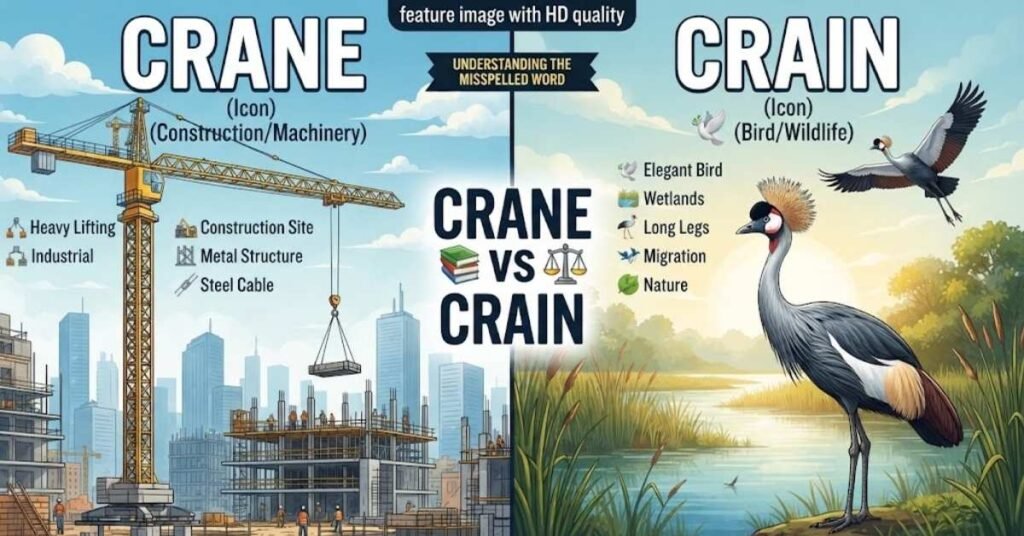
Once you see them side by side, the picture gets clear. One word carries meaning and the other carries a name.
Here’s the quick breakdown.
📊 Comparison Table:
| Feature | Crane | Crain |
| Word type | Common noun and verb | Surname |
| Dictionary status | Listed everywhere | Not a standard entry |
| Machine meaning | Yes | No |
| Bird meaning | Yes | No |
| Correct in general writing | Yes | Only as a name |
| Pronunciation | /kreɪn/ | /kreɪn/ |
Why People Confuse Crain and Crane 🧠⚠️
Nobody mixes these up because they’re careless. The confusion has real causes, and most of them are sneaky.
Here are the top three.
1. Similar Pronunciation
The two words sound identical, so this is a classic pronunciation difference that doesn’t exist. Your ear can’t help you, and that’s the problem.
When you hear the word, you have to guess the spelling. Many people guess the wrong E vs I spelling pattern.
2. Typing Errors
Fast typing causes plenty of writing errors. The letters E and I sit close to each other in your brain, even if not on the keyboard, so a letter replacement slips through easily.
Autocorrect doesn’t always catch it, especially when “Crain” is stored as a name in your contacts.
3. Exposure to the Surname “Crain”
You might know a Crain personally. Or you might’ve seen the name in a newspaper, a company, or a school.
Once your eyes get used to that family name, the spelling starts to feel normal. That’s how word confusion grows.
How to Pronounce Crane 🔊📖
Good news. Pronunciation is the easy part here. There’s only one way to say it.
You say it like the first part of “craning your neck.”
Pronunciation
The pronunciation is /kreɪn/. It rhymes with train, brain, and chain.
Accent differences may stretch or shorten the vowel a little. However, the sound similarity to crain stays complete in nearly every accent.
Crane in Construction 🏗️
Walk past any big construction project and you’ll see a crane working. Cities can’t grow skyscrapers without one.
Cranes are basically the muscle of the building industry. They do the industrial lifting that people and small tools can’t.
Types of Cranes:
Not all cranes look or work the same. Each type fits a specific job, so picking the right one matters.
Here are the three you’ll hear about most.
1. Tower Crane
A tower crane is the tall one that shapes the skyline over tall buildings. It stands on a fixed base and swings loads across the site.
You’ll see these on high rise jobs, where reach and height count the most.
2. Mobile Crane
A mobile crane rides on wheels or tracks. It drives to the job, sets up quickly, and leaves when the lift is done.
That flexibility makes it a favorite for equipment rental. Short projects don’t need a permanent giant.
3. Overhead Crane
An overhead crane runs along rails near a factory or warehouse ceiling. It’s a workhorse of material handling equipment in industrial usage.
Think of it moving steel lifting loads or heavy parts across a plant floor, without ever touching the ground.
Crane in Nature 🐦🌍
Now let’s swap the hard hats for binoculars. The crane bird is one of the most admired wildlife sights on the planet.
These birds fly long distances, so migration is a big part of their story. Migratory birds like cranes travel in loud, beautiful groups.
Famous Crane Species:
- Sarus Crane: It’s the tallest flying bird species and stands roughly as tall as a person. You’ll find it in parts of South Asia, Southeast Asia, and Australia.
- Sandhill crane: Huge flocks stop in places like Nebraska’s Platte River during spring. The sight and the noise are unforgettable.
- Whooping crane: This is one of North America’s tallest birds. Its numbers fell below 25 in the 1940s, so it became a symbol of conservation.
If you love sunset bird photography, cranes are a dream subject. Their silhouettes against orange skies look like paintings.
Crane in Everyday Examples 📱
You don’t need to work on a site or in a marsh to use this word. Crane pops up in normal life more than you’d think.
Let’s see where.
🏠 Daily Life
Ever tried the arcade crane machine, the one with the claw and the plush toys? That’s another use of the same word.
You might also fold an origami crane with your kids. It’s a popular craft and a symbol of hope in Japan.
📱 Social Media
Captions go fast, and typos go faster. You’ll see “crain” in posts about construction photos and bird pictures.
Take an extra second before posting. A quick check keeps your professional writing looking sharp, even on social.
📚 Educational Context
Teachers see this mix up in spelling tests and essays. It’s an easy one for students to miss.
If you’re learning English, use a dictionary to confirm. Good dictionary usage builds your vocabulary and confidence.
Common Mistakes with Crain and Crane ❌⚠️
Everyone slips sometimes. Knowing where the traps sit helps you dodge them.
Here are four common mistakes worth remembering.
1. Writing “Crain” Instead of “Crane”
This is the big one. It’s the classic misspelling.
It usually happens because the sound matches so well. Your brain writes what it hears.
2. Assuming Crain Is Standard English
Some people think crain is just a rare or old spelling. It isn’t.
In standard English, only crane works for the machine, the bird, and the verb.
3. Pronunciation-Based Spelling Errors
Pronunciation based spelling errors happen when you spell by ear. English doesn’t always play fair with that strategy.
Words like train, brain, and chain follow other patterns, so a sound never guarantees a spelling.
4. Forgetting Crane Has Multiple Meanings
Some writers only think of the machine or only the bird. Then they wonder if a different spelling applies to the other meaning.
It doesn’t. Crane covers both, so you can relax.
Memory Tricks to Remember Easily 🧠
You don’t need to memorize rules. A small trick works better than a long lecture.
Try one of these and pick your favorite.
👉 Trick 1: Crane Has an “E” Like Equipment
The word crane ends with an E. So does equipment.
If you’re talking about a machine, picture that E and you’ll get the correct spelling right away.
👉 Trick 2: Think of Construction
Picture a busy construction site with a tall yellow crane. Now picture the word on a sign next to it.
That image sticks. And it never shows up with an “I.”
👉 Trick 3: Crane Rhymes with Train
Crane rhymes with train, and both end in “ane.” Only one of them has an I inside, and it’s the train.
Keep the two “ane” endings paired in your head, and you’ll spell it right.
British vs American English Usage 🌍
Here’s a relief. You won’t need separate rules for each side of the Atlantic.
British English and American English both spell the word the same way.
📌 Key Point:
There’s no regional spelling twist here. International spelling stays the same for crane in all major forms of English.
Crain stays a surname in both places too.
📊 Comparison Table:
| Aspect | British English | American English |
| Machine spelling | Crane | Crane |
| Bird spelling | Crane | Crane |
| Crain as a word | Not standard | Not standard |
| Crain as a surname | Yes | Yes |
| Pronunciation | /kreɪn/ | /kreɪn/ |
History of the Word “Crane” 📜
The etymology of crane goes back a long way. It comes from Old English “cran,” which links to older words for the bird in several languages.
Many linguists think the name imitated the bird’s loud call. That makes it a very old word origin.
The machine sense came later, in the Middle Ages. People saw the lifting device’s long arm and thought of the bird’s crane neck.
That’s the name inspiration behind machine naming here. It’s a neat case of shape similarity and bird resemblance shaping our vocabulary.
Crane as a Verb and in Everyday Phrases 🗣️
Here’s a bonus most articles skip. Crane isn’t only a noun.
To “crane your neck” means to stretch and look over something. Picture a crowd trying to see a street performer.
You might also say someone “craned forward” to hear better. The crane neck image carries over nicely.
Notice that the spelling never changes. Crane is still crane, whether it’s a noun or a verb.
Quick Proofreading Checklist for Writers ✅
Want a simple routine to avoid this writing error? Use these steps before you hit send.
- Search your draft for “crain” and check each result.
- Confirm whether it’s a name or a mistake.
- Read the sentence out loud and picture the machine or bird.
- Check a trusted dictionary when in doubt.
It takes under a minute. And it saves you from a very avoidable typo.
Comparison Table 📋
Here’s the whole article in one glance. Save it or screenshot it if that helps.
| Question | Crane | Crain |
| Standard English word? | Yes | No |
| Means a lifting machine? | Yes | No |
| Means a bird? | Yes | No |
| Works as a verb? | Yes | No |
| Used as a surname? | Sometimes | Yes |
| Safe for general writing? | Yes | Only for names |
Common User Queries 🔍🔥
People ask the same things again and again. So here are quick, honest answers.
- Is crain or crane correct? Crane is correct for the machine and the bird.
- How to spell crane? C, R, A, N, E.
- Is Crain a word? Not in standard English. It’s a surname.
- What does crane mean? A lifting machine, a tall bird, or the act of stretching your neck.
- What is a construction crane? A machine that lifts heavy objects on a site.
- What kind of bird is a crane? A tall, long-legged wetland bird known for its migration.
- How to pronounce crane? /kreɪn/, like train.
- Why is the machine called a crane? Its long arm looks like the bird’s neck.
Conclusion 🧾
Let’s wrap it up. Crane is the right spelling for the machine, the bird, and the verb. Crain belongs to people’s names.Next time you doubt yourself, remember the E in equipment. That tiny trick clears things up fast.
Now it’s your turn. Which memory trick worked best for you? Drop it in the comments and share this guide with a friend who keeps typing “crain.”
FAQs 💡
1. Which spelling is correct in standard English?
Crane is correct. It’s the only version listed as a regular word in the English language.
2. Is crain wrong?
As a common word, yes. As a surname, no, because it’s a valid name.
3. Can crane mean a bird?
Yes. A crane is a tall, long neck bird found near wetlands around the world.
4. Can crane mean a machine?
Yes. It’s a construction crane or other lifting machinery that moves heavy loads.
5. Is Crain a last name?
Yes. Crain is a real family name, and some places and businesses carry it too.
6. Why do people confuse them?
The two sound identical. Add fast typing and familiarity with the surname, and mix ups happen easily.
7. Easy rule?
Use crane for anything you’d read in a dictionary. Use Crain only when you’re writing a person’s name.