


You’re filling out a course form at midnight. The cursor blinks over the word “enroll,” and suddenly you doubt yourself. Is that one L too many, or one too few?Here’s the short answer. Both spellings are correct. Enrol is the British spelling used across the UK and most Commonwealth countries, while enroll is the American spelling used in the United States.
The meaning, the pronunciation, and the job the word does stay exactly the same. Only the regional spelling changes, so your target audience decides which one you pick.
Enrol
Enrol is the single L version. British readers, UK English publishers, and British educational websites use it every day.
You’ll see it on forms in Australia, New Zealand, and South Africa too. It fits the wider British style of trimming extra letters.
Enroll
Enroll is the double L version, and it’s the standard in American English. American official documents, US colleges, and most American educational systems rely on it.
Canadians and Indians see it often as well, mostly through international educational platforms. It’s the version that shows up most on global software.
Enrol or Enroll – Quick Answer
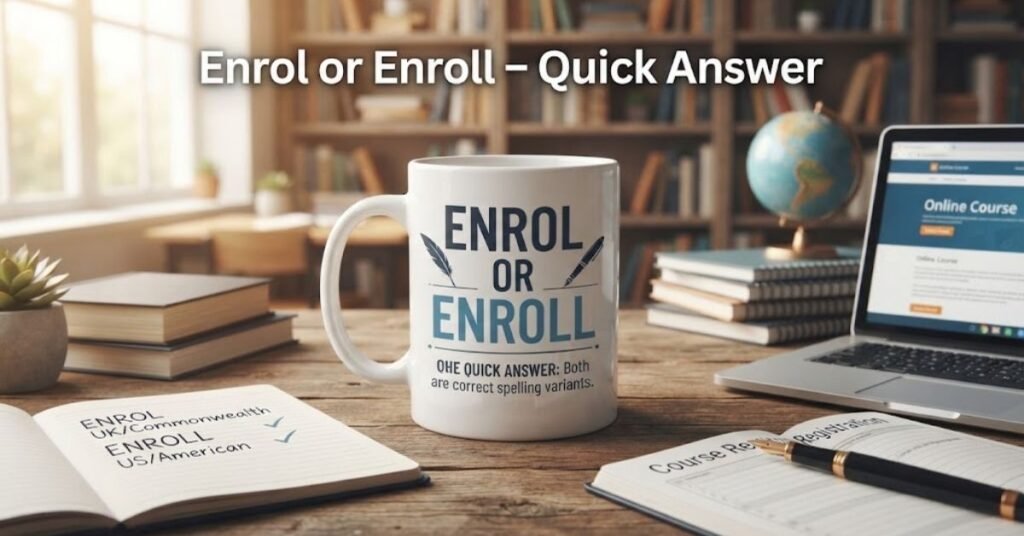
Use enrol for a UK, Australian, or New Zealand audience. Use enroll for a US audience. That’s the whole rule.
If your readers come from everywhere, choose one and stick with it. Consistency matters more than the letter count.
Examples:
- British: “You must enrol before the semester starts.”
- American: “You must enroll before the semester starts.”
- British noun: “Course enrolment closes on Friday.”
- American noun: “Student enrollment closes on Friday.”
Notice that only the spelling moves. The sentence works the same either way.
Enrol vs Enroll: Spelling Differences and Common Variations
The base word isn’t the only thing that changes. The noun forms split too. Enrolment takes one L in the middle in British English, while enrollment keeps both in American English.
Now the good news. Words like enrolled and enrolling use a double L in both varieties. Only the base verb and the noun differ.
You may also spot enroling and enroled online. Those are rare spelling variations, and most style guides treat them as outdated or wrong.
The Origin of Enrol or Enroll

The story starts in Old French. The word enroller meant to put a name on a list, and it came from rolle, a scroll of parchment.
That rolle traces back to Latin roots, where a small wheel or rolled document was called rotulus. Clerks literally wrote names on a roll. Soldiers, members, and later students all landed on those lists.
Later, English spelling reforms and dictionary makers pulled the two versions apart. American writers favored the double consonants in words like this, and British writers kept the traditional spelling with a single L.
British English vs American English Spelling

Think of this as two neighbors who agree on the meaning but label their mailboxes differently. Neither one is wrong.
British English
British English uses enrol as the verb and enrolment as the British English noun form. British publications and British official forms follow this pattern.
Inside a British writing context, “enroll” would look like an import. Most readers would still understand it, but a copy editor would flag it.
American English
American English uses enroll and enrollment. American writing rarely bends from this, especially in American official documents.
If you type “enrol” for a US school website, spellcheck will likely underline it. That’s a small red flag for readers.
Examples in Sentences
- UK: “She’ll enrol on the language course in September.”
- US: “She’ll enroll in the language course in September.”
- UK: “Three hundred enrollees joined the scheme.” (Enrollee is used more in US writing.)
- US: “The program has 300 enrollees this fall.”
Comparison Table
| Feature | British English | American English |
| Verb | Enrol | Enroll |
| Noun | Enrolment | Enrollment |
| Past tense | Enrolled | Enrolled |
| Present participle | Enrolling | Enrolling |
| Common in | UK, Australia, NZ, South Africa | United States |
Which Spelling Should You Use?
Ask one question first. Who’s reading this? The answer settles the debate faster than any dictionary.
For American Readers
Go with enroll and enrollment. A US university, college, or school district will use those spellings, so your page should match.
This also helps with search queries typed by American users. They type what they see on their own school portals.
For UK or Commonwealth Readers
Choose enrol and enrolment. UK English, Australian, and New Zealand readers expect the single L.
Canada sits in the middle. Many Canadian institutions lean toward enrol and enrolment, but American enroll shows up often. Check your target school or employer’s style.
For Global Audiences
Pick one regional style and apply it everywhere. Readers on international educational platforms forgive either spelling, but they notice a mix.
If you run a global blog, note your choice in your style guide. It saves your editors hours of guessing.
Common Mistakes with Enrol or Enroll
These slips are small, but they chip away at trust. Google’s quality raters and your readers both notice sloppy spelling errors.
1. Mixing Both Spellings in One Text
Writing “enrol” in paragraph one and “enroll” in paragraph five is the most common slip. It signals inconsistent spelling.
Fix it with a quick find and replace before you publish. Pick a side, then keep it.
2. Assuming One Version Is Wrong
Some writers mark the other spelling as a mistake. That’s not true, because each one is correct in its own region.
Correct someone only when they’ve broken the rule for their target audience.
3. Forgetting the Double “L” Rule
Here’s the trap. You write enrol and then add “-ed” to get “enroled.” The right form is enrolled, with a double L.
The same goes for enrolling. A quick rule: the base verb may have one L, but the verb forms keep two.
4. Using the Wrong Style for Official Documents
A UK school admission form that says “enroll” looks off. So does a US college application that says “enrol.”
Match the spelling to the official style of the country that issues the form.
5. Incorrect Verb Forms
Watch out for “enrols” versus “enrolls.” British English uses enrols for the third person. American English uses enrolls.
Also avoid “enrolment” as a verb. It’s a noun, so you can’t “enrolment in a course.”
Enrol or Enroll in Everyday Examples
Let’s see the word in real life. Different places call for slightly different tones.
Emails
- UK: “Hi Priya, you can enrol online before Friday.”
- US: “Hi Priya, you can enroll online before Friday.”
Keep the email warm and clear. Add the deadline so nobody has to reply asking.
News Headlines
- UK: “Record numbers enrol for evening classes.”
- US: “Record numbers enroll for evening classes.”
Headlines need speed. Most editors follow the publication’s house style without debate.
Social Media Posts
- “Enrol now and grab a spot in our weekend workshops!”
- “Enroll now and save your seat in our cooking class.”
Short and punchy works best on social. Use the spelling your followers use.
Formal Writing
- “Applicants must enrol by 1 March to access the training programs.”
- “Applicants must enroll by March 1 to receive program updates.”
Formal writing needs strict spelling consistency. One slip can undermine an otherwise polished report.
Enrol or Enroll – Google Trends & Usage Data
Search patterns follow geography. People in the United Kingdom, Australia, and New Zealand search for “enrol” far more, while people in the US search for “enroll.”
I won’t quote made up percentages here. For live numbers, open Google Trends, compare “enrol” and “enroll,” and filter by country. It takes about a minute.
You’ll usually see enroll ahead worldwide because of the size of the US audience. Regional filters flip that picture for the UK and Australia.
Keyword Comparison Table
| Keyword | Where it’s stronger | Typical intent |
| Enrol | UK, Australia, New Zealand | Course or online course registration |
| Enroll | US, often Canada and India | Student enrollment, benefits sign ups |
| Enrol vs enroll | Global | Spelling check |
| Enrolment | UK, Commonwealth | School and university admin |
| Enrollment | US | Health, school, program sign ups |
Enrol or Enroll in Different Countries and Usage Contexts
Australia uses enrol in schools and even for voting. The phrase “enrol to vote” is common there.
New Zealand and South Africa follow the same British style. India mixes both, because British English shaped its education system while US online educational platforms shape what students see on screen.
The United States sticks with enroll everywhere, from school admission to health plans. Wherever you write, ask what the local audience expectations are.
Enroll vs Register: Is There a Difference?
Not exactly, but the words have different flavors. To register is to record your name for something, like a vote or a domain.
To enroll means to officially join a course, program, or membership. Think of it as registering for a service with a longer commitment.
Enroll In or Enroll On: Which Preposition Fits?
American writers almost always say enroll in. British writers often prefer enrol on for a course and enrol in for a school.
Both are fine in context. If in doubt, “in” works nearly everywhere.
A Simple Memory Trick
Picture a coach writing names on a long roll of paper. British English trims the word to one L, and American English keeps the whole “roll.”
That image links the word back to its origin of enroll. It’s tiny, but it sticks.
Related Word Pairs Worth Bookmarking
If regional spelling puzzles you, other pairs work the same way. Resale vs Resell and Bear vs Bare are both worth a look.
Each pair has its own rule, so don’t assume one pattern covers them all.
Conclusion
Enrol and enroll mean the same thing. Choose enrol for British readers and enroll for American readers.For global audiences, pick one and maintain consistency. That habit shows care, and readers trust careful writers.
Which spelling do you use every day? Drop it in the comments and share this guide with a friend who’s filling out a form right now.
FAQs
1. Are enrol and enroll both correct?
Yes. Both spellings are correct and carry the same meaning.They just belong to different English varieties.
2. Which spelling is used in the UK?
The UK uses enrol and enrolment. Australia, New Zealand, and South Africa do the same.Canadian usage leans that way too, though it’s mixed.
3. Which spelling is common in the United States?
The US uses enroll and enrollment. American official documents and school sites follow it.Using “enrol” there may look like a typo.
4. Do they have different meanings?
No. The meaning, pronunciation, and usage are identical. The only gap is regional spelling.Both words mean to officially join a course or program.
5. Which spelling should students use?
Students should follow their school’s style guide. A UK student writes enrol, and a US student writes enroll.If no rule exists, check the spelling used on your school’s own website.
6. Is enrolment different from enrollment?
They’re the same noun in two regional spellings. Enrolment is British, and enrollment is American.Both refer to the act of joining or the number of people joined.
7. Can I use either spelling online?
Yes, but pick the one that matches your readers. Online communication with a mixed audience works with either, as long as you stay consistent.