
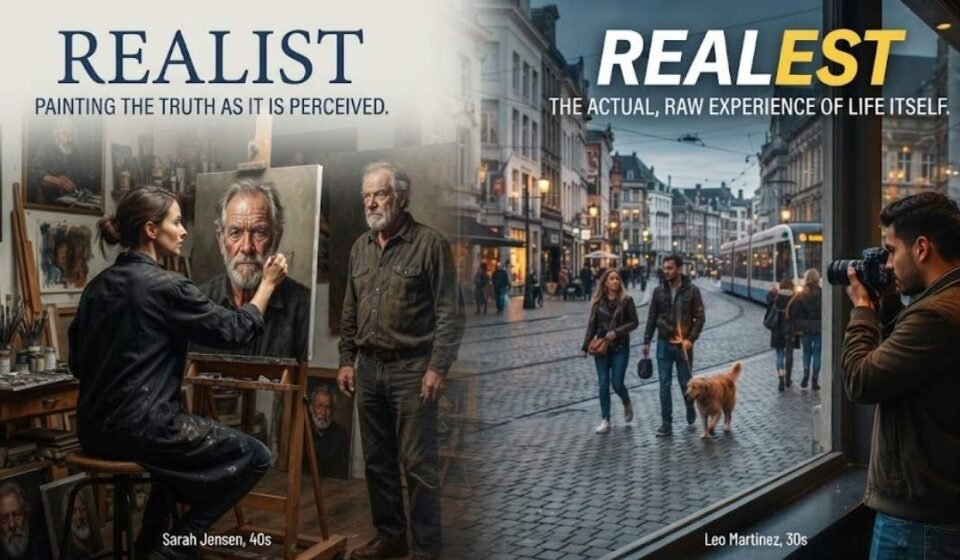

You’ve probably typed “realest” in a text and then paused. Is that even a word? And what about “realist”? Doesn’t that mean something totally different?You’re not alone. These two words look almost identical, but they carry different meanings, different grammar roles, and different vibes.
One is about authenticity. The other is about mindset.Let’s clear up the confusion once and for all.
Realest
Realest is the superlative form of “real.” It means the most genuine, most authentic, most honest version of something or someone. Think “the realest friend I know.”
Realist
Realist is a noun. It describes a person who sees the world as it actually is, not how they wish it were. A realist deals in facts, not wishful thinking.
Realest or Realist: Quick Answer ✅
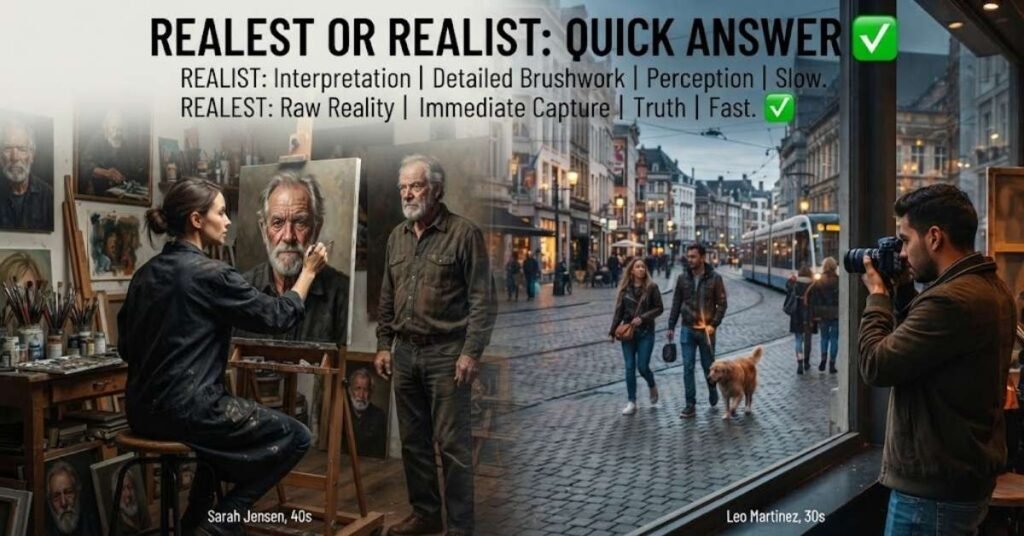
Use realest when you’re talking about how genuine or authentic someone is. Use realist when you’re describing a person’s practical, reality-based thinking.
They sound alike. They are not interchangeable.
Examples
- “She’s the realest person I’ve ever met.” (authenticity)
- “He’s such a realist, always focused on facts over feelings.” (personality type)
Quick Comparison
| Word | Part of Speech | Meaning |
| Realest | Adjective (superlative) | Most genuine or authentic |
| Realist | Noun | A practical, fact based thinker |
The Origin of Realest or Realist 📜

Both words trace back to the same root, but they took very different paths through the English language.
The Origin of “Real”
“Real” comes from the Latin word realis, meaning actual or relating to things that truly exist. It entered English through Old French centuries ago and has kept a simple job ever since: describing what’s genuine rather than fake.
The Origin of “Realest”
“Realest” is just “real” pushed to its superlative degree using the suffix -est. The same pattern gives us tallest, fastest, and strongest. It’s informal and mostly shows up in conversations, music lyrics, and social media.
The Origin of “Realist”
“Realist” uses the suffix -ist, which typically points to a person connected with a certain belief or practice. Think artist, scientist, journalist, or pianist. A realist is someone tied to realistic thinking and grounded, fact based views.
Why the Confusion Exists
Both words share the same root word, “real.” Both sound similar when spoken fast. That’s really the whole story behind the mix up. One word describes a quality. The other describes a person.
British English vs American English Usage 🌍
Good news here. This isn’t one of those words that changes spelling across the pond.
Realest and realist are spelled and used the same way in American English and British English. There’s no regional spelling twist to worry about, unlike words such as “color” versus “colour.”
Comparison Table
| Region | Realest | Realist |
| US English | Same spelling | Same spelling |
| UK English | Same spelling | Same spelling |
Examples
An American might text “you’re the realest,” and a Brit would say the exact same thing. A political realist in London and a political realist in New York mean the same thing too.
Which Word Should You Use? ✍️
This comes down to context. Are you praising someone’s character, or are you describing how they approach life?
Use Realest When You Mean:
- Someone is being completely honest and sincere
- A moment, apology, or conversation feels deeply authentic
- You want to praise a friend’s loyalty and trustworthy nature
Use Realist When Referring to a Person Who:
- Makes decisions based on facts, not fantasy
- Avoids unrealistic expectations and sticks to balanced thinking
- Approaches risk assessment and planning with a grounded mindset
Audience-Based Advice
If you’re writing captions or texting a friend, “realest” fits the casual, emotional tone. If you’re writing academic writing, business reports, or describing someone’s character, “realist” is the accurate, professional choice.
What Does “Realest” Mean? 💯
At its core, realest means the highest level of authenticity. It’s used to describe people, moments, or statements that feel completely true, with zero pretending involved.
Examples
- “That was the realest apology I’ve ever received.”
- “He gave me the realest advice when I needed it most.”
Common Contexts
You’ll spot “realest” most often in social media captions, podcasts, music lyrics, and everyday conversations among friends. It rarely shows up in formal English or academic writing because of its informal tone.
Common Expressions
Phrases like “keeping it real,” “stay real,” and “the realest version of yourself” all lean on this same idea. They celebrate genuine, unfiltered behavior over anything staged.
What Does “Realist” Mean? 🎯
A realist is someone who sees things clearly, without sugarcoating. They lean on reality-based thinking rather than idealism or dreams that ignore the facts.
Examples
- “As a realist, she planned for the worst case scenario.”
- “He’s a financial realist who never overspends on hope alone.”
In Literature and Art
Realism is also a major movement in literature and art, where writers and painters captured everyday life exactly as it looked, skipping the romantic exaggeration. A literary realist or social realist artist focuses on ordinary struggles, not fairy tale endings.
Characteristics of a Realist
- Values facts over emotions when making choices
- Sets goals based on what’s actually achievable
- Balances optimism with practical caution
Realest vs Realist: Key Differences 📊
| Feature | Realest | Realist |
| Word type | Adjective (superlative) | Noun |
| Describes | A quality or trait | A type of person |
| Common use | Casual, emotional | Formal, descriptive |
| Opposite | Fake, phony | Idealist, dreamer |
Realest or Realist in Example Sentences 💬
Context changes everything with these two words. Here’s how they show up across different situations.
About Friendship
“You’ve always been the realest friend, never afraid to tell me the truth.”
About Personality
“He’s a realist by nature, calm and grounded even under pressure.”
About Honesty
“That was the realest thing anyone has ever told me.”
About Decision-Making
“Being a realist, she chose the safer investment over the risky one.”
About Social Media
“This caption feels like the realest thing I’ve posted all year.”
Realest or Realist in Everyday Examples 💬
Beyond casual chats, both words pop up in professional and public settings too, just in different ways.
In Emails
Realist fits better here. “As a realist, I want to set achievable deadlines for this project.”
In Workplace Conversations
“Our manager is a realist who plans budgets around actual numbers, not guesses.”
In Friendships
“She’s the realest person in my group chat, always keeping it honest.”
In Business
Entrepreneurs often need to be realists when assessing market risks before launching a product.
On Social Media
Captions like “keeping it real” or “the realest energy today” use the informal, emotional tone of “realest.”
In News Articles
“The senator described himself as a political realist rather than an idealist on foreign policy.”
In Literature
Writers labeled as literary realists, like those in the Realism movement, focused on everyday truth over dramatic fiction.
Realest or Realist: Google Trends & Usage Data 📊
Search behavior tells its own story about how people actually use these words online.
“Realest”
Searches for “realest” spike mostly around music lyrics, motivational speeches, and social captions, since the word thrives in casual, emotional contexts.
“Realist”
“Realist” sees steadier, more consistent search volume tied to psychology, politics, and philosophy, since it’s a term used in more formal discussions.
Search Popularity by Context
| Context | More Searched Term |
| Music and captions | Realest |
| Politics and psychology | Realist |
| Business and planning | Realist |
| Friendship and loyalty | Realest |
Countries with High Search Interest
United States, United Kingdom, Canada, Australia, and India show the highest combined search interest for both terms, largely driven by English speaking social media users.
Common Mistakes with Realest or Realist ❌
These slip ups happen more often than you’d think, even among confident English speakers.
Mistake #1: Using “Realist” Instead of “Realest”
Writing “he’s the realist friend” when you meant “realest” changes the meaning entirely, turning a compliment into a confusing sentence.
Mistake #2: Using “Realest” for a Practical Thinker
Calling someone “the realest” when you actually mean they’re practical and grounded mixes up authenticity with realistic thinking.
Mistake #3: Assuming They’re Different Spellings of the Same Word
They share a root, but they are not variants of one another. One’s an adjective. One’s a noun.
Mistake #4: Confusing Grammar
Some writers try to use “realist” as an adjective, saying “that’s a realist choice.” The correct word choice here would be “realistic.”
Memory Tricks 🧠✨
A few mental shortcuts can lock this in for good.
Trick #1: “EST” Means Highest
Just like tallest and fastest, “realest” means the highest degree of something, in this case, being real.
Trick #2: “IST” Means Person
Just like artist and scientist, “realist” means a person, specifically one grounded in facts and reality-based thinking.
Trick #3: Friendship vs Personality
If you’re complimenting someone’s heart, go with realest. If you’re describing how their brain works, go with realist.
Realest vs Realist Comparison Table 📋
| Category | Realest | Realist |
| Grammar role | Superlative adjective | Noun |
| Tone | Casual, emotional | Neutral, factual |
| Best used in | Texts, captions, lyrics | Essays, business, news |
| Related to | Authenticity, honesty | Practicality, facts |
| Opposite term | Fake | Idealist |
Realest or Realist in Common Expressions 📝
Certain phrases have made these words part of everyday English vocabulary.
Expressions with Realest
“Keeping it real,” “the realest one in the room,” and “realest advice you’ll ever get” all highlight raw honesty.
Expressions with Realist
“Political realist,” “financial realist,” and “realist versus idealist” are common phrases in debates about leadership and decision-making.
Realist vs Idealist: The Bigger Picture
Since realist so often gets paired against idealist, it deserves its own quick spotlight. A realist works with what’s actually possible. An idealist chases what could be, even if it stretches beyond current facts.
Neither mindset is wrong. A good leader often blends both, using optimism to set direction and realistic thinking to get there without falling for unrealistic expectations.
How Psychology Explains the Realist Mindset
In psychology, being a realist isn’t about pessimism. It’s about processing information without emotional distortion, which helps with clearer risk assessment and better long term planning.
This mindset shows up in therapy conversations too, where balanced thinking is often the goal rather than pure optimism or pure doubt.
Common User Queries 🔍
People searching this topic usually want quick, clear answers to a handful of recurring questions.
- Is “realest” grammatically correct?
- What’s the difference between realest and realist?
- Can realist describe emotions instead of facts?
- Is realist always used for politics?
FAQs ❓
Is “realest” a real word?
Yes, it’s an informal superlative of “real,” widely accepted in casual English grammar, though it’s rarely used in formal English.
Is “realist” a real word?
Yes, it’s a standard noun found in dictionaries, describing someone with practical, fact focused views.
Which word means “most authentic”?
Realest is the word you want when describing something or someone as the most genuine or sincere.
Which word means “practical person”?
Realist describes a practical thinker, someone who bases decisions on facts rather than hopes.
Can I call my friend “the realest”?
Absolutely. It’s a common, friendly compliment that highlights loyalty and trustworthy behavior.
Is “realist” only used in politics?
No. While political realist is common, the term also applies to business, psychology, literature, and everyday personality descriptions.
What is the opposite of a realist?
An idealist is generally considered the opposite, someone who leans toward dreams, hopes, and fantasy over strict facts.
Conclusion 📌
Realest and realist might look like twins, but they play very different roles. One celebrates authenticity. The other describes a mindset built on facts and balanced thinking.
Next time you’re texting a friend or writing a report, you’ll know exactly which word fits. Keep it real, keep it fact based, and you’ll never mix these two up again.