
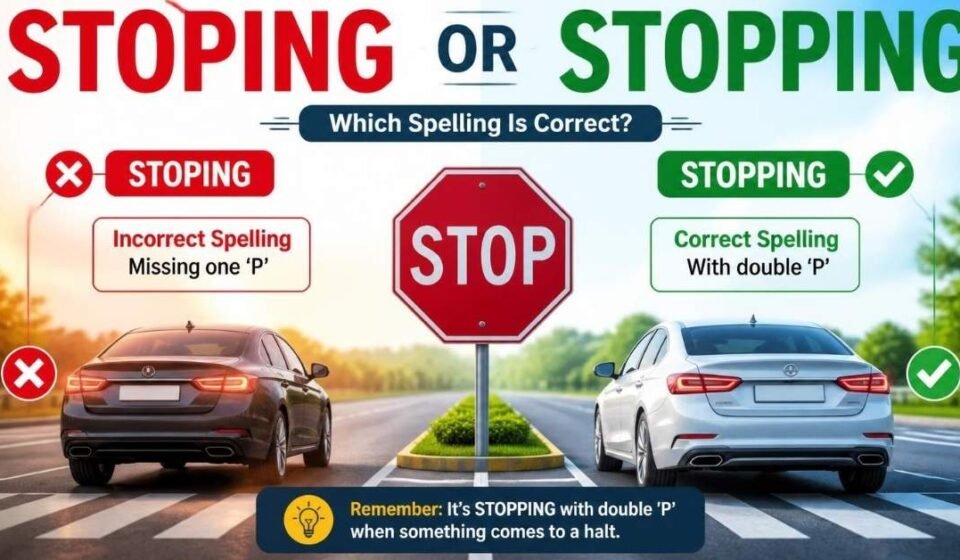

If you’ve ever paused mid-sentence and wondered which spelling to use, you’re not alone. This mix-up trips up more people than you’d think. The good news is the answer is pretty simple once you see the pattern.Stopping is the correct spelling for everyday English. It means bringing something to a halt, like stopping a car or stopping a habit.
Stoping, on the other hand, is a real word too, but it belongs to a very different world.You’ll only run into “stoping” in mining and geology. It describes the process of removing ore or rock from underground. So unless you work in a mine, you almost always want “stopping.”
The Origin of Stopping
The word “stop” has roots that go back centuries in English. It originally meant to plug or block something, like sealing a hole. Over time, the meaning shifted to include halting motion or action.
Adding -ing to “stop” creates the present participle, and that’s where the double “p” comes in. This isn’t random. It follows a spelling rule that’s been part of English grammar for a long time.
British English vs American English Spelling

Here’s some good news for once: this one doesn’t change across the pond. Both British English and American English spell it the same way. Unlike “colour” versus “color,” there’s no regional split here.
Whether you’re writing for a UK audience or a US one, “stopping” stays “stopping.” That consistency makes it a rare case in the world of English spelling differences. No need to switch your spellchecker settings for this one.
Which Spelling Should You Use?
Ask yourself one question: am I talking about halting something, or am I talking about mining? If it’s the first one, go with “stopping.” Nine hundred and ninety-nine times out of a thousand, that’s what you need.
Save “stoping” for technical contexts like geology reports or engineering documents. Using it anywhere else will just confuse your reader. When in doubt, “stopping” is almost always the safe bet.
🔹 How to Spell “Stopping” Correctly (Common Questions)
Why do we double the “p”?
This comes down to a classic English spelling rule. When a one-syllable verb ends in a single vowel followed by one consonant, you double that final consonant before adding -ing. “Stop” has a short vowel and ends in a single “p,” so it becomes “stopping,” not “stoping.”
Compare it to words like running or hopping. They follow the exact same pattern. Once you spot it, you’ll notice it everywhere.
What about “stopped”?
Same rule applies here. The past tense of “stop” doubles the “p” too, giving you “stopped.” Think “stop → stopped,” just like “hop → hopped.”
Common Mistakes with Stopping
Even confident writers slip up on this one sometimes. Here are the mistakes that show up most often:
- Writing “stoping” when you mean the everyday sense of halting something
- Forgetting to double the “p” and writing “stoping” or “stopeing” by accident
- Mixing up “stop,” “stopped,” and “stops” in the wrong tense
- Using “stoping” in casual writing where it just doesn’t belong
A quick proofread catches most of these before they go out the door.
Stopping in Everyday Examples
Language sticks better with real examples, so here are a few. In an email, you might write, “I’m stopping by the office at noon.” On a train platform, a sign might read, “This service is stopping at all stations.”
Drivers deal with it constantly too. “The car kept stopping and starting in traffic” is a sentence almost everyone’s said. Even a barista might mention, “We’re stopping the discount at the end of the month.”
Stopping: Google Trends & Usage Data
Search behavior tells its own story here. “Stopping” gets searched far more often than “stoping,” which makes sense given how common the word is in daily life. Most people typing “stoping” into Google are either misspelling “stopping” or specifically researching mining terminology.
This gap in search data matters for anyone writing online. If your content mixes up the two, readers searching for driving tips or grammar help might land on a mining article by mistake. Getting the spelling right keeps your content matched to the right audience.
Keyword Variations Comparison Table
| Search Variation | Correct Context | Common Use |
| Stopping | Everyday English | Halting an action or motion |
| Stoping | Mining and geology | Removing ore underground |
| Stopped | Past tense | Something already halted |
| Stops | Third-person singular | “The bus stops here” |
| Is it stopping or stoping | Search query | People checking spelling |
🔹 Stopping vs Stoping: Spelling Rules and Meaning
Correct usage:
“The nurse recommended stopping the medication slowly.” That’s everyday English, so “stopping” is correct. “The miners began stoping the ore vein at dawn” uses the mining sense correctly.
Key difference:
The difference isn’t just spelling, it’s meaning too. “Stopping” is about halting. “Stoping” is about extraction in a specialized field.
Common search variations explained:
People search “stopping or stoping meaning” when they’ve seen both spellings and aren’t sure which fits. Others search “stop or stopped which is correct” when they’re unsure about tense. Both questions usually come from writers double checking their grammar before hitting publish.
Related verb forms (important for clarity)
- Stop → the base form, as in “I need to stop”
- Stopping → present participle, as in “I am stopping”
- Stopped → past tense, as in “I stopped yesterday”
- Stops → third-person singular, as in “he stops”
Spelling It Right in Formal and Informal Writing
Formal writing, like reports or professional emails, has zero tolerance for spelling slips. A misspelled “stoping” in a business document can look careless, even if the meaning is still clear. Running a quick spellcheck before sending anything important is always worth the extra minute.
Informal writing, like texts or social media posts, is a bit more forgiving. Even so, getting it right builds trust with your reader. Clear writing, formal or not, always makes a better impression.
A Simple Memory Trick to Never Mix These Up Again
Here’s a trick that sticks: think of the double “p” in “stopping” as two hands slamming together to halt something. That visual pairs the double consonant with the meaning of stopping something suddenly. “Stoping” has just one “p,” which you can link to the single act of digging one tunnel underground.
Little tricks like this make spelling rules easier to remember long term. They also help English language learners who are still getting comfortable with consonant doubling. Once the trick clicks, you won’t second guess yourself again.
Conclusion
“Stopping” is the word you want for nearly every situation you’ll write about. “Stoping” only belongs in mining and geology, so keep it out of your everyday writing. Remember the double “p” rule, and you’ll spell it right every single time.
Got a spelling mix up you want cleared up? Drop a comment below and share this with a friend who might need it too.
FAQs
Is it stopping or stoping?
“Stopping” is correct for everyday English, while “stoping” is a mining term.
Why does “stopping” have two P’s?
Because “stop” ends in a single vowel plus consonant, so English spelling rules require doubling the final consonant before adding -ing.
What does “stoping” mean in mining?
It refers to the process of extracting ore or rock from an underground excavation.
Is “stoping” ever correct in regular writing?
Only if you’re specifically discussing mining or geology, otherwise “stopping” is what you need.
Do British and American English spell it differently?
No, both spell it “stopping,” making this one of the rare words without a regional split.