


You’re typing a report, an email, or a caption. You write “disfunction,” and something feels off.
Here’s the short answer: dysfunction is the correct spelling. “Disfunction” is a common spelling mistake, and editors will flag it in formal writing.
Disfunction
“Disfunction” is what happens when the dis- prefix sneaks into a word that never used it. It looks logical, which is exactly why so many people write it.
Spell checkers underline it in most apps. Some dictionaries list it as a rare variant, but it isn’t standard English.
Dysfunction
“Dysfunction” is the dictionary word you want. It means something isn’t working the way it should.
You can use it for a kidney, a family, a company, or a copy machine. Keep reading and you’ll see why the “y” matters.
Disfunction or Dysfunction: Quick Answer ⚡
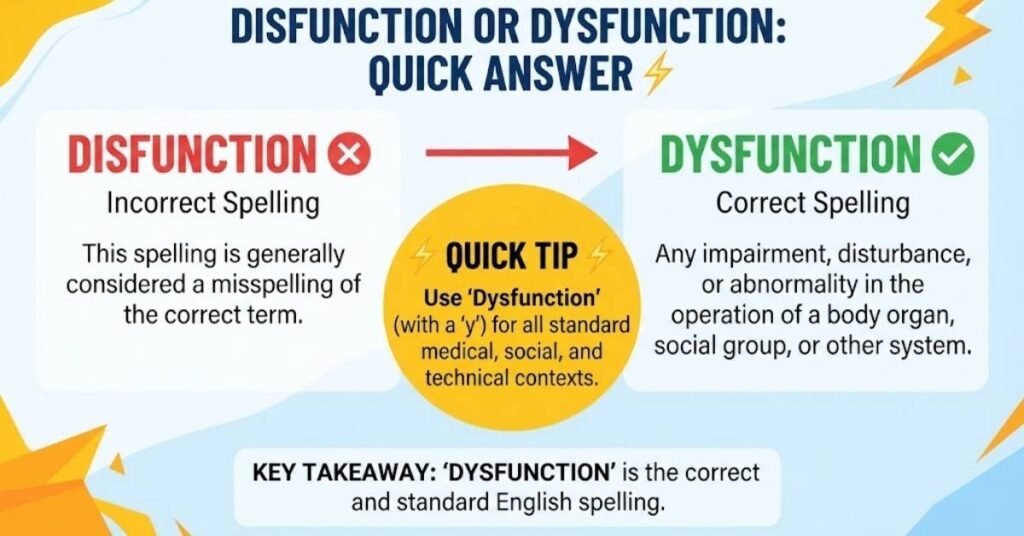
Use dysfunction, every time. That’s the answer to how to spell dysfunction and the one you can trust in school, at work, and online.
Think of it like “definitely” versus “definately.” One version passes the test, and the other gets a red line.
✔ Main Difference:
The difference comes down to the prefix. Dys- signals something bad, hard, or faulty, while dis- usually means “not” or “apart.”
Since the word describes faulty operation, dys- fits. The word “disfunction” would suggest “no function,” which isn’t the same idea.
📌 Examples:
- Correct: The company’s workplace dysfunction slowed every project.
- Incorrect: The company’s workplace disfunction slowed every project.
- Correct: Doctors tested her for kidney dysfunction.
- Incorrect: Doctors tested her for kidney disfunction.
What Does “Dysfunction” Mean? ⚠️📖
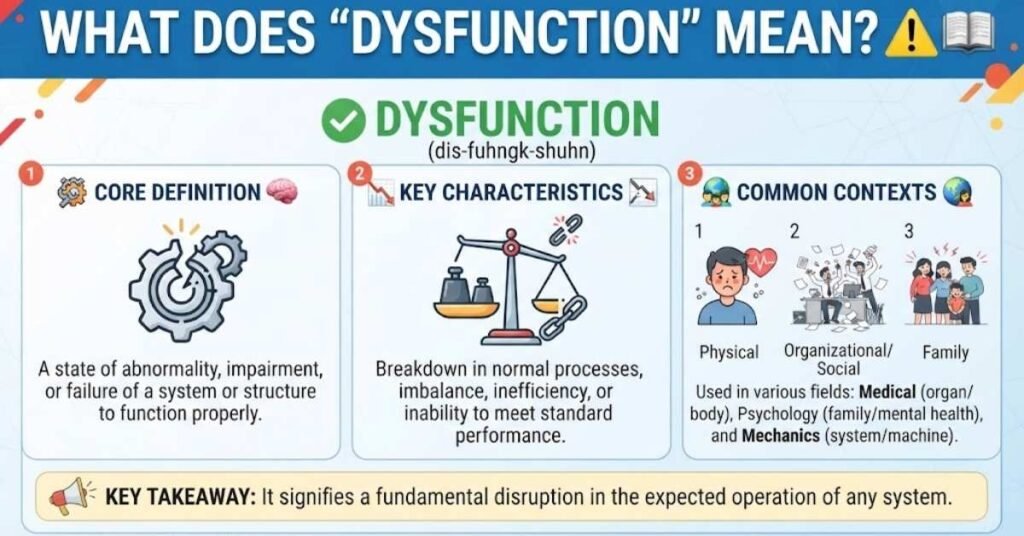
The dysfunction meaning is simple: abnormal function or impaired function. Something still exists, but it doesn’t do its job well.
A good dysfunction definition also covers failure to work correctly. It can describe poor operation in a body, a group, or a machine.
Picture a car that starts but stalls at every red light. It isn’t dead, yet it isn’t reliable either. That’s dysfunction in one image.
📌 Examples:
- A thyroid that produces too little hormone shows biological function problems.
- A team that never shares updates suffers from poor communication.
- A printer that jams every third page has machine dysfunction.
Why “Disfunction” Is Incorrect ❌⚠️
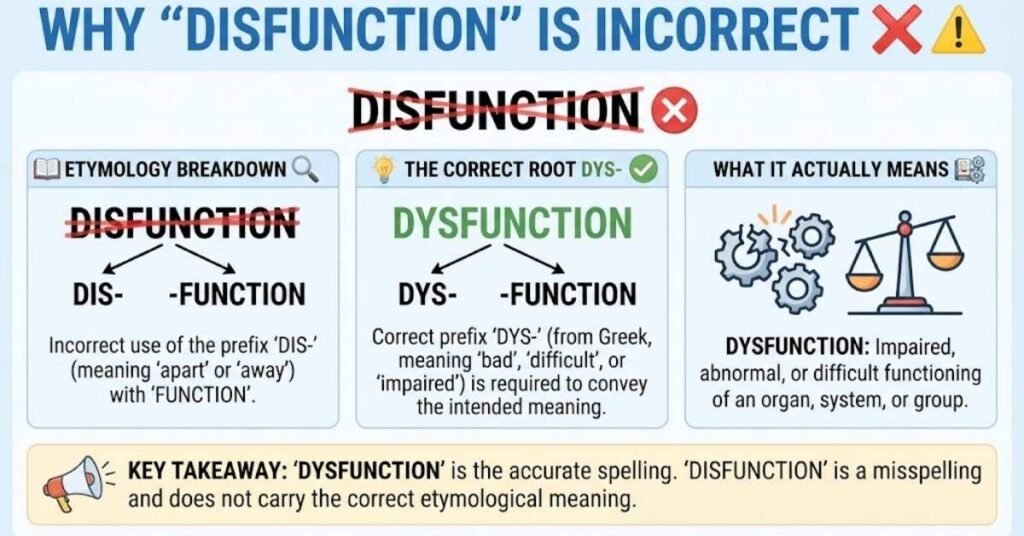
Let’s be honest. Nobody sets out to break English spelling rules. The mistake happens because “dis-” is everywhere, in words like “disagree,” “dislike,” and “disappear.”
Your brain sees a familiar pattern and fills it in. That’s the whole story behind this spelling confusion.
Still, “dysfunction” comes from a different source. The Greek prefix “dys-” was borrowed into English long ago, and the spelling structure stuck.
One quick check helps. Search a trusted dictionary and you’ll find the entry under “dysfunction.” That’s your proof.
What Does the Prefix “Dys-” Mean? 🧠
Dys- comes from Greek, and it carries the sense of “bad,” “difficult,” or “faulty.” This is the prefix meaning doctors and scientists lean on.
It shows up in scientific terms because it names problems quickly. Say “dys-” and everyone hears trouble.
Meanwhile, dis- comes from Latin. It usually means “apart,” “not,” or “the opposite of.” Two prefixes, two histories, two jobs.
Examples of “Dys-” Words:
- Dyslexia: trouble with reading
- Dysgraphia: trouble with handwriting
- Dysplasia: abnormal growth of cells or tissue
- Dyspepsia: poor digestion
- Dysphagia: difficulty swallowing
Notice the pattern? Every one of them points to something hard or faulty. That’s the word formation logic behind dys + function.
Dysfunction in Medical Contexts 🏥
In medical terminology, dysfunction describes an organ or system that isn’t doing its normal work. Doctors use it because it’s precise and neutral.
The word covers a wide range of health conditions. It can point to body system problems without naming a specific disease.
Say a friend gets blood work back with strange numbers. The doctor mentions “mild liver dysfunction,” which just means the liver isn’t performing at full strength. It’s a flag to investigate, not a final diagnosis.
📌 Examples:
- Organ dysfunction describes several organs struggling at once.
- Kidney dysfunction means the kidneys don’t filter waste well.
- Liver dysfunction points to trouble processing toxins or fats.
- Neurological dysfunction affects how nerves and the brain send signals.
- Brain dysfunction can show up as memory problems or confusion.
Dysfunction in Psychology and Relationships 💬🧠
Psychological usage stretches the word beyond the body. It describes patterns that keep people stuck, stressed, or disconnected.
Emotional dysfunction usually involves emotional instability, like mood swings that hurt daily life. It doesn’t label a person, only a pattern.
You’ll also hear it in sociology. Researchers use it for social interaction patterns that break down trust or cooperation.
📌 Examples:
- Family dysfunction often includes unhealthy behavior patterns, such as constant blame or silence.
- Relationship problems grow when partners avoid honest talks.
- Communication issues can turn small disagreements into weeks of tension.
- Social dysfunction might look like avoiding every group event.
Dysfunction vs Disfunction: Core Difference 📚⚖️
Here’s a clean way to see it. Dysfunction vs disfunction isn’t a debate between two valid choices. It’s a word comparison between one standard term and one error.
If you need the difference between dysfunction and disfunction, remember that only one earns a place in serious writing. The other belongs on the “fix it later” list.
📊 Comparison Table:
| Feature | Dysfunction | Disfunction |
| Status | Correct spelling | Incorrect spelling |
| Prefix | Dys- (Greek) | Dis- (Latin) |
| Dictionary acceptance | Standard entry | Rare variant at best |
| Formal writing | Safe | Risky |
| Meaning | Impaired function | Not an established meaning |
Why People Misspell Dysfunction 🧠
Misspelling this word is normal. Even confident writers slip, especially when typing fast.
Three habits cause most of the trouble. Once you spot them, you can dodge them.
1. Confusion with “Dis-” Prefix
The dis- prefix is far more common in everyday English. Your brain chooses the familiar option without asking.
2. Pronunciation Similarity
Both spellings sound identical out loud. That’s the classic trap for language learners, since your ears can’t tell which letter to write.
3. Typing Errors
Sometimes it’s just speed. Typing errors happen when your fingers race ahead, and autocorrect doesn’t always catch this one.
How to Pronounce Dysfunction 🔊📖
The dysfunction pronunciation is easy once you break it into chunks. Say it slowly, then speed up.
Think of it as three parts, with the stress on the middle one. This pronunciation guide keeps it simple.
Pronunciation
dis-FUNK-shun
That’s the same sound for “dis” as in “disagree.” Which explains why the wrong spelling feels so natural.
Different Types of Dysfunction 📋
The word travels across many fields. Here’s how it looks in four common areas.
1. Physical Dysfunction
This covers the body, like a stiff joint, a weak organ, or slow nerve signals. It’s the version you’ll see most in clinics.
2. Emotional Dysfunction
This describes struggles with managing feelings. Someone might react to small problems with big outbursts, or shut down completely.
3. Social Dysfunction
This one shows up when people can’t connect in healthy ways. Think of a friend group where nobody says what they really feel.
4. Organizational Dysfunction
Companies suffer too. Organizational dysfunction hurts company productivity, wastes time, and drains morale.
A manager who changes priorities daily is a classic cause. So is a team where nobody owns the final decision.
Dysfunction in Everyday Examples 💬
You don’t need a medical degree to use this word. It fits into normal conversation, and that’s part of everyday usage.
The examples below show how it changes with the setting.
🏠 Daily Life
“Our Wi-Fi has been a dysfunction machine all week.” Casual, a bit playful, and clearly understood.
📱 Social Media
Scroll through social media discussions and you’ll spot the word in threads about family drama and toxic group chats. People use it as shorthand for “this isn’t working.”
📚 Academic Writing
In academic writing, the word needs backup. Say what’s failing and why, like “Data shows sleep loss causes attention dysfunction.”
💼 Workplace Usage
Workplace communication is a big one. A line like “Unclear roles created constant dysfunction” makes the point fast.
Common Mistakes with Dysfunction ❌⚠️
Most errors are small, but they add up. A single typo can dent your credibility in a report or a job application.
Watch out for these four.
1. Writing “Disfunction”
It’s the number one slip. Read your draft once, and search for “disf” to catch stragglers.
2. Forgetting the “Dys-” Prefix
Some writers drop it completely and write “function problem.” That works in casual chat, but it’s vague in formal pieces.
3. Assuming Pronunciation Matches Spelling
English rarely plays fair. If you hear “dis,” don’t assume you should write “dis.”
4. Using Dysfunction Only for Health
Many people think the word belongs to hospitals. In truth, it also fits mechanical dysfunction, system dysfunction, and team problems.
Memory Tricks to Remember Easily ✨
Rules are fine, but tricks stick better. Here are three that work.
👉 Trick 1: Think “Dyslexia”
If you can spell dyslexia, you can spell dysfunction. Both start with “dys” and both point to something that doesn’t work smoothly.
👉 Trick 2: Dysfunction = Difficult Function
“Dys” means difficult or bad. So dysfunction is just a function that struggles.
👉 Trick 3: Medical Vocabulary Uses “Dys-“
Remember that medical vocabulary loves this prefix. Dysplasia, dysphagia, dyspepsia: the “y” always shows up.
British vs American English Usage 🌍
Good news: there’s no split here. Both varieties spell it dysfunction.
That’s rare in English, where color and colour, or center and centre, cause endless debates.
📌 Key Point:
Regional spelling differences don’t apply to this word. If you’re writing for readers in London, New York, or Karachi, use the same form.
📊 Comparison Table:
| Region | Spelling | Accepted? |
| American English | Dysfunction | Yes |
| British English | Dysfunction | Yes |
| Either variety | Disfunction | No |
History of the Word “Dysfunction” ⏳
The history of dysfunction starts with Greek “dys” and Latin “functio,” which means performance or execution. English writers joined them, which is why we call it one of many Latin adaptations built on a Greek origin.
Medical writers picked it up first in the early 1900s. Later, psychologists and sociologists adopted it to describe families and groups.
Today the word has spread well beyond medicine. That’s normal, since useful words tend to travel.
Comparison Table ⚖️
Here’s a quick summary you can screenshot.
| Point | Dysfunction | Disfunction |
| Correct spelling | ✔ | ✘ |
| Prefix | Dys- | Dis- |
| Used in medicine | Yes | No |
| Used in psychology | Yes | No |
| Safe for academic writing | Yes | No |
Common User Queries 🔥
People search this topic a lot, and their questions are pretty consistent. Here are the top ones, answered fast.
- How to spell dysfunction? D-Y-S-F-U-N-C-T-I-O-N.
- Is disfunction a word? It shows up as a rare variant in some places, but it isn’t standard.
- Family dysfunction meaning? It describes a household where unhealthy patterns block healthy connection.
- Organ dysfunction meaning? It means one or more organs aren’t working normally.
Got another question? Drop it in the comments, and I’ll add it here.
Conclusion 🧾
Dysfunction wins, and it isn’t close. The dys- prefix carries the idea of trouble, and that’s exactly what the word describes.
Next time your fingers type “disfunction,” you’ll catch it. Share this with a friend who keeps making the mistake, and tell me which memory trick worked for you.
FAQs ❓
1. Which spelling is correct?
Dysfunction is correct. It’s the form found in standard dictionaries and used by doctors, teachers, and editors.
2. Is disfunction wrong?
Yes, in standard usage. A few dictionaries note it as a rare variant, but you shouldn’t use it in formal writing.
3. What does dysfunction mean?
It means abnormal function or poor operation. It can describe a body, a relationship, a workplace, or a machine.
4. Does dysfunction only apply to medicine?
No. It also fits psychology, sociology, business, and technology.
5. Why does it use “dys-“?
Because the Greek prefix means “bad” or “difficult.” That matches the idea of something not working right.
6. Is dysfunction used in psychology?
Yes. Psychologists use it for emotional dysfunction, family patterns, and behavior that disrupts daily life.
7. Easy rule?
If it’s about trouble working, start with “dys.” Think dyslexia, and you’ll never miss.