


You’re packing for a mountain trip and typing a quick message. Do you write “I need new skiis” or “I need new skis”? That tiny pause is more common than you’d think.
The short answer: skis is the only correct plural of ski. Skiis is a common misspelling, and you won’t find it in any dictionary.
Skiis
Skiis is what happens when the brain adds an extra “i” to a word that already ends in a vowel. It looks plausible, but it breaks basic English plural rules.
You’ll spot it in rushed captions, search boxes, and casual chats. It’s a spelling mistake, not a regional variant.
Skis
Skis is the standard English spelling everywhere. You take the singular noun “ski” and add a plain “s.”
That’s the whole trick. The rest of this guide explains why it works and how to never second-guess it again.
Skiis or Skis: Quick Answer ✅
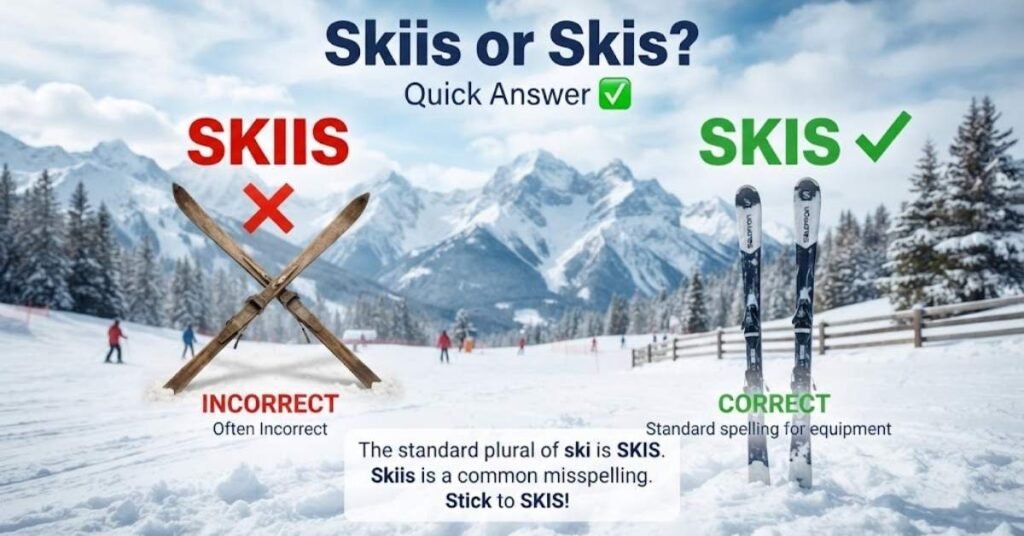
Write skis. Every major dictionary lists it, and every ski shop, magazine, and ski resort sign uses it.
If you type skiis, most spell checkers will underline it in red right away. That’s your cue to delete the extra letter.
✔ Main Difference:
The difference is one letter. Skis follows the basic plural rules, while skiis adds an “i” that has no job to do.
Think of it like this: one letter changes, and the word goes from correct spelling to incorrect spelling.
📌 Examples:
Correct: “She packed two pairs of skis for the ski trip.” Incorrect: “She packed two pairs of skiis for the trip.”
Correct: “His skis are lightweight and easy to carry.” Incorrect: “His skiis are lightweight and easy to carry.”
What Does “Ski” Mean? 🎿
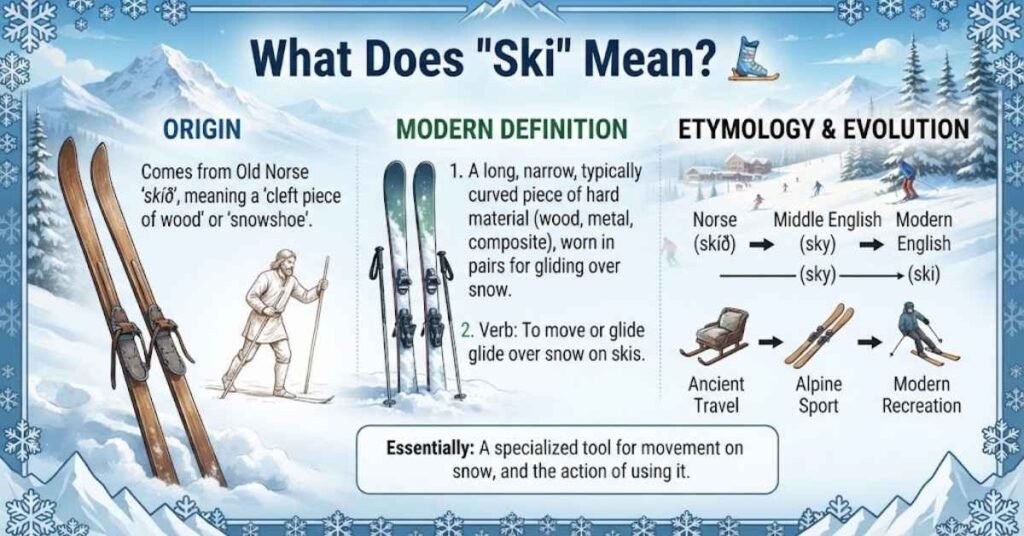
A ski is a long, narrow strip you strap to your boot so you can glide over snow. It’s also a verb, as in “I ski every winter season.”
So the word plays two roles. It can be a noun (the gear) or an action (the sport of skiing).
📌 Examples:
“He lost one ski on the downhill run.” Here it’s a singular noun for a single piece of gear.
“They ski every weekend in January.” Here it’s a verb, and no plural is involved at all.
What Does “Skis” Mean? 🎿
Skis means more than one ski. In practice, most people mean a matched pair, since you rarely use just one.
It can also work as a verb form for a single person: “She skis like a pro.” Same spelling, different job.
📌 Examples:
“Those skis are built for powder.” That’s the plural noun in action.
“He skis before work on Fridays.” That’s the verb for one person, third person singular.
Why “Skiis” Is Incorrect ❌⚠️
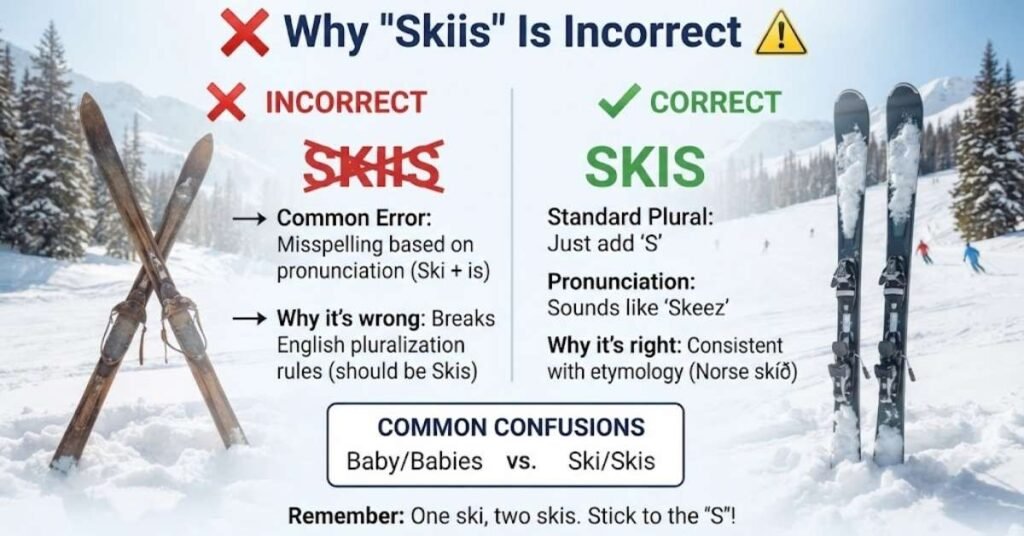
English handles most plurals with one simple move: add “s.” Ski already ends in a vowel, and nothing in the spelling rules asks you to double it or add another.
Skiis also creates an odd cluster of three vowel sounds in writing. It looks like a typo because it is one.
Incorrect Pattern:
Ski + i + s = skiis. This pattern invents a rule that doesn’t exist. Nobody writes “taxiis” or “kiwiis” either.
Correct Pattern:
Ski + s = skis. That’s the same pluralization you use for car → cars and book → books. It’s boring, and boring is good here.
Why People Misspell “Skis” 🧠
Nobody misspells this word out of laziness. There are real reasons your brain wants to write skiis, and knowing them makes the mistake easier to catch.
Let’s look at the three big causes behind this spelling confusion.
1. Double-Vowel Confusion
Here’s the sneaky part: skiing really does have two i’s. That double “i” sticks in memory, so people carry it over to the plural.
It’s classic double-vowel confusion. The verb form uses “ii,” so the noun form feels like it should too.
2. Pronunciation Misunderstanding
Skis sounds like “skeez,” with a long “ee” and a “z” at the end. Some writers hear that stretched sound and think it needs extra letters.
But pronunciation and spelling don’t always match in English. That’s why pronunciation-based spelling so often goes wrong.
3. Rare Word Familiarity
Unless you live near the mountains, you probably don’t write this word often. Rare word usage means less practice and less muscle memory.
When a word shows up once a year, you second-guess it. That’s normal.
How to Pronounce Ski and Skis 🔊
Say ski like “skee.” The vowel is a long “ee,” and the word is one syllable.
The two forms sound almost the same. Only the last spoken sound changes.
Ski Pronunciation
The phonetic pronunciation is /skiː/. Start with a crisp “sk,” then hold the “ee” sound.
You’ll hear it as “skee” in both UK English and US English.
Skis Pronunciation
The plural is /skiːz/. Keep the same “skee” and finish with a buzzing “z” sound.
Notice the ending isn’t an “s” hiss. It’s a “z,” but the spelling still uses a plain “s.”
What Is Skiing? 🎿🏔️
Skiing is the sport of sliding across snow on skis. It started as practical snow travel and grew into one of the world’s best-known winter sports.
Today people ski for fun, fitness, and competition. A weekend at a ski resort can mean anything from gentle beginner slopes to high-speed ski race courses.
Popular Types of Skiing:
Three styles cover most of what you’ll see on the mountain. Each one uses different gear and a different technique.
Whichever type you choose, the plural of your equipment stays the same: skis.
1. Alpine Skiing
Alpine skiing, also called downhill skiing, means racing or cruising down steep slopes. Your heels stay locked to the ski, so you focus on speed and control.
It’s the style most tourists try on a first ski trip. Lifts carry you up, gravity brings you down.
2. Cross-Country Skiing
Cross-country skiing works on flat or rolling terrain. You glide forward using your legs and arms, which makes it a serious workout.
Your heel lifts freely, so it feels closer to striding than sliding. Many people love the quiet trails.
3. Freestyle Skiing
Freestyle skiing is all about tricks and jumps. Riders launch off ramps, spin, flip, and ride rails in a terrain park.
It takes more balance than muscle at first. Start small, and please wear a helmet.
Ski Equipment Vocabulary 🎿
Learning a few skiing terms helps you talk to shop staff and read gear reviews. It also gives you plenty of chances to use skis in a sentence.
Good ski equipment doesn’t need to be fancy. It needs to fit you and match how you ski.
Common Skiing Terms:
Ski poles help you balance and time your turns. Ski boots are specialized footwear that lock your foot to the ski, and they matter more than most beginners expect.
A ski lift is the mountain transportation that carries you uphill. Modern lightweight skis and durable skis often use carbon fiber to stay strong without adding bulk.
You’ll also hear people compare skis with snowboards. Both are sports equipment for the snow, but each has its own plural: skis and snowboards. Both follow the same easy “add s” rule.
Skis in Everyday Examples 📱
Seeing a word in real sentences makes the spelling stick. Here are quick examples from different parts of life.
Use them as templates the next time you write about ski gear.
🏠 Daily Life
“I left my skis in the garage.” “We rented skis at the base lodge.” Simple, natural, and correctly spelled.
If you’re texting a friend, “Grab your skis, we’re leaving at six” works perfectly.
📱 Social Media
Captions love this word. “Fresh powder and fresh skis ⛷️” or “New season, new skis.” Hashtags like #skis and #skiseason are common.
Watch out for #skiis in your own posts. It hurts searchability, and people who scroll fast will notice the slip.
📚 Sports Writing
Reporters write “The team waxed their skis before the ski race.” Clean and precise, no room for misspelling.
For sports writing, consistency matters. Pick skis, and keep it everywhere.
💼 Retail Context
Product pages and receipts use it constantly. “Men’s all-mountain skis, 172 cm” is a typical listing in a ski shop.
A typo here costs trust. Shoppers may assume the store is careless with details, and details matter with gear.
Common Mistakes with Skis ❌⚠️
Most errors fall into a few predictable buckets. Spotting them takes the guesswork out of proofreading.
Here are the four you’ll run into most often.
1. Writing “Skiis”
This is the big one. The extra “i” sneaks in when you type fast or trust the sound of the word too much.
Fix: delete the second “i.” Remember that skis takes just an “s.”
2. Adding Unnecessary Letters
Some writers try “skiies” or “skeese.” These are also incorrect spelling choices born from phonetic pronunciation guesses.
The word ending is simply “s.” Don’t overthink it.
3. Pronunciation-Based Spelling
Because skis sounds like “skeez,” people spell what they hear. English doesn’t always play fair with sounds.
Trust the grammar rules, not your ears, when spelling plurals.
4. Forgetting Basic Plural Rules
We learn early that nouns just get an “s.” Under pressure, that rule goes missing.
Ask yourself: would I write “cars” or “carrs”? Same logic applies here.
Memory Tricks to Remember Easily ✨
The best spelling memory tricks are short and a little silly. You don’t need a mnemonic poem for a five-letter word.
Try one of these and pick the one that clicks for you.
👉 Trick 1: Keep It Simple
If a word already ends in a vowel, adding “s” is usually all you need. Ski → skis is the same idea as taxi → taxis.
The easy spelling rule: don’t add anything extra unless English clearly asks for it.
👉 Trick 2: One Extra Letter Only
Picture a plural as “singular plus one.” One extra letter, not two. That single “s” is your whole job.
When you feel the urge to type a second “i,” picture a red stop sign.
👉 Trick 3: Think of Similar Words
Say them together: car → cars, book → books, ski → skis. They all share the same noun pluralization pattern.
If skis looks odd, put it next to “kiwis” or “bikinis.” It suddenly looks normal.
Words Ending in “i” That Follow the Same Plural Rule 🔤
Skis isn’t a special case. Plenty of English nouns end in “i” and take a plain “s” in the plural.
Think of taxis, kiwis, bikinis, yetis, and safaris. None of them double the “i.”
That’s a helpful sanity check when you doubt yourself. If taxis looks right, skis does too.
Ski, Skis, Skied, and Skiing: All the Forms 🧩
The word ski changes in a few predictable ways. Knowing them helps you avoid mixing up the verb forms with the noun.
The present tense is “ski” or “skis” (for he, she, it). The past tense is skied, and the ongoing form is skiing. A person who does it is a skier.
Only skiing keeps the double “i.” That’s the exception that explains most skiis slips, so it’s worth remembering.
British vs American English Usage 🌍
Here’s some good news for anyone who dreads regional spelling rules. There’s no split on this one.
Both British English and American English use skis. The worldwide usage is consistent.
📌 Key Point:
Unlike “color” and “colour,” this word has no alternate version. The spelling rules are the same in the UK, the US, Canada, and Australia.
Skiis isn’t a British spelling, an American spelling, or any standard English variant at all.
📊 Comparison Table:
| Feature | British English | American English |
| Plural of ski | skis | skis |
| Past tense | skied | skied |
| Ongoing form | skiing | skiing |
| Person who skis | skier | skier |
| “Skiis” accepted? | No | No |
History of the Word “Ski” 📜
The word comes from the Scandinavian languages. It traces back to an Old Norse term for a stick or split piece of wood, which fits what early skis really were.
English borrowed it from Norwegian. That’s why ski doesn’t follow some typical English spelling patterns, and why its pronunciation feels a bit different.
Modern Skiing Developed In:
Norway shaped modern skiing. Communities there used skis for travel across snowy distances long before anyone raced on them for fun.
From there, skiing culture spread across Europe and North America. Today the history of skiing lives on in every ski resort and every winter sports broadcast.
Comparison Table ⚖️
Here’s everything side by side. Screenshot it if you like.
| Word | Status | Meaning |
| Ski | Correct | One ski, or the verb “to ski” |
| Skis | Correct | More than one ski, or verb form for he/she/it |
| Skiis | Incorrect | Common misspelling with an extra “i” |
| Skied | Correct | Past tense of ski |
| Skiing | Correct | The sport or activity |
Common User Queries 🔍
People search this topic in a lot of ways. Here are quick answers to the questions that come up most.
Is skis or skiis correct? Skis. What is the plural of ski? Skis. Is skiis a real word? No, it isn’t in standard dictionaries.
How to spell skis? S, K, I, S. What does skis mean? More than one ski, the long strips used for gliding on snow.
How to pronounce skis? “Skeez,” written /skiːz/. What are skis used for? Downhill skiing, cross-country skiing, jumps, and snow sports in general.
Does skiing come from Norway? The word and the modern sport both have deep roots there. How to remember the correct spelling? Add just an “s,” like car → cars.
Conclusion 🧾
The rule is refreshingly simple: it’s skis, never skiis. The plural form follows the same basic plural rules you already know.Next time you type it, pause for one second and skip the second “i.” Your captions, emails, and product pages will look sharper.
Found this useful? Share it with the friend who always writes “skiis,” and drop a comment below with your favorite ski trip story.
FAQs ❓
1. Which spelling is correct?
Skis is correct. Skiis is a common spelling mistake.Every major dictionary agrees on this.
2. Is skiis wrong?
Yes, it’s wrong in every context. It doesn’t follow English plural rules and isn’t a regional variant.Spell checkers flag it for good reason.
3. What is the plural of ski?
The plural is skis. Just add “s” to the singular noun.You can also use the same word as a verb: “she skis.”
4. Why do people write skiis?
Mostly because of double-vowel confusion from the word skiing. Some also spell by sound.It’s a natural slip, not a sign of poor English.
5. Is skis used worldwide?
Yes. British English, American English, and other varieties all use skis.There’s no regional alternative to worry about.
6. Does pronunciation affect spelling confusion?
Absolutely. The “z” sound at the end of skis tempts people into odd spellings.Remember that English doesn’t always match spoken sounds to letters.
7. Easy rule?
Ski + s = skis. Keep it simple.If it works for cars and books, it works here.