


Ever stopped mid-sentence and wondered how to write the plural of mouse?You aren’t alone, because this tiny question trips up students, writers, and office workers every day.The short answer is mice.
You use it for the small rodent and for the computer mouse in nearly every situation.”Mouses” does exist, but only in a few narrow cases. This guide shows you exactly when, why, and how to remember it.
Mouses

Mouses follows the regular “-s” plural rule, the one you use for cats and cups.
It shows up rarely, mostly as a verb or in odd technical contexts.
Most style guides and teachers mark it as nonstandard for the animal.
So if you’re unsure, don’t reach for it.
Mice

Mice is the irregular plural that came down from Old English.
It works for the animal, the device, and general standard English.
Editors, teachers, and dictionaries treat it as the default.
When in doubt, pick mice and move on.
Mouses or Mice: Quick Answer ⚡
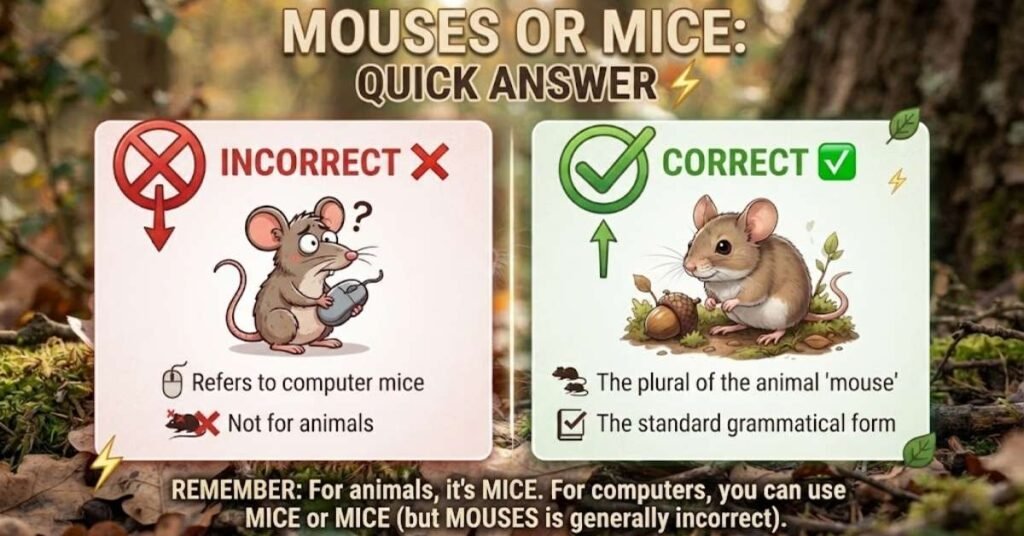
Use mice for both the animal mouse and the computer device.
Save mouses for rare cases, like the verb “she mouses around the barn.”
Think of it as a 95 percent rule.
Nearly every sentence you write will need mice.
Examples
Here are quick sentence examples you can copy straight into your work:
- Two mice ran across the kitchen floor.
- We bought five wireless mice for the computer lab.
- The cat mouses around the barn every evening.
Definition of Mouses or Mice 📘
The word “mouse” is a singular noun, and it carries two main meanings today.
One is a living creature, and the other is a computer peripheral.
Both meanings share one root, and both take the same plural in everyday writing.
Let’s look at each one.
Mouse as an Animal
A mouse is a small rodent with a pointed nose, round ears, and a long tail.
You’ll find house mice in kitchens, field mice in meadows, and farm mice in a barn or storage shed.
They breed fast and eat almost anything.
That’s why one mouse in the pantry usually means many mice soon.
Mouse as a Computer Device
A computer mouse moves the cursor across your computer screen.
You use it to click icons, open programs, scroll pages, and select text.
Engineer Douglas Engelbart built an early prototype in the 1960s.
The cord looked like a tail, so the nickname stuck.
The Origin of Mouses and Mice 🌍
English didn’t invent this odd plural.
It inherited it from Germanic languages, and the story is neat once you see it.
Understanding the word origin also makes similar words easier to remember.
It’s language history you can actually use.
Old English Grammar
In Old English, the word for mouse was “mūs,” and the plural was “mȳs.”
The plural came from a sound shift called vowel mutation, also known as umlaut.
An ending sound in the old plural pulled the vowel forward in the mouth.
Over centuries, the Great Vowel Shift turned that sound into the “ice” in mice.
Why “Mouses” Appeared Later
As English language evolution rolled on, most nouns adopted the simple “-s” ending.
People naturally tried the same pattern on mouse, and “mouses” popped up.
The computer age gave it a second push.
Some writers felt a device wasn’t a real animal, so it deserved a regular plural.
Mouses or Mice: Grammar Comparison 📊
Both forms follow real patterns, but only one is widely accepted.
This table shows the main differences in grammar rules:
| Feature | Mice | Mouses |
| Type of plural | Irregular plural | Regular plural |
| Pattern | Vowel change | Adds “-s” |
| Used for animals | Yes | No |
| Used for devices | Yes, most common | Rare |
| Accepted by style guides | Yes | Limited |
Noun plural rules usually favor the “-s” ending.
But a handful of very old, very common words kept their ancient shapes.
When to Use Mouses or Mice 🎯
Your decision should take five seconds.
Ask what you’re writing, who’s reading, and how formal the piece is.
Most readers expect mice.
Anything else can make them pause.
Use Mice in Most Situations
Pick mice for everyday English, school essays, emails, blog posts, and product pages.
It works for animals, ergonomic mice, and gaming mouse reviews alike.
Even in technical writing, mice is safe.
Nobody will question it.
Use Mouses in Rare Technical Contexts
Some technical manuals and technology discussions use “mouses” for devices.
Certain engineers like it because it separates the gadget from the animal.
If you follow that path, stay consistent through the whole document.
Also check the style guide your team uses first.
Common Mistakes with Mice or Mouses ⚠️
Most errors come from guessing instead of checking.
Here are the five grammar mistakes we see most often.
Mistake 1: Using “Mouses” for Animals
Writing “three mouses in the attic” sounds wrong to nearly every reader.
It’s the most common incorrect usage among English learners.
Fix it by writing “three mice in the attic.”
That’s the accepted form for any living rodent.
Mistake 2: Forgetting the Irregular Plural
Some writers forget that mouse belongs with irregular nouns.
They apply the “-s” rule out of habit.
Remember the club of vowel-changing words.
It includes goose and geese, tooth and teeth, foot and feet, and man and men.
Mistake 3: Thinking “Mice” Only Refers to Animals
Many people assume mice can’t describe gadgets.
That’s a myth.
Sales sites, tech reviewers, and office computers guides use “mice” for devices all day.
It’s perfectly correct.
Mistake 4: Overusing the Rare Form
Once someone learns “mouses” is valid in a tiny niche, they start using it everywhere.
That backfires fast.
A rare form should stay rare.
Use it only when your context demands it.
Mistake 5: Mixing Singular and Plural Forms
Watch out for lines like “The mice is broken” or “One mice stopped working.”
Those slips break basic singular and plural noun agreement.
The fix is simple.
One mouse is broken, and two mice are broken.
Mouses vs Mice in Everyday Examples 💬
Rules feel abstract until you see them in real sentences.
These examples cover the situations you’ll actually meet.
Animal Example
Last winter, my neighbor found house mice nesting in a storage shed.
She set humane traps and released six mice near a field.
Home Example
You spot droppings behind the stove and hear scratching at night.
Chances are you’ve got mice in the kitchen, and you should call a pest expert.
Technology Example
A friend of mine bought two optical mouse models for her home office.
She loved that both mice worked on a plain desk without a pad.
Classroom Example
A teacher writes “one mouse, many mice” on the board and asks students to add “goose, geese.”
Kids catch the pattern quickly, and language learners remember it longer.
Technical Example
A manual might say, “Each terminal supports two mouses or one trackball.”
That’s a rare, deliberate choice, and most readers would still understand “mice.”
Google Trends & Usage Data for Mouses or Mice 📈
People search this question constantly, and their behavior tells us what confuses them.
For exact numbers, open Google Trends yourself and compare the terms over the last 12 months.
Interest tends to spike during school terms.
It also rises when a new wireless mouse launches.
Popular Search Questions
Readers commonly type:
- What is the plural of mouse?
- Is “mouses” a real word?
- Is it mice or mouses for a computer?
- Why is the mouse plural form irregular?
These are grammar questions with clear, simple answers.
That’s why a direct reply near the top of a page works best.
Countries Searching the Phrase
Interest usually appears in the United States, United Kingdom, Canada, India, and Australia.
Those are large English learning and English writing markets.
Local spelling and style habits differ slightly.
The plural rule for mouse, however, stays the same everywhere.
Keyword Variations
Searchers phrase the question in many ways, such as “mouses or mice,” “computer mouse plural,” and “mice or mouses.”
Others type “plural noun explanation” or “correct plural usage.”
All of them want the same clear answer.
Give it fast, then add context.
Comparison Table: Mouses vs Mice 📊
Here’s a fast reference you can bookmark.
It sums up the key differences in one glance.
| Question | Mice | Mouses |
| Plural of the animal | Correct | Incorrect |
| Plural of the computer device | Correct | Rare variant |
| Verb form (to hunt or move a cursor) | No | Correct |
| Safe for school and work | Yes | Not advised |
| Found in dictionaries | Yes | Sometimes as a minor variant |
Sources like Merriam-Webster list mice first for the device.
Some entries note “mouses” as a less common option.
Memory Trick for Mouses or Mice 🧠
Grammar sticks better with a hook.
These two tricks take under a minute to learn.
Trick 1
Say it aloud: one mouse, many mice.
Rhymes are easy to recall, and this one echoes “ice.”
Trick 2
Link mouse to its vowel sound change cousins.
If you’d never say “tooths” or “foots,” you’d never say “mouses” for the animal either.
Extra Tips for Writers and Students ✍️
Bookmark a trusted dictionary and check any word that feels shaky.
Reading your draft aloud also catches odd plurals quickly.
If you write for a company, ask for the style guide early.
It saves editing time and keeps your standard writing consistent.
Conclusion
Use mice almost every time, for animals and for computer devices. Keep mouses for verbs and rare technical setups where your style guide allows it.Did this clear things up for you?
Drop a comment with the grammar puzzle you’d like solved next, and share this guide with a friend who keeps asking.
FAQs
1. What is the correct plural of mouse?
The correct plural is mice. It applies to animals and computer devices in standard English.
2. Is “mouses” a real word?
Yes, but it’s a verb form or a rare plural variant. You’ll see it in niche technical writing, not in everyday sentences.
3. Can computer devices be called mice?
Absolutely. Retailers, reviewers, and dictionaries all use “mice” for the device.
4. Why does mouse become mice?
The change comes from an ancient sound shift in Old English called umlaut. The vowel moved forward in the mouth, and it later became the “ice” sound.
5. Is “mouses” wrong?
For animals, it’s wrong in standard English. For devices, it’s uncommon but accepted in a few technical contexts.
6. Do dictionaries accept “mouses”?
Some list it as a minor variant for the device only. Almost all put “mice” first.
7. Should writers use “mice” or “mouses”?
Choose mice unless a style guide tells you otherwise. Readers will find it natural, and it keeps your writing clean.