
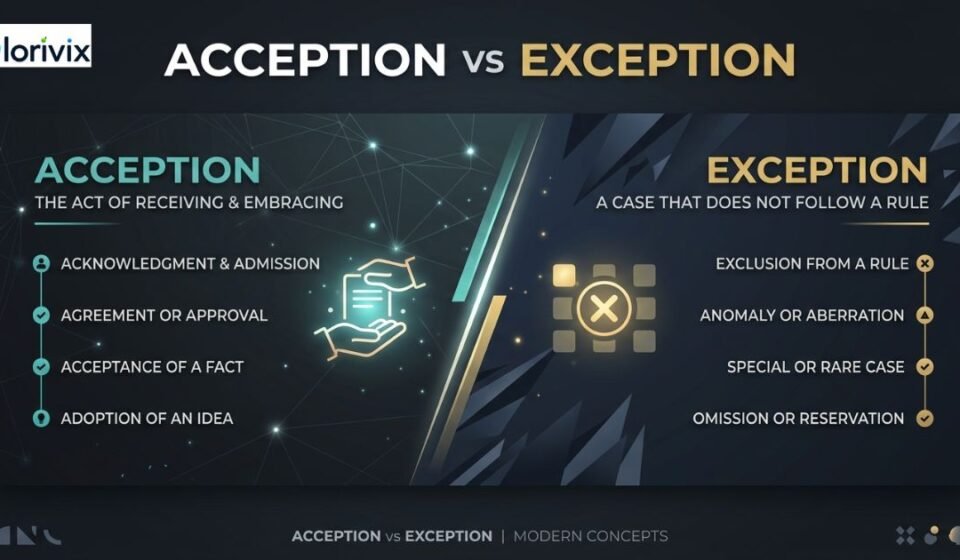

You’re halfway through an email, and you stop. Is it “with the acception of” or “with the exception of”? One of these words sounds fancy but might not even be real. The other you use all the time without thinking twice.
Getting acception vs exception wrong is one of those small mix-ups that can quietly undercut your writing, especially in professional emails or academic papers where precision matters.
Quick Answer
Exception is the correct word to use when you mean something excluded from a general rule (“everyone passed, with one exception”). Acception is not a standard English word. If you’re tempted to write it, you almost always mean either exception or acceptance.
What “Exception” Actually Means
An exception is a person, thing, or situation that doesn’t follow the usual rule or pattern. It’s the word you reach for when something breaks the mold.
Simple definition: Something that is left out, different from the norm, or doesn’t fit the general case.
The word comes from the Latin exceptio, related to excipere, meaning “to take out.” That root makes sense once you see it: an exception is something “taken out” of the general rule.
Examples of “Exception”
- She reads every genre, with the exception of horror.
- The store is open daily, with the exception of major holidays.
- He’s usually late, but today was an exception.
- All employees must clock in, no exceptions.
Common Phrases With “Exception”
These set phrases show up constantly in both writing and speech:
- With the exception of – meaning “except for”
- Make an exception – to allow something outside the usual rule
- Without exception – meaning “with no exclusions at all”
- The exception proves the rule – an idiom suggesting a rule exists because of its rare exceptions
- Take exception to – to object to or feel offended by something
Is “Acception” a Real Word?
Here’s the short version: no, not in modern standard English. You won’t find “acception” in major dictionaries like Merriam-Webster, Oxford, or Cambridge as an active, recognized word. If a spellchecker flags it, that’s working correctly.
Historically, “acception” did appear in older English texts, sometimes as an archaic or dialectal variant tied to the idea of “acceptance” or “the accepted meaning of a word.” But that usage faded out centuries ago and isn’t part of contemporary English. If you see it in a modern document, it’s almost always a typo or a mix-up, not a deliberate word choice.
Why This Matters
Using “acception” in a resume, email, or academic paper can make writing look careless, even if the rest of the content is strong. Readers (and hiring managers) notice.
Acception vs Exception: Side-by-Side Comparison
| Feature | Exception | Acception |
| Standard English word? | Yes | No (archaic/obsolete) |
| Meaning | Something excluded from a rule | Not used in modern English |
| Common usage | Very common | Essentially none |
| Correct in formal writing? | Yes | No |
| What people usually mean instead | — | Exception or acceptance |
Why People Mix Up Acception and Exception
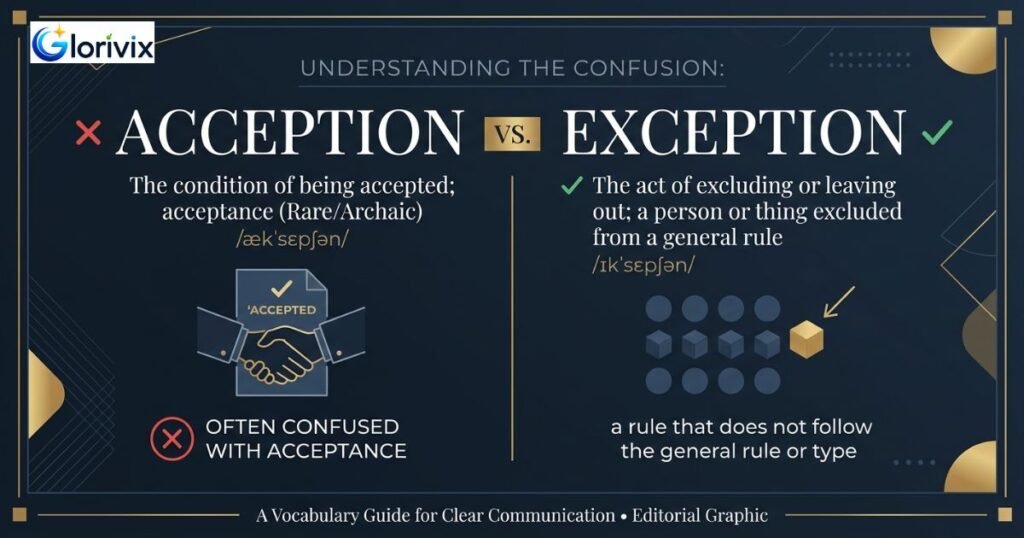
This confusion isn’t random. A few clear patterns explain why the mistake keeps happening.
1. They Look Similar on the Page
Both words share the “-ception” ending and start with a vowel sound, which makes them easy to swap when typing quickly.
2. They Sound Alike When Spoken Fast
In casual speech, the difference between “ex-” and “ac-” can blur, especially for non-native English speakers or in noisy environments.
3. Confusion With “Acceptance”
This is the biggest driver. Many people who write “acception” actually mean acceptance (the act of accepting something) but blend it with the spelling pattern of “exception.” The two real words, acceptance and exception, get merged into a word that doesn’t exist.
Common Mistakes and How to Fix Them
Incorrect: “With the acception of Mondays, the office is open all week.” Correct: “With the exception of Mondays, the office is open all week.”
Incorrect: “Her acception into the university was a proud moment.” Correct: “Her acceptance into the university was a proud moment.”
Incorrect: “We made an acception for late submissions.” Correct: “We made an exception for late submissions.”
A fast way to check yourself: if the sentence is about something being left out or different from the rule, you want exception. If it’s about something being approved, agreed to, or received positively, you want acceptance.
Does British English Use “Acception” Differently?
No. This isn’t a US vs UK spelling issue like “color” and “colour.” Both American and British English treat “acception” as nonstandard or obsolete. “Exception” and “acceptance” are used the same way on both sides of the Atlantic. If you’ve seen “acception” used somewhere, it’s more likely a personal or regional error than a recognized dialect difference.
Is There Ever a Correct Time to Use “Acception”?
Practically speaking, no. Unless you’re quoting a historical text or studying older forms of English for academic or linguistic research, there’s no situation in modern writing, business, or casual conversation where “acception” is the right choice. If you’re ever unsure which word fits, default to exception or acceptance and you’ll be right almost every time.
Real-World Usage Scenarios
In Business Writing
Business communication relies on precision, so this is exactly where a mistake like “acception” stands out. Compare these:
- Weak: “We can make an acception to the refund policy.”
- Strong: “We can make an exception to the refund policy.”
The second version reads as polished and professional, which matters when you’re emailing clients, writing policies, or drafting proposals.
In Academic Writing
Students often reach for “acception” when discussing research findings or exclusions in a study.
- Weak: “All participants completed the survey, with one acception.”
- Strong: “All participants completed the survey, with one exception.”
Academic readers, including professors and reviewers, tend to notice spelling errors quickly, so getting this right protects your credibility.
Synonyms and Related Words
Understanding related words helps you choose the right term faster, without second-guessing yourself.
Synonyms for Exception
- Exclusion
- Anomaly
- Deviation
- Irregularity
- Outlier
Related Words to Know
- Acceptance – the act of receiving or agreeing to something
- Except – used to introduce an exclusion (“everyone except John”)
- Exceptional – unusually good or notable
- Accept – to agree to receive or take something
Notice that “exception” and “except” share a root, while “acceptance” and “accept” share a different root. Keeping these two word families separate in your head is the real key to avoiding the mix-up.
A Quick Memory Trick
Here’s a simple way to lock this in: exception starts with “ex,” like “exit,” because an exception is something that exits or is taken out of the general rule. Acceptance starts with “ac,” like “accept,” because it’s about accepting something. If you remember those two starting points, “acception” won’t have anywhere to sneak in.
FAQs
Is “acception” a real word in English?
No. “Acception” is not part of standard modern English. It appears occasionally in very old texts, but dictionaries today don’t recognize it as a current word. Writers who use it typically mean either “exception” or “acceptance.”
What is the correct word: acception or exception?
Exception is correct. It refers to something excluded from a general rule, such as “everyone was on time, with one exception.”
What’s the difference between exception and acceptance?
An exception is something left out of a rule or pattern. Acceptance is the act of agreeing to or receiving something, such as an offer, apology, or idea. They come from different word families and mean very different things.
Why do people confuse acception with exception?
The confusion usually comes from blending the spelling of “exception” with the meaning of “acceptance.” Since both words end in similar sounds and relate to inclusion or exclusion, it’s an easy slip to make, especially when typing quickly.
Can I use “acception” in formal writing?
No. Formal writing, including business emails, resumes, and academic papers, should avoid “acception” entirely. Use “exception” or “acceptance” depending on your intended meaning.
Final Summary
“Exception” is the correct, standard word for describing something left out of a general rule, and it’s the one you should use in nearly every context. “Acception” isn’t part of modern English, and most people who write it actually mean “acceptance.” When in doubt, ask yourself whether you’re talking about something being excluded (exception) or something being agreed to and received (acceptance). That one question will steer you to the right word every time.