
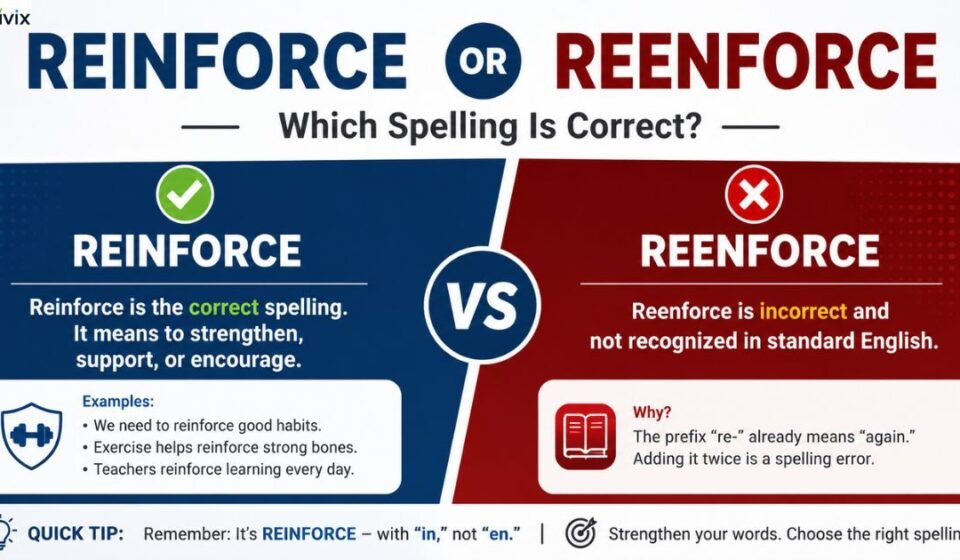

You’re typing a sentence about strengthening a wall, a habit, or an argument, and your fingers pause. Is it reinforce or reenforce? Spellcheck hasn’t flagged either one, so now you’re second-guessing yourself.
This mix-up trips up even confident writers, especially since both words look like they should mean the same thing. The good news: only one of them belongs in standard English, and once you see why, you’ll never hesitate again.
Quick Answer
Reinforce is the correct and only standard spelling in modern English. Reenforce is a nonstandard variant that occasionally appears in casual writing but is not recognized by major dictionaries as a preferred form. If you’re strengthening, supporting, or emphasizing something, always write reinforce.
What Does Reinforce Mean?
Reinforce means to make something stronger, more effective, or more secure. It applies to physical objects, ideas, emotions, and behaviors alike.
You can reinforce a concrete wall with steel bars. You can reinforce a habit by repeating it daily. You can reinforce an argument with solid evidence. The word works across construction, psychology, education, military contexts, and everyday conversation, which is part of why it shows up so often.
The verb comes from the prefix re- (again) combined with enforce, which itself traces back to the Old French enforcier, meaning to strengthen. Over centuries of use, English settled on reinforce as the standard spelling, and dictionaries, style guides, and publishers have followed that convention ever since.
Is Reenforce a Real Word?
Reenforce shows up sometimes, particularly in casual writing, forum posts, or quick typing where someone reasons through the word logically: “re” plus “enforce” should equal “reenforce,” right?
It’s an understandable guess, but it doesn’t match how English actually evolved this word. Major dictionaries, including Merriam-Webster and Oxford, list reinforce as the standard entry. Reenforce doesn’t appear as an accepted alternate spelling in current editions. Some older or historical texts used variant spellings before English orthography standardized, but in modern writing, reenforce reads as a spelling error, not a stylistic choice.
If you’re writing for school, work, publishing, or any professional context, stick with reinforce.
Why Reinforce Is the Preferred Spelling

Spelling conventions in English often come down to which form gained the widest, most consistent use over time, and reinforce won that race clearly.
A few reasons this spelling stuck:
- Etymology: The word evolved through French and Latin roots that settled into “reinforce,” not “reenforce.”
- Dictionary standardization: Every major English dictionary lists only reinforce as correct.
- Consistent usage: News outlets, academic journals, and style guides all use reinforce without exception.
- No functional difference: Since both spellings would mean the same thing, English didn’t need two versions, so the language naturally converged on one.
Think of it like the word “cooperate.” Some early printed texts used a hyphen (“co-operate”), but modern English dropped it because the unhyphenated form became the standard. Reinforce followed a similar path toward one accepted form.
Reinforce vs Reenforce: Comparison Table
| Feature | Reinforce | Reenforce |
| Standard spelling | Yes | No |
| Found in major dictionaries | Yes | No |
| Used in professional/academic writing | Yes | No |
| Grammatically valid | Yes | No |
| Common in casual typos | No | Yes |
| Correct in formal English | Yes | No |
Common Mistakes Writers Make
Most people don’t confuse these words on purpose. The mistake usually comes from one of these patterns:
Overthinking the prefix. Writers sometimes assume that adding “re-” to “enforce” should double the “e,” similar to words like “reenter” or “reelect.” But “reinforce” isn’t built the same way. It’s not “re” plus “enforce” spelled fresh each time; it’s a word that already settled into its own spelling centuries ago.
Autocorrect confusion. Some spellcheck tools flag both spellings inconsistently depending on the dictionary they reference, which makes writers assume both are valid.
Mixing it up with similar words. Words like “reenter,” “reelect,” and “reexamine” do keep the double “e” because they’re straightforward combinations of “re-” plus a standalone word. “Reinforce” doesn’t follow that same pattern, which is exactly where the confusion starts.
American vs British English: Any Differences?
Here’s some good news: this isn’t one of those words where American and British English disagree. Unlike “color” versus “colour” or “organize” versus “organise,” reinforce is spelled identically on both sides of the Atlantic.
Both American and British dictionaries list reinforce as the standard form, and reenforce isn’t a recognized regional variant in either version of English. So no matter which style guide you’re following, the answer stays the same.
When to Use Reinforce (Real-Life Contexts)
Reinforce shows up naturally across many everyday and professional situations:
- Construction and engineering: reinforcing concrete, beams, or foundations with steel or fiber materials
- Education and parenting: reinforcing good behavior or a lesson through repetition and positive feedback
- Relationships and communication: reinforcing trust or commitment through consistent actions
- Military and security: reinforcing troops, defenses, or a position
- Marketing and business: reinforcing a brand message across multiple channels
- Psychology: reinforcing a behavior through reward, a concept central to behavioral learning theory
Because the word applies so broadly, it’s one of those verbs worth knowing cold, since a small spelling slip can undercut an otherwise polished piece of writing.
Synonyms and Related Words
If you want variety in your writing, or you’re checking whether “reinforce” is really the word you need, here are close synonyms:
- Strengthen
- Support
- Bolster
- Fortify
- Solidify
- Buttress
- Toughen
- Consolidate
Each carries a slightly different shade of meaning. “Fortify” leans toward physical or defensive strength, while “bolster” often applies to confidence or morale. “Reinforce” sits comfortably in the middle, flexible enough for both literal and figurative use.
Memory Trick to Avoid Confusion
Here’s a simple way to lock in the correct spelling: think of the word “force.”
Rein-FORCE contains the word “force” right inside it, which makes sense since reinforcing something adds force or strength to it. There’s no second “e” hiding in there, and there’s no reason to add one.
If you ever catch yourself typing “reenforce,” pause and picture the word “force” sitting at the end. That visual cue is usually enough to correct the spelling on the spot.
Example Sentences Showing Correct Usage
Seeing the word in context makes it easier to internalize the correct spelling:
- The construction crew used steel rods to reinforce the bridge’s foundation.
- Positive feedback can reinforce good habits in young children.
- Her calm response only reinforced his respect for her leadership.
- The company plans to reinforce its supply chain after last year’s delays.
- Regular practice will reinforce what you learned in class today.
Notice how the word adapts to past tense (reinforced), present tense (reinforce or reinforces), and the -ing form (reinforcing) without ever picking up that extra “e.”
Expert Writing Tip
When you’re unsure about a spelling, resist the urge to sound it out phonetically and instead think about the word’s most common written form in professional text you already trust, like news articles or textbooks.
Chances are, you’ve seen reinforce printed correctly hundreds of times without noticing. Trusting that visual memory is often more reliable than trying to logically reconstruct a word from its parts, especially with English, which doesn’t always follow tidy rules.
If you’re writing something formal, a quick dictionary check takes seconds and removes all doubt.
Frequently Asked Questions
Is reenforce ever correct in any context?
No. Reenforce is not listed as a standard or accepted spelling in current major dictionaries. Regardless of context, formal or casual, reinforce is the correct choice.
Why do some people spell it reenforce?
Many writers assume “re-” plus “enforce” should double the “e,” following patterns seen in words like “reenter” or “reelect.” However, “reinforce” developed its own established spelling and doesn’t follow that same rule.
What is the noun form of reinforce?
The noun form is reinforcement, as in “the wall needed additional reinforcement” or “positive reinforcement helps build good habits.”
Does reinforce have a British spelling difference?
No. Reinforce is spelled the same way in both American and British English, unlike words such as “color/colour” that differ by region.
What’s a simple way to remember the correct spelling?
Look for the word “force” inside “reinforce.” Since reinforcing something means adding force or strength, remembering that root word helps you spell it correctly every time.
Summary
Reinforce, not reenforce, is the standard, dictionary-approved spelling in both American and British English. The confusion usually comes from assuming the word follows the same double-“e” pattern as words like “reenter,” but “reinforce” simply doesn’t work that way. Whether you’re talking about strengthening a structure, a habit, or an argument, reinforce is the spelling to use every time. Keep the word “force” in mind, and you’ll never second-guess this one again.