

Ever filled out a form and paused before writing your birth date, unsure whether to write “born in May 14″ or “born on May 14”? You’re not alone. This tiny preposition mix-up trips up even confident English speakers, and getting it wrong in a resume, essay, or conversation can make your writing look careless.
The good news is that born in or born on follows a simple, learnable pattern once you understand what each word pairs with.
Quick Answer
Use “born on” with a specific date or day, like “born on May 14” or “born on a Monday.” Use “born in” with a year, month, city, or country, like “born in 1995” or “born in Chicago.” The rule depends on how specific the time or place is, not on personal preference.
What Does “Born In” Mean?
“Born in” pairs with broader units of time or place. Think of it as the preposition for anything that isn’t an exact date. This includes years, months (without a specific day), decades, seasons, cities, states, and countries.
The logic is simple: when you’re talking about a general period or a location rather than one precise calendar day, “in” is the correct fit. English speakers naturally use “in” for anything that functions like a container, a whole year, a whole month, a whole city holds many days or many places inside it.
Examples:
- She was born in 2001.
- He was born in December.
- They were born in the 1990s.
- I was born in Texas.
- My grandmother was born in Italy.
What Does “Born On” Mean?
“Born on” is reserved for specific days. This includes exact calendar dates and named days of the week. If you can point to one single day on a calendar, “on” is the word you need.
This is one of the most consistent rules in English grammar. Days and dates are treated as fixed points in time, and prepositions of time treat single points differently from broader spans.
Examples:
- She was born on July 4, 2000.
- He was born on a Sunday.
- I was born on the 15th of June.
- My son was born on New Year’s Day.
Born In vs Born On: The Main Difference
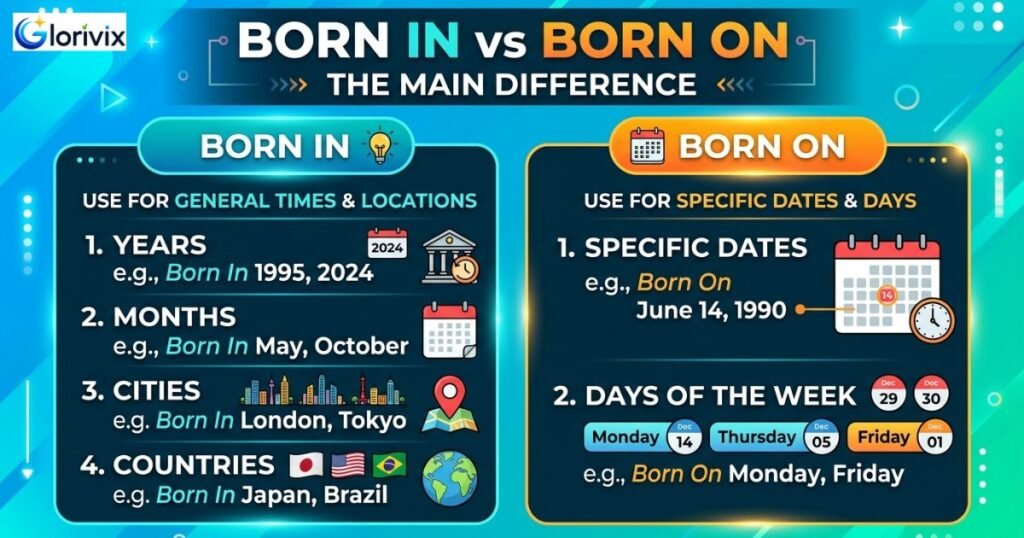
The core difference comes down to specificity. “In” works with general time periods and places. “On” works with exact dates and days.
| Use “Born In” For | Use “Born On” For |
| Years (1998, 2010) | Full dates (May 14, 1998) |
| Months alone (April, October) | Days of the week (Monday, Friday) |
| Decades (the 1980s) | Specific calendar days (the 3rd) |
| Seasons (winter, summer) | Named holidays (Christmas Day) |
| Cities, states, countries | — |
This table captures the pattern at a glance, but the sections below walk through the reasoning and edge cases so the rule actually sticks.
Examples of Born In
Here are more real world sentences that show “born in” in action across different contexts:
- The actor was born in Los Angeles in 1985.
- Many immigrants in this neighborhood were born in Vietnam.
- She was born in early spring, though she doesn’t remember the exact date.
- Both twins were born in the same hospital.
- He was born in a small village in the mountains.
Notice how “born in” always attaches to something broader than a single day, whether that’s a place or a stretch of time.
Examples of Born On
These examples show “born on” used correctly with specific dates and days:
- My father was born on August 9, 1962.
- The baby was born on a Tuesday morning.
- She was born on the same day as her cousin.
- He always jokes that he was born on Friday the 13th.
- Our dog was born on the first day of spring, technically March 20.
Notice that last example carefully. Even though “spring” is a season, “the first day of spring” is a specific date, so “on” is correct.
Common Mistakes People Make
Even fluent speakers slip up here. Here are the most frequent errors and quick fixes.
Mistake 1: Saying “born on 1998” instead of “born in 1998.” A year is a broad span of time, not a single point, so it needs “in.”
Mistake 2: Saying “born in May 14” instead of “born on May 14.” Once a specific day number joins the month, the phrase becomes a full date, and full dates always take “on.”
Mistake 3: Saying “born on Texas” instead of “born in Texas.” Places never take “on.” Locations always pair with “in,” regardless of size, city, state, or country.
Mistake 4: Mixing formats, like “born on May.” “May” alone is a month with no specific day attached, so it needs “in,” not “on.”
Mistake 5: Forgetting the day of the week rule. Days like Monday or Friday are treated the same as dates. They always take “on.”
Why This Grammar Rule Matters
Getting this right matters more than it might seem. Birth dates show up constantly, on job applications, legal documents, school records, dating profiles, and everyday introductions. A small preposition error can make writing look unpolished, and in formal documents, consistency signals attention to detail.
This rule also reflects a broader pattern in English: prepositions of time aren’t random. They follow a logical hierarchy from large units of time down to small, specific ones. Once you understand that hierarchy, you can apply it far beyond just talking about birthdays.
Time Prepositions Related to Birth
The “in” versus “on” pattern isn’t unique to birth dates. It applies to time expressions generally, and knowing the full pattern makes the birth date rule easier to remember.
| Preposition | Used With | Example |
| In | Years, months, decades, seasons | in 1999, in June, in the 2000s |
| On | Dates, days of the week | on May 3, on Thursday |
| At | Specific clock times | at 6 p.m., at midnight |
So while this article focuses on born in and born on, the same “in, on, at” logic applies whenever you’re describing time in English, from meetings to holidays to historical events.
American vs British English
The good news is that this rule stays consistent between American and British English. Both varieties use “born in” for years, months, and places, and “born on” for specific dates and days.
Where the two forms sometimes differ is in how the date itself is written, not in the preposition. American English typically writes dates as month-day-year (born on May 14, 2000), while British English favors day-month-year (born on 14 May 2000).
The preposition “on” stays the same either way. This is a useful distinction to know if you’re writing for an international audience or double-checking a document written in a different English dialect.
Tips to Remember the Difference
A few mental shortcuts make this rule easy to apply without overthinking it:
- Ask yourself: is it a single day? If yes, use “on.” If it’s broader, use “in.”
- Places always take “in.” Never pair a location with “on,” no matter how small the town or how large the country.
- Full dates always take “on.” The moment a day number appears next to a month, switch to “on.”
- Years always take “in.” There’s no exception here, even for very recent or very old years.
- Practice with your own birthday. Write both forms, “born in [month]” and “born on [full date],” until the pattern feels automatic.
Frequently Asked Questions
Is it born in or born on a date?
It’s “born on” a date. Specific calendar dates, like May 14 or the 3rd of June, always pair with “on” because they refer to one exact day.
Do we say born in a year?
Yes. Years always take “in,” as in “born in 1990” or “born in 2015.” Years are treated as broad spans of time rather than single points.
Is it born in May or born on May?
It’s “born in May” when referring to the month alone. If you add a specific day, like May 14, it becomes “born on May 14.”
Is it born on Monday correct?
Yes, that’s correct. Days of the week always take “on,” so “born on Monday” or “born on a Friday” is grammatically accurate.
Can I say born in 15 May?
No. The correct order in American English is “born on May 15,” and in British English it’s “born on 15 May.” Either way, the preposition is “on,” not “in,” because it’s a specific date.
Summary
The rule behind born in or born on is more straightforward than it first appears. Use “born in” for years, months on their own, decades, seasons, and any place, city, state, or country. Use “born on” for exact dates and specific days of the week.
Once you internalize that specific points in time and specific dates take “on,” while broader spans and locations take “in,” you’ll apply this rule correctly without needing to pause and think.