


You’re typing an email, a school assignment, or a caption, and suddenly you freeze. Is it “writing” or “writting“? One letter shouldn’t cause this much stress, but double letters in English have a way of tripping up even confident writers.
If you’ve ever hovered over that word wondering whether you added one “t” too many, you’re not alone, and the fix is simpler than you think.
Quick Answer
Writing is the correct spelling. Writting is always a spelling error, no matter how the word is used. The correct form has one “t,” not two, because of a specific spelling rule explained below. If you remember one thing from this article, remember this: one “t” is right, two is wrong.
Writing vs Writting: The Simple Rule Behind It
English has a rule for adding “-ing” to short verbs ending in a consonant. It depends on the vowel sound before that final consonant.
The verb write ends in a silent “e.” When you add “-ing,” you drop the silent “e” and simply attach “-ing.” That gives you writing, with one “t.”
The confusion happens because of a different rule: doubling the final consonant. Words like run (running), stop (stopping), or swim (swimming) double their last letter before “-ing” because they end in a short vowel sound plus a consonant, with no silent “e” to drop. “Write” doesn’t follow that pattern because it already ends in a silent “e,” so the doubling rule never applies here.
That’s the entire explanation. Writting tries to apply the doubling rule to a word that doesn’t need it, which is why it’s incorrect in every context.
What “Writing” Actually Means
Writing is the present participle and gerund form of the verb “write.” It refers to the act of forming letters, words, or symbols to communicate, or, as a noun, to the finished result of that act.
It can function in a few different ways:
- As a verb (present participle): “She is writing a letter.”
- As a gerund (noun): “Writing is her favorite hobby.”
- As an adjective: “He bought a new writing desk.”
Because it plays multiple grammatical roles, you’ll see “writing” constantly in everyday English, from casual texts to formal reports.
Why “Writting” Is Always Wrong
There’s no version of English, formal or informal, American or British, where “writting” is accepted. It isn’t a regional variant, an old spelling, or an alternate form. It’s simply a misspelling caused by mixing up two different consonant-doubling patterns.
Spell checkers will flag it immediately, and most style guides don’t even bother listing it as a common exception because it doesn’t follow any recognized rule. If you see “writting” in a document, treat it as a typo that needs fixing, not a stylistic choice.
How to Remember the Difference
A few memory tricks can help this stick:
- Think of the base word first. “Write” already has one “t.” Adding “-ing” doesn’t add another.
- Compare it to “site” and “siting.” Words ending in a silent “e” typically just drop the “e,” not double the consonant.
- Say it out loud slowly. “Writ-ing” naturally has one “t” sound, not a doubled one.
- Use the two-syllable test. “Write” is one syllable with a long “i” sound. Words that double their consonant before “-ing” usually have a short vowel sound instead, like “sit” or “hit.”
Writing in a Sentence: Real Examples
Seeing the word in context makes the correct usage easier to internalize.
- “I spent the morning writing my thesis introduction.”
- “Her writing style is clear and direct.”
- “Good writing takes practice, not just talent.”
- “He left a writing sample with his job application.”
- “They’re writing a screenplay together this summer.”
Notice how “writing” fits naturally as both an action and a description, without ever needing a second “t.”
Writing vs Writting at a Glance
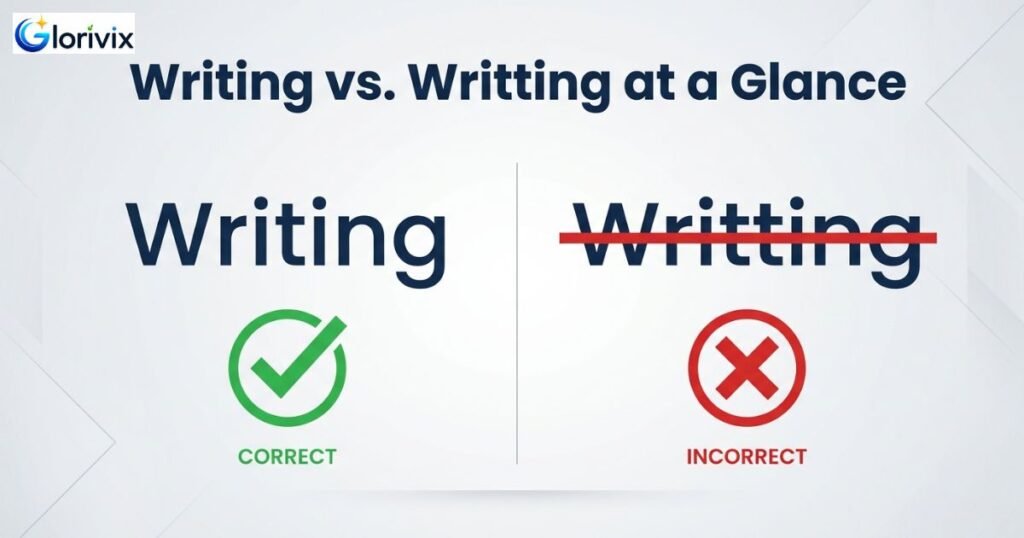
| Feature | Writing | Writting |
| Correct spelling | Yes | No |
| Number of “t”s | One | Two |
| Recognized in dictionaries | Yes | No |
| Follows English spelling rules | Yes | No |
| Acceptable in any context | Yes | Never |
Words Related to Writing
Expanding your vocabulary around this word can also improve how naturally you use it in different contexts.
Synonyms (as an activity): composing, drafting, penning, scripting, authoring
Related nouns: author, manuscript, draft, composition, prose
Common phrases: “writing style,” “creative writing,” “writing prompt,” “technical writing,” “in writing”
Each of these terms builds on the same root word and follows the same one-“t” spelling, since they all derive from “write.”
Other Words That Follow the Same Pattern
If “writing” makes sense once you see the rule, it helps to recognize other words that behave the same way. Verbs ending in a silent “e” simply drop the “e” before adding “-ing”:
| Base Verb | Correct -ing Form | Incorrect Form |
| write | writing | writting |
| bite | biting | bitting |
| hope | hoping | hopping* |
| site | siting | sitting* |
*Note: “hopping” and “sitting” are actually correct spellings, but for different base words, “hop” and “sit,” which do follow the doubling rule because they end in a short vowel plus a single consonant. This is exactly why mix-ups happen. Always check which base word you’re starting from before deciding whether to double the consonant.
Common Mistakes People Make With “Writing”
Beyond the writting error, a few related mistakes show up often:
- Confusing “writing” with “writen.” The correct past participle is “written,” with two “t”s, not “writen” with one. This is the opposite mistake, and it happens because people overcorrect after learning “writing” only needs one “t.”
- Mixing up “write” and “right.” These are homophones with completely different meanings. “Write” means to compose text; “right” means correct or a direction.
- Dropping the “g” in casual writing. Informal texting sometimes uses “writin,” which is fine in casual chat but shouldn’t appear in formal writing.
Knowing these related pitfalls helps you avoid a chain reaction of small errors once you start second-guessing your spelling.
Quick Exercises to Lock In the Spelling
Try filling in the blanks below, then check your answers against the key.
- She enjoys ______ short stories on weekends.
- His ______ has improved a lot since last year.
- They are ______ a report for the meeting.
- Good technical ______ requires clarity and precision.
- I found his ______ sample impressive.
Answer key: writing, writing, writing, writing, writing. Every blank uses the same one-“t” spelling, since the word doesn’t change form based on context, only based on grammar and tense.
Why This Mistake Is So Common
Doubling errors like this aren’t a sign of poor language skills. English spelling rules around consonant doubling are genuinely inconsistent, and many words that look similar follow opposite rules depending on their origin and vowel sound.
Learners and even fluent speakers sometimes apply a pattern that works for one word to a different word where it doesn’t apply. Recognizing this makes it easier to be patient with yourself while still fixing the error going forward.
Frequently Asked Questions
Is “writting” ever correct in British English?
No. British and American English agree on this spelling. “Writing” is correct in both, and “writting” isn’t recognized as a valid variant in either.
Why does “write” become “writing” and not “writteing” or “writting”?
Because “write” ends in a silent “e,” you drop that “e” before adding “-ing.” The doubling rule that creates words like “sitting” only applies to short verbs ending in a single consonant after a short vowel sound, which “write” is not.
What is the past tense of “write”?
The simple past tense is “wrote,” as in “She wrote a letter yesterday.” The past participle, used with helping verbs like “has” or “have,” is “written,” as in “She has written three books.”
Is “writing” a noun or a verb?
It can be both. As a verb form, it describes an ongoing action, like “He is writing now.” As a noun (gerund), it names the activity or its result, like “Writing is hard work” or “I liked your writing.”
Summary and Takeaways
Writing is the only correct spelling, and writting is a common but avoidable mistake that comes from applying the wrong consonant-doubling rule. Because “write” ends in a silent “e,” you simply drop the “e” and add “-ing,” no doubling needed.
Once you understand this rule and can spot the difference between silent-e verbs and short-vowel verbs, you’ll never second-guess this spelling again. Keep it to one “t,” and your writing will always be correct on this front.