
You’re typing up an ad campaign report or a quick email, and your fingers pause right before that one word. Is it “targetted” or “targeted” with one T? Spellcheck might not even flag the wrong version if autocorrect has learned your habits.
This mix-up is more common than you’d think, and it quietly shows up in resumes, marketing copy, and business emails. The correct spelling is targeted, and understanding why will keep you from making the mistake again.
Quick Answer
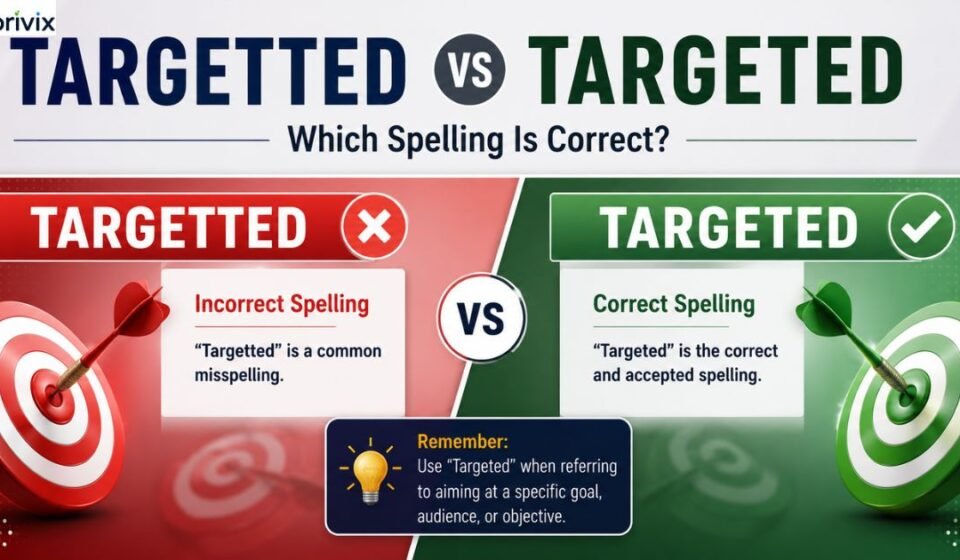
Targeted is the correct spelling in both American and British English. Targetted (with two T’s) is a common misspelling that isn’t recognized by standard dictionaries.
The confusion happens because English spelling rules for adding suffixes can seem inconsistent, but “target” follows a specific pattern that calls for just one added T.
What Does “Targeted” Mean?
“Targeted” is the past tense and past participle form of the verb “target.” It means something was aimed at, focused on, or selected as the object of an action or effort.
You’ll see it used in a few common ways:
- As a verb form: “The company targeted new customers in the Midwest.”
- As an adjective: “She launched a targeted marketing campaign.”
- In compound phrases: “targeted therapy,” “targeted advertising,” “targeted approach”
In each case, the word signals precision. Something wasn’t done randomly. It was aimed at a specific goal, audience, or outcome.
Why “Targetted” Feels Right (But Isn’t)
If “targetted” looks correct to you, you’re not alone, and there’s a real reason for the confusion. English has a well-known spelling rule: when you add “-ed” or “-ing” to a short verb ending in a single vowel followed by a single consonant, you often double that final consonant. Think “stop” becoming “stopped,” or “plan” becoming “planned.”
The problem is that this doubling rule depends on where the stress falls in the word. “Target” is a two-syllable word, and the stress lands on the first syllable: TAR-get, not tar-GET. When the stress falls on the first syllable, the final consonant usually does not get doubled before adding a suffix.
That’s why “target” becomes “targeted,” not “targetted.” The same pattern shows up in other words like “market” (marketed, not marketted) and “visit” (visited, not visitted).
The Simple Rule to Remember
Here’s the rule in plain terms: double the final consonant only when the stress falls on the last syllable of the base word.
- or-DER → ordered (stress on first syllable, no doubling)
- pre-FER → preferred (stress on last syllable, doubling happens)
- TAR-get → targeted (stress on first syllable, no doubling)
- oc-CUR → occurred (stress on last syllable, doubling happens)
Once you hear where the stress lands, the spelling almost writes itself.
But: Watch for British English Exceptions
A few verbs break this pattern in British English regardless of stress, most famously “travel” becoming “travelled” (British) instead of “traveled” (American). Luckily, “target” isn’t one of these exceptions. Both American and British English agree: it’s “targeted,” one T, everywhere.
Targeted vs Targetted: Comparison Table
| Feature | Targeted | Targetted |
| Correct spelling | ✅ Yes | ❌ No |
| Found in dictionaries | ✅ Yes | ❌ No |
| Used in American English | ✅ Yes | ❌ No |
| Used in British English | ✅ Yes | ❌ No |
| Recognized by grammar tools | ✅ Yes | ❌ Flagged as an error |
| Common in professional writing | ✅ Yes | ❌ No |
American vs British English: Any Real Difference?
This is where “targeted” stands out from many other words that split along American and British lines. Words like “colour/color,” “travelled/traveled,” and “cancelled/canceled” have accepted regional variants. “Targeted” does not.
Because the stress in “target” sits firmly on the first syllable, both British and American style guides apply the same non-doubling rule. So no matter which side of the Atlantic your reader is on, “targeted” is the spelling to use. This makes it one of the more forgiving words in English, at least in terms of regional spelling drama.
Common Mistakes People Make
Beyond the double-T error, a few related mistakes show up often:
- Targetted vs Targeted in headlines: Marketing copy is a frequent offender since writers move fast and skip proofreading.
- Confusing it with “targetting”: The “-ing” form has the same issue. The correct spelling is targeting, one T.
- Mixing it up with “target-ed” as two words: It’s always written as one word, no hyphen.
- Overcorrecting other words: Some writers, once they learn the “target” rule, mistakenly remove doubled consonants from words that actually need them, like “referred” or “occurred.”
A quick way to catch this in your own writing is to read the word out loud and listen for the stress. If the emphasis lands on the first beat, you likely don’t need to double the consonant.
Example Sentences Using “Targeted” Correctly
Seeing the word in context makes the correct usage easier to remember:
- The nonprofit targeted low-income families for its food assistance program.
- Our new ad platform lets you run targeted campaigns based on location and interests.
- Doctors are increasingly using targeted treatments that focus on specific genetic markers.
- The sales team targeted three key industries for the next quarter.
- Her feedback felt targeted rather than general, which made it more useful.
Synonyms and Related Words
If you want alternatives to “targeted” depending on context, these work well:
- Focused – “a focused approach”
- Aimed – “aimed at reducing costs”
- Directed – “directed toward new markets”
- Specific – “a specific audience”
- Selective – “selective outreach efforts”
Related word forms to keep straight:
- Target (noun/verb, base form)
- Targeting (present participle, one T)
- Targeted (past tense/adjective, one T)
- Targets (plural noun or third-person verb)
When Should You Use “Targeted”?
Use “targeted” whenever you’re describing an action that was deliberately aimed at a specific person, group, goal, or outcome, rather than something general or random. It fits naturally in these settings:
- Marketing and advertising: targeted ads, targeted campaigns, targeted content
- Business strategy: targeted growth, targeted markets, targeted outreach
- Healthcare: targeted therapy, targeted treatment
- Everyday writing: describing a focused effort of any kind
If you’re describing something broad or unfocused, “targeted” isn’t the right word. Save it for moments where precision and intention matter.
A Memory Trick to Never Misspell It Again
Here’s a simple trick: think of the phrase “one target, one T.” Since “target” itself only has one T at the end, and the stress sits on “TAR” not “get,” you never add a second one when forming “targeted” or “targeting.”
Another option is to compare it to “market.” Nobody writes “marketted,” and “target” follows the exact same spelling pattern. If the market comparison sticks better in your memory, use that instead.
Frequently Asked Questions
Is “targetted” ever correct in any form of English?
No. “Targetted” is not a recognized spelling in American, British, Canadian, or Australian English. It’s considered a spelling error in all standard style guides and dictionaries.
Why do people double the T in “targetted” by mistake?
It usually happens because of confusion with other “-ed” spelling rules, where doubling the final consonant is required. Since “target” looks similar to words like “permit” (permitted) or “occur” (occurred), writers assume the same doubling applies, even though the stress pattern is different.
Is it “targeting” or “targetting”?
The correct form is targeting, with one T. The same stress-based rule that applies to “targeted” applies here too.
Does “targeted” change spelling in British English?
No. Unlike words such as “travelled” or “cancelled,” “targeted” stays the same in both American and British English because of where the stress falls in the base word.
What’s a quick way to check if I’m spelling “targeted” correctly?
Say the word “target” out loud and notice the stress falls on the first syllable. Words stressed on the first syllable typically don’t double the final consonant before adding “-ed” or “-ing,” which confirms “targeted” is correct.
Summary
Targeted is the only correct spelling, used consistently across American and British English. Targetted is a common but incorrect variation that results from confusing “target” with other verbs that follow a different stress pattern.
Remembering that the stress in “target” falls on the first syllable, paired with the “one target, one T” trick, makes it easy to spell correctly every time. Whether you’re writing a marketing plan, a business email, or a school assignment, using “targeted” correctly adds a small but noticeable layer of polish to your writing.