
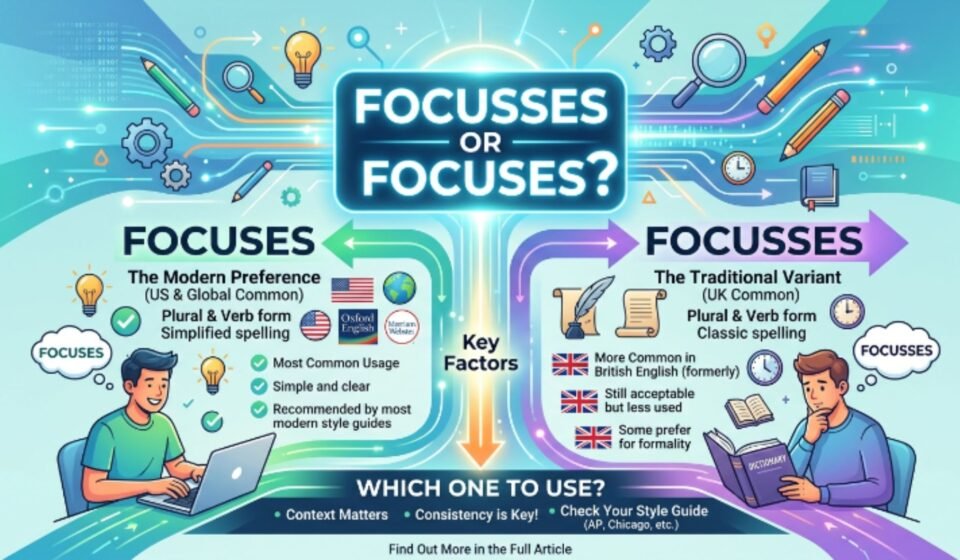

You typed a sentence. Then you stopped. “He focuses on his work” or “he focusses on his work”? Both look almost right. That tiny extra “s” can throw off even confident writers.
Here’s the short version. Focuses is the standard spelling almost everywhere today. Focusses shows up mostly in older British English texts and a small pocket of formal writing. Neither one is made up, but only one of them is going to serve you well in 2026.
Let’s dig into why this mix-up happens, where it comes from, and which spelling actually belongs in your next email, essay, or blog post.
Focusses
Focusses is the double-consonant version of the word. You’ll spot it in older British publications, some academic papers, and the occasional formal document from the UK or Commonwealth countries. It follows an older pluralization rule where a short vowel before the final consonant sometimes gets a double consonant before adding “es.” Think of it as the road less traveled today, still valid in some corners, but shrinking fast.
Focuses
Focuses is the version you’ll see everywhere else. It’s the third-person singular form of the verb “to focus” (“she focuses”), and it also works as the standard plural form in casual usage. American publications use it without exception. British newspapers, style guides, and even most UK universities have shifted toward it too. If you only remember one spelling, make it this one.
Focusses or Focuses: Quick Answer
Use focuses. That’s the answer, no long detour needed.
It’s the correct spelling recognized by nearly every major dictionary, style guide, and professional publication on the planet. Whether you’re writing for a US audience, a UK audience, or anyone in between, focuses won’t get flagged, questioned, or side-eyed by an editor.
Focusses isn’t a spelling mistake in the strict sense. It’s a regional spelling that’s fading out of use. Unless you’re intentionally matching an older British text or a very traditional style guide, stick with focuses and move on with your day.
The Origin of Focusses or Focuses
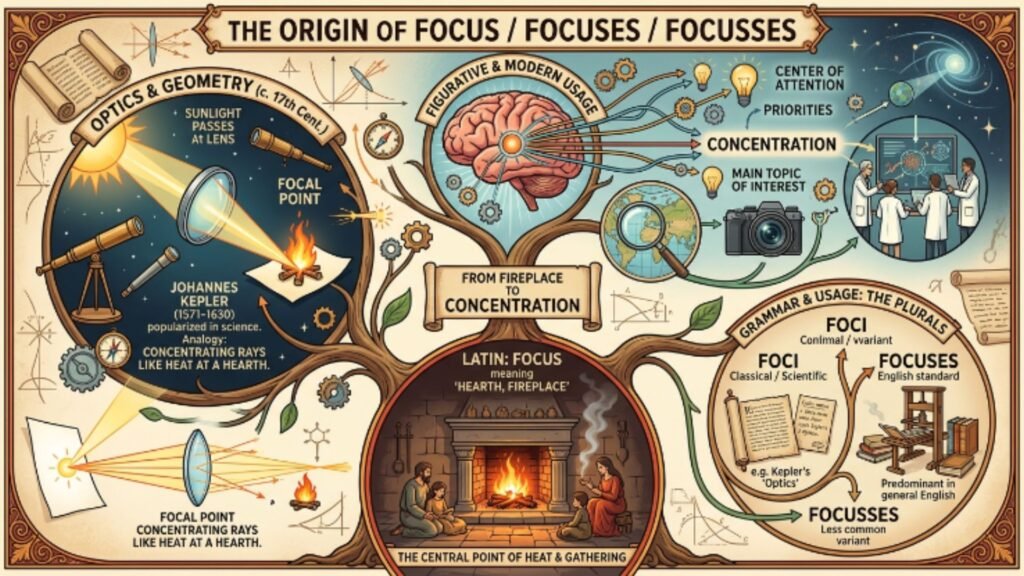
The word origin traces back to Latin, where “focus” literally meant hearth or fireplace. Picture a Roman home with the fire pit as the center of daily life. Everyone gathered there. Everything revolved around it. That image of a central point of attention is exactly how English borrowed the word centuries later.
Its journey into English usage runs through science, not poetry. In the 17th century, astronomer Johannes Kepler used “focus” in the context of optics and astronomy, describing the point where light rays converge. From there, the word spread into everyday English, picking up its now familiar meaning of concentrated attention or effort.
As English grew and split across continents, spelling conventions started to diverge too. American English simplified many word forms, while British English held onto some older, classical Latin-inspired spelling patterns longer. That single fork in the road is where focuses and focusses split apart.
British English vs American English Spelling
This isn’t the first time British and American spelling have gone separate ways. Think about travelling versus traveling, or cancelled versus canceled. The pattern repeats: British English often doubles the consonant before adding a suffix, while American English usually keeps it single.
Focusses followed that same double consonant rule for a while. But here’s the twist. Unlike “travelling,” which is still common in UK English today, “focusses” never fully caught on even in Britain. Most British style guides, including the Oxford Dictionary itself, now list focuses as the primary or sole accepted spelling.
So while the general UK vs US spelling divide is real for plenty of words, focus is one where the gap has mostly closed. Global English, shaped by international business, media, and the internet, has nudged both regions toward the same simpler spelling.
Which Spelling Should You Use?
For nearly every situation, the answer is focuses. It works in formal writing, casual writing, professional writing, academic writing, and everything in between. If you’re writing for a global audience or international readers, this spelling won’t confuse anyone or look out of place.
There’s one narrow exception. If you’re editing or quoting a historical document, a classic British text, or matching the exact style of an older institution, focusses might be the accurate choice for that specific context. Outside of that, there’s no real argument for using it.
A simple rule to remember: when in doubt, pick the shorter, simpler form. That’s usually the direction modern English is heading anyway, and focuses fits that trend perfectly.
📌 Focuses vs Focusses and Related Forms (Complete Usage Guide)
The confusion doesn’t stop at the base word. Related word forms trip people up just as often, so let’s clear them up one at a time.
Focusing is the standard present participle, used in phrases like “I’m focusing on my goals.” Focussing is the older double-consonant version, again mostly seen in outdated British texts. The same logic that applies to focuses versus focusses applies here: go with the single-s version.
Focused and focussed follow the identical pattern for past tense. “She focused on her studies” is the modern, widely accepted choice. “She focussed on her studies” is the older form that’s largely faded from active use. And when you need a plural noun, foci is the technical, Latin plural used in scientific or academic contexts, while “focuses” can also serve as a plural in everyday writing.
| Form | Modern Spelling | Older/British Variant |
| Verb (present) | focuses | focusses |
| Present participle | focusing | focussing |
| Past tense | focused | focussed |
| Plural noun (technical) | foci | foci |
Common Mistakes with Focusses or Focuses
Even careful writers slip up here, and it usually comes down to a handful of repeatable errors. Spotting the pattern makes it much easier to avoid.
- Mixing styles within one document, using “focuses” in one paragraph and “focussed” in another
- Typing focuss or focussess, which aren’t recognized words at all
- Writing focusess instead of focuses, a simple typing mistake that spell check often misses
- Dropping the apostrophe incorrectly, like writing “focus'” when a plural or possessive form is needed
- Misspelling it entirely as foucses, a transposition error that’s more common than you’d think
Subject-verb agreement trips people up too. “He focus on his work” is wrong. It needs to be “he focuses on his work” since the subject is singular and third-person. Small slip, but it’s the kind of thing that quietly chips away at your credibility in professional or academic writing.
⚠️ Common Search Confusions About Focuses and Focusses
A lot of people land on this topic because they typed a question into Google and got mixed signals. Let’s answer the most common ones directly.
Is “focusses” wrong? Not technically, but it’s outdated and rarely used in modern writing, so treat it as a spelling to avoid rather than one to adopt.
Can I use “focusses” in the US? You can, but American readers and editors will likely flag it as an error since it simply isn’t part of standard American English. Is “focuses” only for verbs? No, it also works as an informal plural noun, though foci remains the preferred technical plural in scientific writing.
Focusses or Focuses in Everyday Examples
Seeing the word in context makes the choice easier to lock in. Here’s how focuses shows up naturally across different situations people actually write about.
A manager might say the team “focuses on hitting project deadlines” this quarter. A company report could mention how leadership “focuses on customer satisfaction” above all else. A university course description might explain that the program “focuses on climate change and sustainable development goals.”
Even outside the office, the word fits everywhere. A wellness blog “focuses on fitness and mental health tips.” A travel guide “focuses on budget-friendly travel tips for students.” A policy paper “focuses on healthcare reforms and economic recovery strategies.” In every one of these, focuses is the natural, correct choice.
Focusses or Focuses: Google Trends & Usage Data
Search behavior tells its own story here. Google Trends data consistently shows focuses dominating search volume across nearly every English-speaking country, including the United States, the United Kingdom, Canada, Australia, and India.
Focusses does still register some worldwide searches, but the volume is a fraction of its counterpart, and it skews toward older demographics or niche academic queries. Online usage across news sites, blogs, and social platforms confirms the same trend: focuses is the widely accepted, globally preferred form, while focusses remains a niche usage case with only moderate acceptance in specific regions.
If search engines and usage data are any indication, the shift toward focuses isn’t slowing down. It’s the most common form by a wide margin, and that gap is only growing as digital content continues to standardize spelling worldwide.
Comparison Table: Focusses vs Focuses
| Feature | Focuses | Focusses |
| Region | American and modern British English | Older British English texts |
| Popularity | Widely used, most common form | Rare, declining usage |
| Recommended for | All writing, US and UK alike | Historical or niche contexts only |
| Search volume | High across all regions | Low, niche |
| Dictionary status | Primary listed spelling | Secondary or outdated variant |
Should You Update Old Documents Using “Focusses”?
If you’re revising an older report, thesis, or archive that used focussed or focussing throughout, it’s worth updating to the modern spelling, especially if the document is going public or being reused for current work. Consistency matters more than nostalgia here.
That said, if you’re preserving a historical document for archival or academic reference, leave the original spelling intact. Changing quoted or historical text can misrepresent the source, which matters a lot in academic writing and journals.
Why Consistency in Spelling Matters for Writers
Bouncing between focuses and focussed in the same piece looks careless, even if each individual word isn’t technically wrong. Readers notice inconsistency faster than they notice a single spelling choice, and it can quietly undercut your professionalism.
Picking one standard, ideally focuses across all its forms, and sticking with it through an entire piece signals attention to detail. That’s a small thing that adds up, especially in work-related documents, reports, and anything meant for a global audience.
FAQs
Is “focusses” a real word? Yes, it’s a recognized but outdated British spelling, largely replaced by “focuses” in modern usage.
Which is correct, “he focuses” or “he focusses”? “He focuses” is the standard, correct choice for both American and modern British writing.
Is “focusing” or “focussing” correct? “Focusing” is correct in modern English. “Focussing” is the older, rarely used British variant.
What’s the plural of “focus”? “Foci” is the technical, Latin-derived plural, while “focuses” works fine in everyday, informal contexts.
Should I avoid “focusses” completely? For most writing, yes. Reserve it only for quoting or matching older historical texts.
Conclusion
The debate between focuses and focusses isn’t really much of a debate anymore. Focuses has become the standard across American English, modern British English, and pretty much every English-speaking region tracked by search data today.Focusses hasn’t vanished completely, but it’s holding on mostly in older texts and a shrinking corner of formal British writing.
Unless you’re working with historical material, there’s no strong reason to reach for it.So the next time you pause mid-sentence wondering which spelling to use, you already have your answer. Go with focuses, keep your writing consistent, and let the small details do their quiet work of building trust with your readers.