
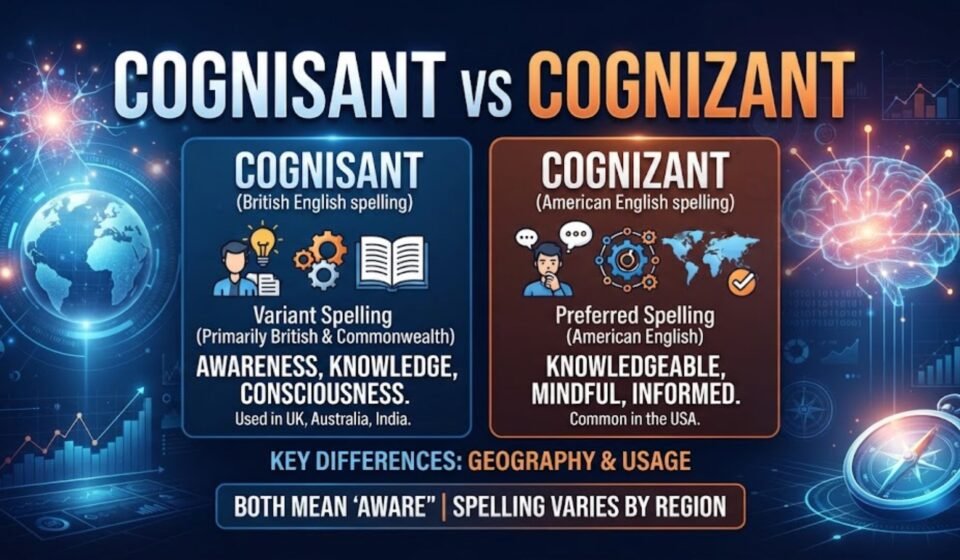

You typed a word into an email, paused, and thought: wait, is that spelled right? That’s the exact moment most people land here. Both cognisant and cognizant are real words. Neither one is a typo.
The difference comes down to where you’re writing from and who’s reading it.Stick around, because this gets a lot less confusing once you see the pattern behind it.
Cognisant or Cognizant: Quick Answer
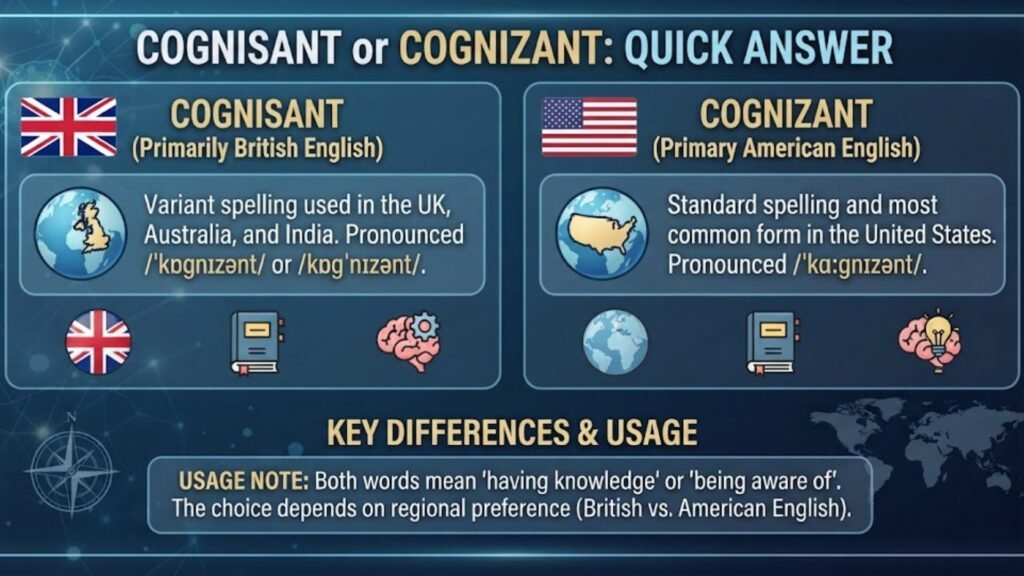
Here’s the short version before we dig in. Cognizant is the American English spelling. Cognisant is the British English spelling. Same word, same meaning, same pronunciation. The only thing that changes is a single letter, the S versus the Z.
If you’re writing for a US audience, go with cognizant. If you’re writing for UK readers, Australia, or most Commonwealth countries, cognisant fits better. Both mean the same thing: being aware of something, or having knowledge of a fact, risk, or situation.
That’s really the whole answer. But knowing why this split exists, and how to avoid tripping over it in real writing, is where things get useful.
The Origin of Cognisant / Cognizant
This word didn’t start out as two spellings fighting for attention. It traces back to the Latin word cognoscere, which means “to know.” From there it passed through Middle French as cognosant, picking up a slightly different shape along the way.
English absorbed the word centuries ago, and like a lot of borrowed vocabulary, it settled into slightly different forms depending on which side of the Atlantic picked it up first. This is part of a much bigger pattern in English language history, where Latin origin words often split into S spelling and Z spelling versions once American English and British English started drifting apart.
Knowing the etymology doesn’t just satisfy curiosity. It explains why the word feels formal. Words with a Latin origin tend to show up in academic writing, legal documents, and business writing rather than casual chat. Nobody says “I’m cognizant of the traffic” to a friend. They say “I know about the traffic.” Save the formal version for formal moments.
British English vs American English Spelling
This S versus Z pattern isn’t unique to cognisant and cognizant. It’s a recurring orthographic difference across huge chunks of the English vocabulary. Think about organise versus organize, or realise versus realize. Same story, same split.
British English spelling generally favors ise endings, while American English spelling leans toward ize endings. This didn’t happen by accident. Noah Webster, the guy behind the first major American dictionary, pushed for simplified, more phonetic spellings back in the early 1800s. That reform stuck in the US, while the UK kept closer to the older French influenced forms.
So when you see cognisant in a British newspaper or cognizant in an American report, you’re not looking at a mistake. You’re looking at two centuries of spelling variation playing out in real time, one word at a time.
Which Spelling Should You Use?
Honestly? It depends on who’s reading it. There isn’t a universal “correct” answer here, just a “correct for your audience” answer. Let’s break that down.
1. Audience Based Advice
If your readers are mostly in the United States, use cognizant. If they’re in the United Kingdom, Australia, New Zealand, or India, cognisant will feel more natural to them. Canada is a bit of a mixed bag, leaning slightly British in spelling but influenced heavily by American media, so either spelling tends to pass without complaint.
For a global audience or an international audience, many writers default to the American spelling simply because it dominates online content and search behavior. But if you know your readers skew British or Commonwealth, respecting their regional usage shows attention to detail.
2. Academic & Professional Writing
In academic writing, the rule is simpler: match your institution’s style guide. A UK university paper should use cognisant. A US journal submission should use cognizant. In business writing or corporate reports, check your company’s house style, especially if you’re producing content for international audience distribution.
The real risk isn’t picking the “wrong” spelling. It’s picking one and then switching halfway through your document. That inconsistency is what actually makes writing look sloppy.
Cognisant vs Cognizant: Spelling, Meaning & Regional Variations
Let’s slow down and look at both the meaning and the mechanics side by side, because people often search for this pairing wanting reassurance more than a lecture.
Meaning and Usage
Both words mean the same thing: being aware of something, having knowledge of something, or being informed about a fact or condition. If you’re cognizant of a deadline, you know about it and you’re not pretending otherwise. If a company says it’s cognisant of market risks, it means the leadership team is fully aware of them, not blindsided.
This word works as an adjective only. You can’t turn it into a verb or use it as a noun. You’d never say “I cognized the report” or “her cognizance level was high” in casual speech, that’s a much rarer, more technical usage. Stick to phrases like “cognizant of” or “cognisant of,” and you’re using it correctly every time.
Spelling Clarification
Some readers assume one spelling is older or more “proper,” but that’s not accurate. Neither is more correct than the other. It’s purely a matter of regional spelling variations, similar to how colour and color sit side by side without one being wrong.
The pronunciation doesn’t change either. Say cognisant or cognizant out loud, and you’ll notice the S and Z both come out sounding like a soft Z sound anyway. This is common across many British pronunciation versus American pronunciation comparisons where the spelling differs but the spoken word barely does.
Common Mistakes with Cognisant / Cognizant
People trip up on this word more often than you’d think, and it’s rarely about the S or Z. Here are the mistakes that actually cause problems in real writing.
- Mixing spellings in one document. Using cognizant in paragraph one and cognisant in paragraph four looks careless, even if both are technically valid.
- Misspelled cognisant and misspelled cognizant variants show up constantly: cognicent, cogniscent, cogniscient, cognosant, cognizent. None of these are real words.
- Treating it like it has a plural form. There’s no such thing as “cognizants.” It’s an adjective, not a noun, so it doesn’t pluralize.
- Using it in casual speech where “aware” would sound far more natural. Saying “I’m cognizant of your point” in a group chat comes across stiff and try hard.
- Confusing pronunciation because of the spelling change, when actually both versions sound nearly identical when spoken.
Avoiding these five slip ups instantly makes your writing look sharper, whether you’re drafting emails, reports, or a quick social media post.
Cognisant or Cognizant in Sentences and Real Usage
Reading rules is one thing. Seeing the word actually working in a sentence is what makes it stick. Let’s walk through it.
1. Basic Sentence Examples
“She was fully cognizant of the risks before signing the contract.” “The committee remained cognisant of the community’s concerns throughout the review.” “He’s cognizant of his responsibilities as team lead.”
Each of these examples shows the word doing the same job: signaling awareness of something specific, whether that’s a risk, a duty, or a group’s feelings.
2. Cognisant vs Conscious
People often ask about cognisant vs conscious, assuming they’re interchangeable. They’re close, but not identical. Conscious usually refers to a mental or physical state, like being awake after an accident. Cognizant leans more toward understanding or knowing a specific fact.
You’d say “he was conscious after the accident” to describe his physical state. You’d say “he was cognizant of the risks involved in the surgery” to describe his understanding. One’s about being awake, the other’s about being informed.
3. UK vs US Sentence Style
A UK sentence style example: “The board is cognisant of the legal implications facing the company.” A US sentence style version of the exact same sentence: “The board is cognizant of the legal implications facing the company.” Nothing changes but that one letter, and both versions read as completely natural to their respective audiences.
4. Quick Usage Tips
Keep these in your back pocket:
- Pair it with “of,” almost always. “Cognizant of” is the standard structure.
- Use it in formal writing, not casual chats.
- Pick one spelling and use it consistently across the entire piece.
- Swap in “aware” for everyday conversation, save cognizant or cognisant for reports and formal documents.
5. Common Search Based Clarifications
People frequently search “what is cognisant,” “how to spell cognizant,” or “cognizant in a sentence” looking for quick confirmation, not a grammar lecture. The short answer stays the same across every version of that question: it means aware, it’s spelled two accepted ways, and the choice depends on your target audience.
Cognisant / Cognizant in Everyday Examples
Outside of textbooks, this word shows up more than you’d expect. A manager might tell a team, “Please stay cognizant of the deadline shift.” A government notice might read, “Residents should remain cognisant of updated safety guidelines.”
In workplace communication, you’ll spot it in performance reviews, compliance memos, and internal reports. It’s the kind of word that signals professionalism without sounding cold. That’s probably why it survives in corporate writing decades after fresher, punchier synonyms could have replaced it.
Cognisant / Cognizant: Google Trends & Usage Data
Search interest for both spellings has stayed fairly steady over the last decade, without the sharp spikes you’d see with trendy slang. That tells you something: this is a stable, established word, not a fad phrase that fades in a year or two.
Cognizant consistently pulls more search volume overall, mostly because the US produces a larger share of English language content online. But cognisant holds firm and steady traffic across UK, Australian, and Indian search regions. Neither spelling is disappearing anytime soon, so learning the difference now pays off long term.
Comparison Table: Cognisant vs Cognizant
| Feature | Cognisant | Cognizant |
| Region | British English, UK, Australia, India | American English, US |
| Meaning | Aware, informed | Aware, informed |
| Pronunciation | Same | Same |
| Word type | Adjective only | Adjective only |
| Common in | Academic, formal, Commonwealth writing | Business, US media, formal writing |
| Origin | Latin cognoscere via Middle French | Latin cognoscere via Middle French |
Cognisant and Confidence in Your Writing
Here’s something most guides skip. Picking the right spelling isn’t just about grammar snobbery, it directly affects how confident and professional your writing looks. A reader in London who sees “cognizant” won’t necessarily think you’re wrong, but they might clock you as writing for an American audience by default. That’s a small signal, but small signals add up across a whole document.
If you’re producing content meant to travel across regions, like a global audience blog or an international audience report, consider adding a quick style note for your team. Decide once, write it down, and stop relitigating the S versus Z question every single time someone drafts a new document.
FAQs
Is cognisant a real word? Yes. It’s the British English spelling of the same word as cognizant, meaning aware or informed.
Is cognizant correct in the UK? It’s understood everywhere, but cognisant is the preferred UK spelling for formal and academic writing.
Do cognisant and cognizant sound different? No. Both are pronounced the same way, despite the spelling difference.
Can cognizant be used as a verb? No. It’s an adjective only, so you can’t conjugate it like a verb.
Which spelling should I use for a global audience? Many writers default to cognizant since American content dominates search results, but match your specific readership when you can.
Conclusion
At the end of the day, cognisant and cognizant are the same word wearing two different outfits. One dresses for British English, the other for American English. Neither is more correct, more formal, or more professional than the other. What matters is picking one, sticking with it, and matching it to your audience.
Next time that spelling doubt creeps in while you’re drafting an email or a report, you’ll already know the answer. Pick your region, pick your spelling, and move on with confidence.