
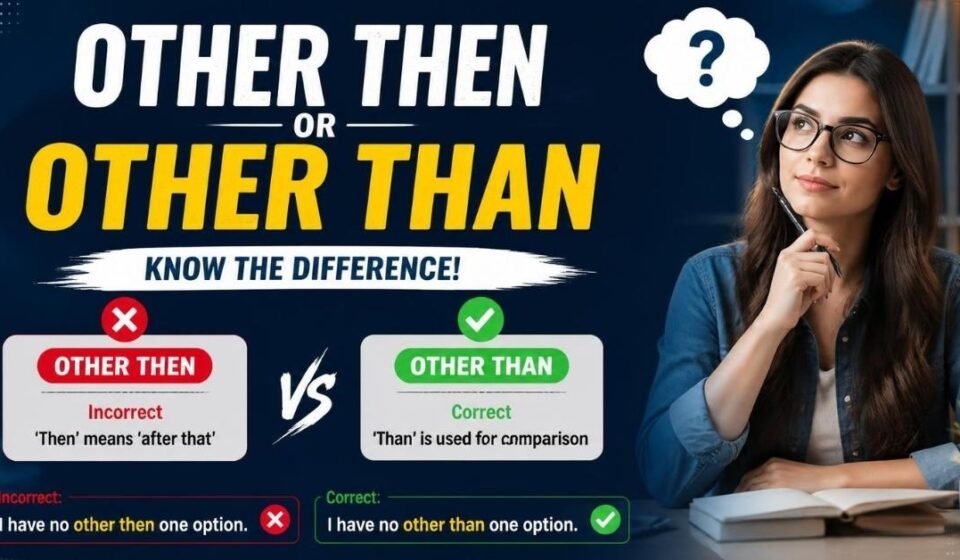

Ever typed a sentence, paused, and thought “wait, is it than or then here?” You’re not alone. This mix up shows up in texts, emails, school papers, even in work reports that should sound polished.Here’s the quick answer before we go any further: other than is the phrase you almost always want. It’s a comparison word used to mean “except” or “besides.”
Other then is not standard English, and using it is a spelling mistake that can quietly hurt how professional your writing looks.Let’s break this down properly, so you never second guess it again.
Other Than or Other Then: Quick Answer ✅
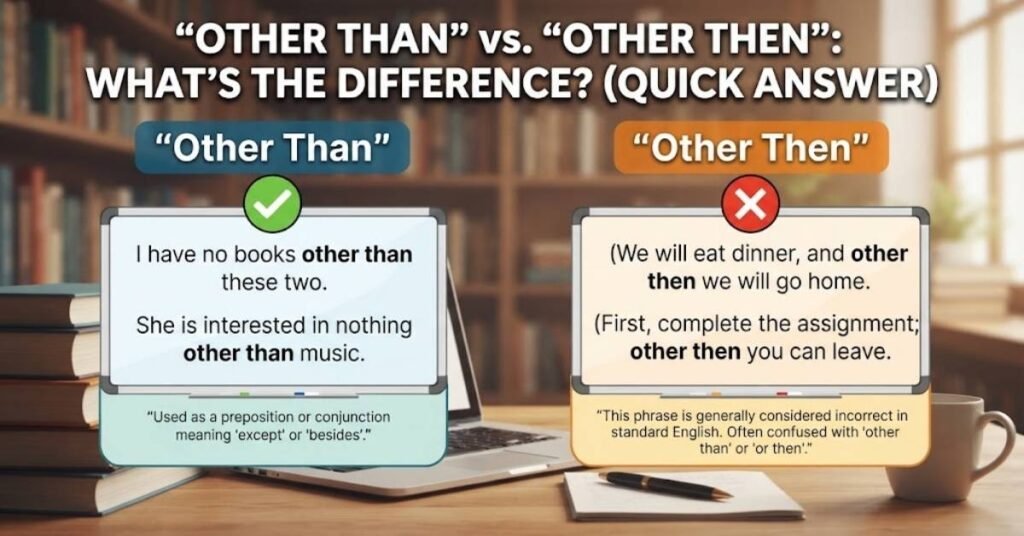
✔ Main Difference:
Than is used for comparisons. Then is used for time or sequence. Since “other than” is about excluding or comparing something, than is the correct spelling. Then belongs in sentences about what happens next, not in this phrase at all.
📌 Examples:
- Correct: “I have no plans other than relaxing this weekend.”
- Incorrect: “I have no plans other then relaxing this weekend.”
- Correct: “Other than the rain, the trip was great.”
Other Than or Other Then: Definitions with Examples 📖✍️
🟢 Other Than (Definition)
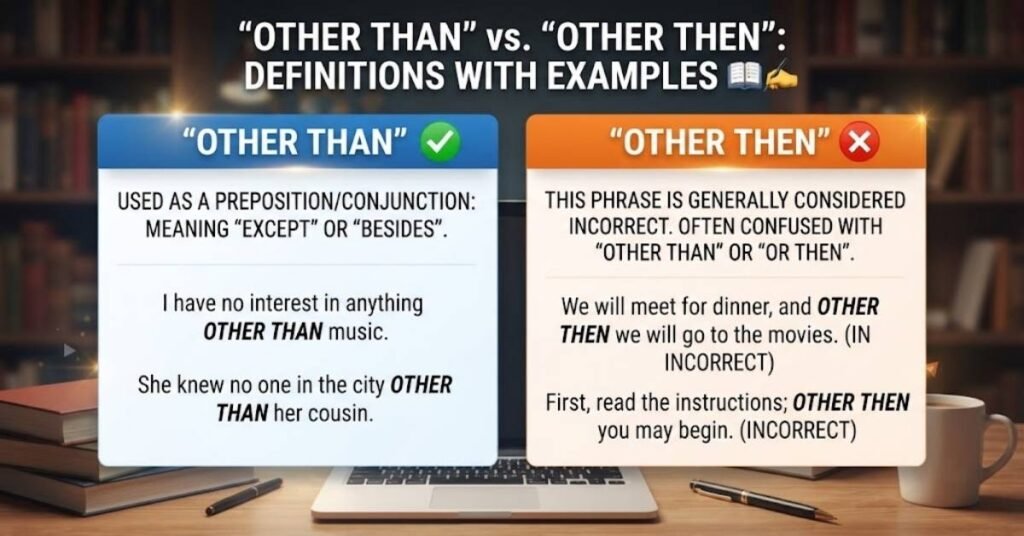
Other than works as a preposition and means “except for” or “apart from.” You’ll see it constantly in formal writing, casual chats, and everything in between. It’s one of the most common English grammar phrases used to point out an exception.
📌 Examples:
- “Nobody knew, other than my sister.”
- “There’s nothing to do here other than hike.”
- “Other than that one typo, the report looked solid.”
🔴 Other Then (Definition)
“Other then” isn’t a recognized phrase in standard English. It comes from confusing then, a time word, with than, a comparison word. Dictionaries don’t list it as correct usage, and most style guides flag it as an incorrect spelling any time it appears.
📌 Incorrect Examples:
- “I have no plans other then this.” ❌
- “Nothing changed other then the price.” ❌
🟡 Simple Meaning
Think of it this way: other than means “except.” That’s it. If you can swap in the word “except” and the sentence still makes sense, than is the one you need every time.
The Origin of Other Than or Other Then 📜
Than
Than has been a comparison word in English for centuries, used to measure one thing against another. “Bigger than,” “faster than,” “other than” all follow the same job: setting up a contrast.
Then
Then, on the other hand, has always pointed to time. “First this, then that.” It marks sequence, not comparison, which is exactly why swapping it into “other than” breaks the meaning of the sentence.
Why confusion happens:
The two words look almost identical and sound similar when spoken fast. Add autocorrect into the mix, and it’s easy to see why this common spelling mistake keeps popping up, even among careful writers.
British English vs American English Usage 🌍
📌 Key Point:
Good news here. There’s no regional spelling difference for this one. British English, American English, Australian English, and Canadian English all agree: it’s other than, full stop.
📊 Comparison Table:
| Region | Correct Form | Notes |
| American English | Other than | Standard in all writing |
| British English | Other than | No regional variation |
| Australian English | Other than | Matches global usage |
| Canadian English | Other than | Same rule applies |
Which Phrase Should You Use? 🎯
✔ Use “Other Than” When:
You’re talking about an exception or a comparison. If your sentence could be rewritten using “except for” or “apart from,” other than is your answer. This covers emails, academic writing, business writing, and everyday conversation.
❌ Avoid “Other Then” Because:
It’s not a recognized phrase in any dictionary. Using it in professional writing or published content can quietly chip away at your credibility, even if the rest of your message is solid.
🌍 Audience Tip
ESL learners especially benefit from memorizing this one early, since than and then trip up even confident English learners. Once it clicks, it sticks for good.
🧠 Memory Trick (Easy)
Here’s a trick that works: then has an “e” like sequence, while than has an “a” like a comparison. If you’re comparing or excluding something, reach for the “a.” Simple as that.
Common Mistakes with Other Than or Other Then ❌⚠️
1. Using “Then” Instead of “Than”
This is the classic slip. Writers mean to compare something but accidentally type the time word instead, creating an incorrect plural of the phrase’s actual meaning.
2. Mixing Time and Comparison Words
Sentences that jump between sequence and comparison confuse readers fast. “First we ate, other then we left” doesn’t work because then belongs with sequence, not exception.
3. Typing Too Quickly
Fast typing on phones is a huge culprit here. Autocorrect errors and rushed thumbs turn a simple word into the wrong one before you even notice.
4. Ignoring Grammar Context
Some writers just don’t pause to check which job the word is doing in the sentence. A quick read aloud usually catches it before it becomes a grammar confusion moment.
Other Than or Other Then in Everyday Examples 💬
🏠 Daily Life
“Other than the traffic, my commute was fine.” You’ll hear this kind of phrase constantly in casual chats between friends and family.
📱 Social Media
Captions like “Nothing to report other than good vibes” show up everywhere online, proving this phrase isn’t just for formal writing.
📚 School Writing
Students use it in essays to introduce exceptions: “Other than one source, all the research supported the theory.” It’s a staple of clear academic writing.
💼 Professional Writing
In meetings and reports: “Other than the Q3 numbers, everything is on track.” Getting this right supports writing accuracy and keeps your message sounding sharp.
Other Than or Other Then: Usage Trends & Popularity 📊
📌 Trend Insight:
Search behavior shows people frequently look up this exact confusion, which tells you it’s a widespread spelling confusion, not a rare mistake.
📊 Key Observation:
Writers searching for clarity here are usually double checking before hitting send on an email or publishing a post, which says a lot about how much writing quality matters to them.
Other Than vs Besides: Is There a Difference?
They’re close cousins, but not identical twins. Besides can mean “in addition to,” while other than almost always means “except for.” Swapping them works sometimes, but not always, so it pays to read the full sentence first.
Other Than in Everyday Conversation vs Professional Writing
In casual talk, small slips barely register. Nobody’s grading your texts. But in business writing or an email to a client, a wrong word like “other then” can look careless, and that’s the last impression you want to leave.
Why Search Engines Care About Small Grammar Details
Search engines reward published content that reads clean and accurate. Small spelling errors scattered through a page can quietly hurt readability, and readability plays into how content performs in search results.
Comparison Table 📋
| Word | Job | Example |
| Than | Comparison | “Faster than before” |
| Then | Time/Sequence | “We ate, then left” |
| Other than | Exception | “Nothing changed other than the date” |
| Other then | Not standard | Avoid using this |
Common User Queries 🔍
- “Is other then ever correct?” No, not in standard English.
- “Can I use other than in formal writing?” Yes, it fits both casual and formal writing.
- “Why do people mix these up?” Mostly because than and then look and sound alike.
Conclusion 🧾
Other than is the phrase you want, every time you’re pointing out an exception or making a comparison. Other then simply isn’t a recognized part of standard English, no matter how often it slips into a quick text or email.
Once you remember that than handles comparisons and then handles time, this mix up stops being a problem. A small fix like this can make your writing feel sharper and more trustworthy, whether you’re texting a friend or sending a report at work.
FAQs ❓
1. Which phrase is correct?
Other than is correct. Other then is not part of standard English.
2. Is other then wrong?
Yes, it’s considered an incorrect spelling of the phrase and isn’t listed in dictionaries.
3. What does other than mean?
It means “except for” or “apart from,” used to point out an exception.
4. What does then mean?
Then refers to time or sequence, as in “we finished, then left.”
5. Can I use other than formally?
Yes, it works in both formal writing and casual conversation without any adjustment.
6. Does British English use a different spelling?
No, there’s no regional spelling difference. Other than is standard across British, American, Australian, and Canadian English.
7. Easy rule?
If you can replace it with “except,” use than. If you’re talking about what happens next, use then.